
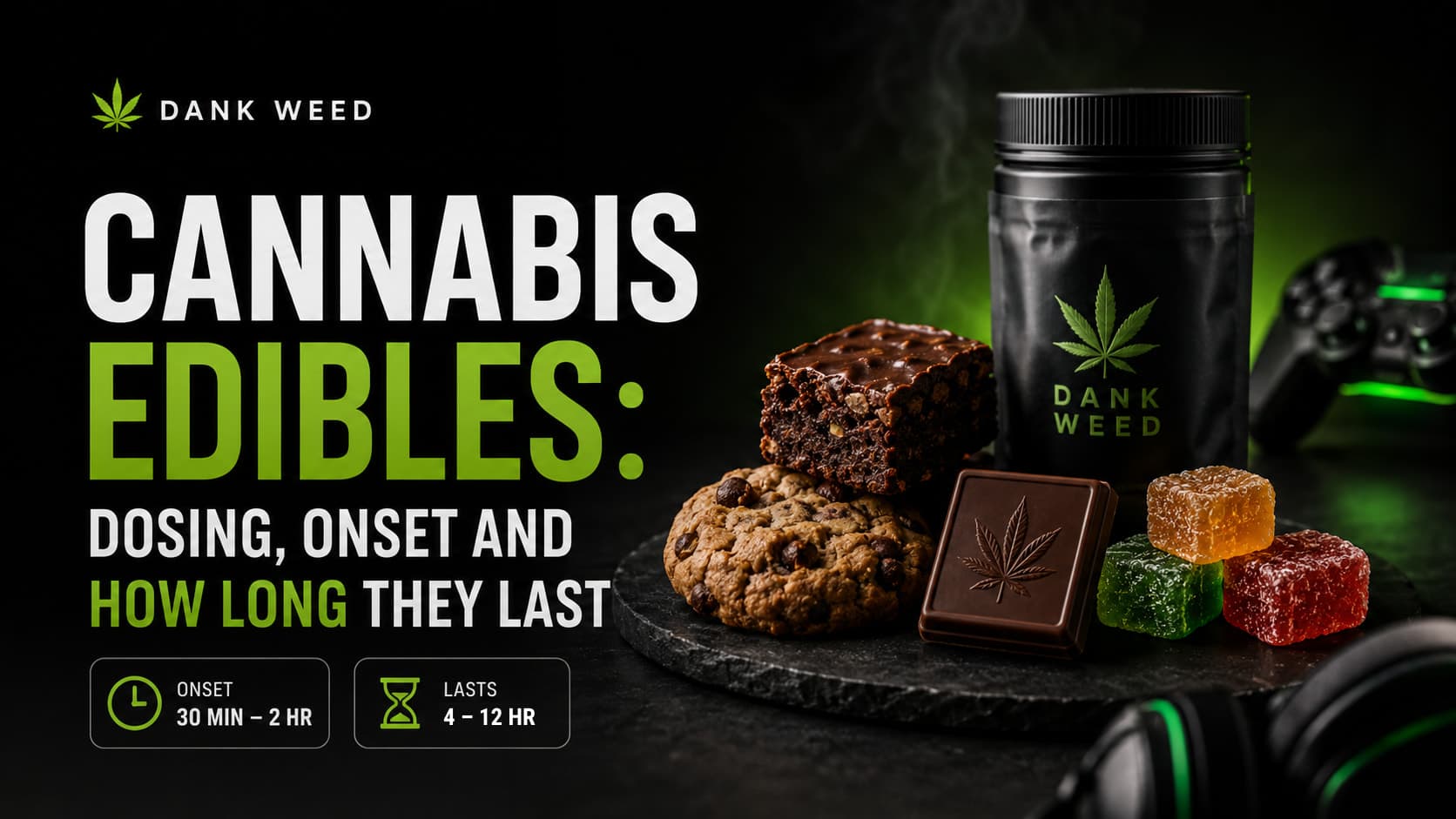
Almost every problem people have with edibles comes from one mistake: taking a second dose before the first one has arrived. Everything else in this guide — the milligram numbers, the timings, the label caveats — exists to make that mistake harder to make.
Edibles are the format where the popular advice is broadly right and almost entirely unsourced, and where one widely repeated explanation is simply wrong. This guide gives the numbers, says where each one comes from, and is clear about which parts nobody actually knows.

Key Takeaways
- Allow four hours, not thirty minutes. Canadian public health guidance says it can take up to two hours to feel edible cannabis and up to four hours to feel the full effects.[2]
- Effects last 4 to 12 hours, and some last up to 24.[2][3] That tail is why an evening edible can still be with you in the morning.
- Start at 2.5 mg of THC or less.[2][3] A full legal package holds up to 10 mg, which is a lot for a first time.
- The 10 mg cap is per package, not per gummy — section 102.7 of the Cannabis Regulations.[1]
- 11-hydroxy-THC is not established as four to five times stronger than THC. The most recent direct comparison reports rough parity.[8] Edibles land differently because of dose and duration.
- You cannot dose a homemade batch. Four unknowns multiply — input potency, decarboxylation, transfer into fat, and mixing.
- Store them like medicine, not like snacks. Canadian paediatric poisoning cases rose roughly ninefold after commercial edibles were legalised.[6]
What Are Cannabis Edibles?
Edibles are cannabis products you swallow — gummies, chocolates, baked goods, capsules and drinks — where THC is absorbed through the gut and passes through the liver before it reaches your brain. That single detour is what makes them behave so differently from smoke.
People search for these as weed edibles, cannabis edibles or just edibles, and the category is broader than most pictures of it. What matters for dosing is not the flavour but the format, because format drives how fast the THC arrives and how long the edible high runs.
| Format | Typical examples | What to know |
|---|---|---|
| Gummies and chews | Weed gummies, THC gummies, fruit chews | The default format. Easy to split, easy to mistake for candy |
| Chocolates and baked goods | Bars, weed brownies, cookies | Fat-based, so dose can sit unevenly through the piece |
| Beverages | THC drinks, seltzers, tea, cannabis beverages | Often emulsified; onset claims are covered below |
| Capsules and oils | Softgels, measured droppers | The most consistent dose per unit, the least fun |
| CBD edibles | CBD gummies, low-THC formats | Non-intoxicating at typical CBD-dominant ratios |
| Homemade | Cannabutter, infused oil, home baking | No reliable dose — see the uncertainty stack |
How Long Do Edibles Take to Kick In?
Up to two hours to feel anything, and up to four hours for the full effect. Those are the numbers Canada’s Council of Chief Medical Officers of Health uses, and they are the most useful two facts on this page.[2]
The wide range is not hedging. Controlled pharmacokinetic work finds peak blood concentrations arriving at very different times depending on what the THC is carried in, and the spread between individuals is large even within a single format.[4]
| Oral format tested | Reported time to peak blood THC |
|---|---|
| Capsules | 0.78 – 4 hours |
| Tablets | 0.66 – 2.07 hours |
| Baked goods | 0.9 – 2.6 hours |
Ranges pooled across studies in a 2020 systematic review of oral cannabis administration.[4] The review’s own conclusion is that oral THC has a highly variable profile that differs between formulations.
Notice that the fastest reported figure and the slowest differ by roughly five-fold. There is no schedule you can rely on, which is exactly why the guidance is written as a maximum wait rather than an average.
How Long Do Edibles Last?
Four to twelve hours, with some effects lasting up to 24 hours.[2] Dose, tolerance, formulation and what else you have eaten all move that, and the long tail is why an evening edible can still be with you the next morning.
The practical version is a timeline rather than a number. This is the shape most people report, and it is worth reading before your first edible rather than during it.
| Time after swallowing | What is usually happening | What people get wrong here |
|---|---|---|
| 0 – 30 min | Nothing. Absorption has barely started | This is where the second dose gets taken |
| 30 – 120 min | First effects may appear | Assuming a mild start means a mild peak |
| 2 – 4 hours | Full effects, usually the peak | Driving, because the first hour felt fine |
| 4 – 12 hours | Gradual decline | Underestimating how long the decline takes |
| 12 – 24 hours | Residual effects for some people | Booking an early morning after a late edible |
Canada’s lower-risk cannabis use guidelines recommend not driving for at least six hours after use, and note that impairment can persist beyond the subjective high.[9] With an edible, six hours is a floor, not a target.
Why Do Edibles Feel Different From Smoking?
Because swallowing THC routes it through your liver before it reaches your bloodstream, which lowers the peak, delays it, and stretches it out. Inhaling sends THC almost directly from lung to blood, so the curve is sharp and short.
The size of that difference is measurable. In pooled study data, peak plasma THC after smoking ran roughly 33–118 ng/mL, while oral dosing produced roughly 4.4–11 ng/mL.[4] Lower peak blood levels, but a far longer and less controllable experience.
The liver also converts a large share of swallowed THC into 11-hydroxy-THC, a metabolite that is itself active. Oral dosing produces markedly higher concentrations of THC metabolites than inhaling the same material does.[5]
| Property | Inhaled | Swallowed |
|---|---|---|
| Time to effect | Seconds to minutes | Up to 2 hours; full effect up to 4[2] |
| Peak plasma THC | Higher (≈33–118 ng/mL)[4] | Lower (≈4.4–11 ng/mL)[4] |
| Duration | 1 – 4 hours | 4 – 12 hours, some to 24[2] |
| Titration | Easy — you feel each draw | Impossible once swallowed |
| Metabolite load | Lower | Higher[5] |
Is 11-Hydroxy-THC Five Times Stronger Than THC?
No good evidence supports the four-to-five-times figure that every edibles article repeats. The most recent direct comparison reports the metabolite as roughly comparable to THC — somewhat greater on some measures, lower on others — in a preclinical model.[8]
The claim has become load-bearing in this topic. It is used to explain why edibles feel stronger, why they last longer, and why people green out on them, all from one number that traces back to nothing very solid.
The better explanation is duller and holds up: you swallow a fixed dose you cannot adjust, absorption is slow and variable, more of the compound reaching your brain is metabolite rather than parent THC, and the whole thing runs for hours. That is enough to explain the difference without a potency multiplier.
Where this could be overcorrected: 11-hydroxy-THC is genuinely psychoactive and genuinely present at higher levels after eating than after smoking.[5] The disputed part is the specific multiplier, not the existence of the metabolite.
How Much Should You Take? An Edible Dosage Guide
Start at 2.5 mg of THC or less and wait the full four hours before deciding anything. That starting figure comes from Canadian public health guidance, not from us.[2][3] Everything above it is a matter of tolerance.
| Dose (total THC) | Who it suits | Notes |
|---|---|---|
| 1 – 2.5 mg | First time, or a deliberate microdose | The recommended starting point in Canada[2] |
| 2.5 – 5 mg | Occasional users with some tolerance | Half a typical legal package |
| 5 – 10 mg | Regular users | 10 mg is the entire legal package[1] |
| Above 10 mg | High daily tolerance only | Requires multiple packages; the ceiling exists for a reason |
General information, not medical advice, and not a recommendation to consume any amount. Tolerance varies enormously and there is no dose that is right for everyone.
The rule that matters more than the number
Pick a dose, then commit to the clock. The four-hour wait is the whole discipline — a person who takes 10 mg and waits will almost always have a better evening than a person who takes 2.5 mg three times in ninety minutes, even though the second person swallowed less in total at the start.
Splitting a package
A 10 mg package divided into four pieces is 2.5 mg each only if the manufacturer divided it that way. Where a legal package contains multiple units, each unit must hold the same amount of THC as every other.[1] Cutting a single gummy in half is an estimate.
Why Didn’t My Edible Work?
Usually because not enough time has passed. After that, the common causes are a dose that is small relative to your tolerance, a product holding less THC than the label claims, and the ordinary variation in how people absorb it.[4]
| If edibles are not working | Likely cause | What to do differently |
|---|---|---|
| Nothing after 45 minutes | Normal. Absorption is slow | Wait. Do not add a second dose |
| Nothing after four hours | Dose too low, or product under-dosed | Try a slightly higher dose next time, not tonight |
| Works for friends, not you | Tolerance, or absorption differences | Consider a tolerance break before escalating |
| Worked before, not now | Tolerance has built | Same. Escalating dose is the expensive answer |
| Homemade batch did nothing | Decarboxylation or transfer failed | See the uncertainty stack |
One thing worth saying plainly: “it didn’t work so I took more” is the single most common route to a bad night with edibles, and the delay is precisely what makes it feel reasonable at the time.
What Should You Do If You Take Too Much?
Nothing meaningfully speeds it up, so the answer is to make the wait tolerable and safe. Sit somewhere cool and quiet, drink water, do not drive, and tell someone what you took so they can keep an eye on you.
Too much cannabis produces what people call greening out — pallor, nausea, dizziness, sweating, a racing heart and a sharp spike of anxiety. It is unpleasant and it is self-limiting. With an edible it also lasts considerably longer than it would after smoking.
If symptoms are severe, or if a person cannot be roused, that is a call to a poison centre or emergency services rather than something to ride out. Canada’s lower-risk guidelines also single out combining cannabis with alcohol, which raises blood THC concentrations rather than balancing anything.[9][10]

Do Fast-Acting Edibles and THC Drinks Work Faster?
Possibly, but the evidence behind the packaging is thin. The nanoemulsion and water-soluble claims attached to fast-acting edibles and THC drinks come overwhelmingly from manufacturers and equipment suppliers rather than from independent clinical research.
There is a real mechanism being described. THC is fat-soluble, absorption from the gut is limited by that, and emulsifying it into fine droplets is a well-understood way to change how a compound is taken up. The step that is missing is published, independent human data showing how much difference it makes and in whom.
The pharmacokinetic literature does show liquid and oil formats reaching peak concentrations earlier than some solid formats, alongside very wide variation between people.[4] That supports “sometimes sooner.” It does not support a specific promised onset time on a can.
How we would read a fast-acting label: as a reason to expect a possibly earlier start, not as permission to shorten the four-hour rule. The cost of being wrong is asymmetric.
How Accurate Is the Dose on an Edible Label?
In an unregulated market, historically terrible. When researchers tested 75 edible products from 47 brands across three US cities in 2015, just 17% were accurately labelled. Sixty percent held less THC than stated, and 23% held more.[7]
That study is the most cited number in this topic and it is usually quoted without its context. It sampled the US medical dispensary market of the time, which had no mandatory potency testing. It is evidence about what happens without regulation, not a verdict on every label everywhere.
Canada’s legal market is a different regime: a hard cap per container, mandatory testing and licensed production.[1] Even so, Health Canada’s own sampling of legal dried flower found a substantial share of samples testing below 80% of their label claim,[11] so “tested” does not mean “exact.”
| Source of your edible | How much the number means |
|---|---|
| Legal Canadian retail | Capped at 10 mg per container and lab-tested; the best number available[1] |
| Unregulated market | Varies by seller; the 2015 data is the cautionary case[7] |
| Homemade | No number exists — see below |
| Gifted, unlabelled | Unknown dose and unknown format. Treated as unknown |
Why You Cannot Dose a Homemade Edible
Because four separate unknowns stack up, and they multiply rather than add. This is our own framework rather than a published finding, and it explains why home batches swing from inert to overwhelming with no change in recipe.
Most people searching how to make edibles are really asking a dosing question, and that is the part a recipe cannot answer. Every homemade batch passes through four estimates before it reaches a plate. Each one is a range, not a figure, and the ranges compound.
| Stage | The unknown | Why you cannot pin it down |
|---|---|---|
| 1. Input potency | How much THCA the flower actually holds | Untested material has no figure, and cultivar names do not predict chemistry (see article on labels) |
| 2. Decarboxylation | How much acid converted to active THC | Conversion depends on temperature and time, and overshooting degrades what you made[12] |
| 3. Transfer | How much moved into the butter or oil | Depends on fat, ratio, time, agitation and straining losses |
| 4. Distribution | Whether the batch is evenly mixed | Fat-based batter is not a homogeneous solution |
If each stage is only accurate to plus or minus 30%, the compounded uncertainty across all four is far wider than any of them alone. That is the arithmetic behind “the first brownie did nothing and the second one ruined my night.”
What the decarboxylation research actually shows
A 2024 kinetic study tracked cannabinoid acid conversion across 80–160 °C for 1 to 90 minutes and found conversion follows predictable first-order kinetics — but also that at 160 °C the neutral cannabinoids began degrading after roughly 30 minutes.[12] Hotter is not faster past a point; it is lossier.
The caveat belongs in the same passage as the number: that work used pressurised liquid extraction on hemp under controlled conditions, not a home oven with an uncalibrated thermostat and a baking tray. It tells you the shape of the curve, not your kitchen’s position on it.
How Long Do Edibles Stay in Your System?
Far longer than the effects last, and eating puts more metabolite into you than inhaling does.[5] In frequent users, THC has been detected in blood for up to 30 days after intake.[5]
The point people miss is what a drug test measures. Urine screens look for THC-COOH, an inactive breakdown product that lingers long after any effect is gone. A positive result establishes past exposure, not present impairment, and the two questions have different answers.
Because oral dosing produces higher concentrations of that metabolite than smoking the same amount does,[5] switching to edibles to avoid a test is the wrong move. There is no reliable way to shorten the window, and the marketed products that claim to do so are outside anything we would source.
Edibles vs Smoking vs Vaping: How Do They Compare?
Edibles trade control for duration. You give up the ability to stop mid-dose, and you get hours instead of an hour. Whether that is a good trade depends entirely on what the evening is for.
| Edibles | Smoking | Vaping | |
|---|---|---|---|
| Onset | Up to 2–4 h[2] | Seconds | Seconds |
| Duration | 4–12 h, some to 24[2] | 1–3 h | 1–3 h |
| Dose control | None after swallowing | High | High |
| Combustion byproducts | None | Yes | No combustion |
| Smell | Minimal | Strong | Moderate |
| Main hazard to manage | Delayed onset and overconsumption[2] | Inhaled smoke | Hardware and product quality |
Vaporizing and smoking deliver cannabinoids comparably, according to controlled comparisons of the two routes.[5] Our guides to vapes and carts, rolling and concentrates cover the inhaled side in detail, and the shop splits the same way: flower, vapes, concentrates and edibles.
What Do Canada’s Edible Rules Actually Say?
Ten milligrams of total THC per immediate container — the innermost package — under section 102.7 of the Cannabis Regulations.[1] That is the number most articles state loosely, and the distinction matters when you split a package.
| Rule | What it means for you |
|---|---|
| 10 mg total THC per immediate container[1] | The cap is on the package, not on each piece inside it |
| Units in a multi-unit package must match[1] | Four gummies in a 10 mg pack hold 2.5 mg each |
| Caffeine limited to naturally occurring sources, max 30 mg per container[1] | No cannabis energy drinks in the legal market |
| Plain, child-resistant packaging | Part of why legal edibles look so joyless |
Canada’s chief medical officers were direct about the reasoning: delayed onset from swallowed cannabis “can result in overconsumption and increase the risk of poisoning,” and a full 10 mg package is a large amount for someone consuming for the first time.[2] The cap is a dosing tool, not decoration.
How Should You Store Edibles Around Children and Pets?
Locked away, labelled, in original packaging, and never in the snack cupboard. This is the one part of the edibles topic where the Canadian evidence is unambiguous and local.
Emergency department visits for unintentional cannabis poisoning in Ontario children under 10 rose from 81 in the pre-legalisation period to 317 after commercial edibles became available — roughly 2.5 visits a month to 22.6, about a ninefold increase, with a mean age of three years and nine months.[6]
A national comparison makes the mechanism clearer still. Hospitalisations for these poisonings rose about 7.5-fold in provinces that permitted edible sales, against about 3.0-fold in provinces that did not, across 581 cases.[13] Quebec, which restricted edibles, showed no comparable rise.[13]
Not an argument that edibles are uniquely dangerous. It is an argument about one specific property: they look like food. A gummy in a candy jar is a hazard in a way a jar of flower simply is not, and the fix is storage rather than abstinence.

Frequently Asked Questions
How long do edibles take to kick in?
Canadian public health guidance says it can take up to two hours to feel the effects of edible cannabis and up to four hours to feel the full effects. Controlled studies show peak blood levels arriving anywhere from about 40 minutes to four hours, depending on the format and the person. Plan around four hours, not thirty minutes.
How long do edibles last?
Four to twelve hours for the main effects, with some effects lasting up to 24 hours according to Canada’s chief medical officers of health. Higher doses stretch the tail. If you take an edible late in the evening, expect that some of it may still be with you when you wake up the next morning.
How much of an edible should I take the first time?
Canadian guidance is to start with 2.5 mg of THC or less and to wait the full four hours before deciding whether to take any more. A single legal package can hold up to 10 mg, which is a large amount for someone new to edibles. This is general information, not medical advice.
Why didn’t my edible work?
The most common reasons are that not enough time has passed, the dose was small relative to your tolerance, or the product contained less THC than the label claimed. Absorption also varies a lot between people and formats. Wait the full four hours before concluding nothing happened, and do not stack a second dose.
Is 11-hydroxy-THC five times stronger than THC?
There is no good evidence for the five-times figure that circulates online. A 2024 comparison in the Journal of Pharmacology and Experimental Therapeutics reported the metabolite as roughly comparable to THC, greater on some measures and lower on others, in a preclinical model. Edibles feel different because of dose and duration, not per-molecule potency.
What should I do if I take too much of an edible?
Nothing speeds it up meaningfully. Sit somewhere cool and quiet, drink water, do not drive, and let it pass. Tell someone what you took so they can keep an eye on you. If symptoms are severe, or a person cannot be roused, contact a poison centre or emergency services rather than waiting.
Do fast-acting edibles and THC drinks really work faster?
Possibly, but the evidence is thin. The nanoemulsion claims you see on packaging come mostly from manufacturers rather than independent clinical studies. Liquid formats do tend to show earlier peak times in the pharmacokinetic literature, but the variation between people is large. Read a fast-acting label as a hint, not a schedule.
How long do edibles stay in your system?
Longer than the high lasts. Oral cannabis produces higher concentrations of the THC-COOH metabolite than inhaling does, and in frequent users THC has been detected in blood for up to 30 days. Urine screens look for the metabolite, not impairment, so a positive result says nothing about whether you are currently affected.
Can you dose a homemade edible accurately?
Not really. Four unknowns stack up: the potency of the input material, how much acid converted to THC during decarboxylation, how much of that transferred into the butter or oil, and how evenly it spread through the batch. Each is an estimate, and estimates multiply. Assume a homemade batch is unlabelled.
How much THC can a legal Canadian edible contain?
Ten milligrams of total THC per immediate container, under section 102.7 of the Cannabis Regulations. That cap applies to the whole package, not to each gummy in it, and where a package holds several units each unit must contain the same amount. Products bought outside the legal market are not bound by that limit.
References
- Government of Canada. Guide on composition requirements for cannabis products, and Cannabis Regulations (SOR/2018-144), ss. 102.2 and 102.7 — 10 mg total THC per immediate container for edible cannabis; equal THC per unit in multi-unit containers; caffeine limited to naturally occurring sources to a maximum of 30 mg per immediate container. canada.ca
- Council of Chief Medical Officers of Health. CCMOH Statement on Cannabis Extracts, Edibles and Topical Products. Public Health Agency of Canada, January 2020 — up to 2 hours to feel effects and up to 4 hours for full effects; effects lasting 4 to 12 hours with some up to 24 hours; start with 2.5 mg THC or less; delayed onset increases overconsumption and poisoning risk. canada.ca
- Canadian Centre on Substance Use and Addiction. Edible Cannabis: Always Read the Label — Start Low, Go Slow. 2019 — effects can take up to 4 hours to appear and can last up to 12 hours, with some effects lasting up to 24 hours; start with no more than 2.5 mg of THC. ccsa.ca (PDF)
- Poyatos, L., Pérez-Acevedo, A. P., Papaseit, E., et al. Oral Administration of Cannabis and Δ-9-tetrahydrocannabinol (THC) Preparations: A Systematic Review. Medicina, 2020, 56(6), 309. DOI: 10.3390/medicina56060309
- Newmeyer, M. N., Swortwood, M. J., Barnes, A. J., et al. Free and Glucuronide Whole Blood Cannabinoids’ Pharmacokinetics after Controlled Smoked, Vaporized, and Oral Cannabis Administration in Frequent and Occasional Cannabis Users. Clinical Chemistry, 2016, 62(12), 1579–1592. DOI: 10.1373/clinchem.2016.263475
- Myran, D. T., Cantor, N., Finkelstein, Y., Pugliese, M., Guttmann, A., Jesseman, R., & Tanuseputro, P. Unintentional Pediatric Cannabis Exposures After Legalization of Recreational Cannabis in Canada. JAMA Network Open, 2022. DOI: 10.1001/jamanetworkopen.2021.42521
- Vandrey, R., Raber, J. C., Raber, M. E., Douglass, B., Miller, C., & Bonn-Miller, M. O. Cannabinoid Dose and Label Accuracy in Edible Medical Cannabis Products. JAMA, 2015, 313(24), 2491–2493. DOI: 10.1001/jama.2015.6613 (75 products, 47 brands, three US cities, 2014 sampling of an unregulated medical market.)
- Zagzoog, A., Halter, K., Jones, A. M., et al. The Intoxication Equivalency of 11-Hydroxy-Δ9-Tetrahydrocannabinol Relative to Δ9-Tetrahydrocannabinol. Journal of Pharmacology and Experimental Therapeutics, 2024. DOI: 10.1124/jpet.123.001998 (Preclinical. Volume and page numbers could not be confirmed from a cloud run and are deliberately not stated.)
- Fischer, B., Russell, C., Sabioni, P., van den Brink, W., Le Foll, B., Hall, W., Rehm, J., & Room, R. Lower-Risk Cannabis Use Guidelines: A Comprehensive Update of Evidence and Recommendations. American Journal of Public Health, 2017, 107(8), e1–e12. DOI: 10.2105/AJPH.2017.303818
- Hartman, R. L., Brown, T. L., Milavetz, G., Spurgin, A., Gorelick, D. A., Gaffney, G., & Huestis, M. A. Controlled Cannabis Vaporizer Administration: Blood and Plasma Cannabinoids with and without Alcohol. Clinical Chemistry, 2015, 61(6), 850–869. DOI: 10.1373/clinchem.2015.238287 (Vaporized, not oral — cited for the alcohol interaction only.)
- Health Canada. Cannabis Data Gathering Program, 21 February 2025 — sampling of legal dried flower found a substantial share of samples below 80% of their labelled THC claim.
- Olejar, K. J., Urvashi, Han, J.-H., Hong, M., Kwon, T.-H., Druelinger, M., Park, S.-H., & Kinney, C. A. Thermo-chemical conversion kinetics of cannabinoid acids in hemp (Cannabis sativa L.) using pressurized liquid extraction. Journal of Cannabis Research, 2024, 6, 33. DOI: 10.1186/s42238-024-00243-x (80–160 °C over 1–90 minutes; pseudo-first-order kinetics; neutral cannabinoids degrading after roughly 30 minutes at 160 °C. Pressurised liquid extraction on hemp, not a home oven.)
- Myran, D. T., et al. Pediatric Hospitalizations for Unintentional Cannabis Poisonings and All-Cause Poisonings Associated With Edible Cannabis Product Legalization and Sales in Canada. New England Journal of Medicine / JAMA Health Forum correspondence, 2022. DOI: 10.1056/NEJMc2207661 (581 hospitalisations, January 2015 – September 2021; ~7.5-fold rise in provinces permitting edibles versus ~3.0-fold where prohibited.)
This article is for informational and harm-reduction purposes only and is not medical advice. Do not drive after using cannabis, and do not combine cannabis with alcohol. Keep all cannabis products locked away from children and pets. Follow the cannabis laws applicable in your jurisdiction.