
510 Battery Guide: What the Voltage Setting Really Does
Published · Katie S.
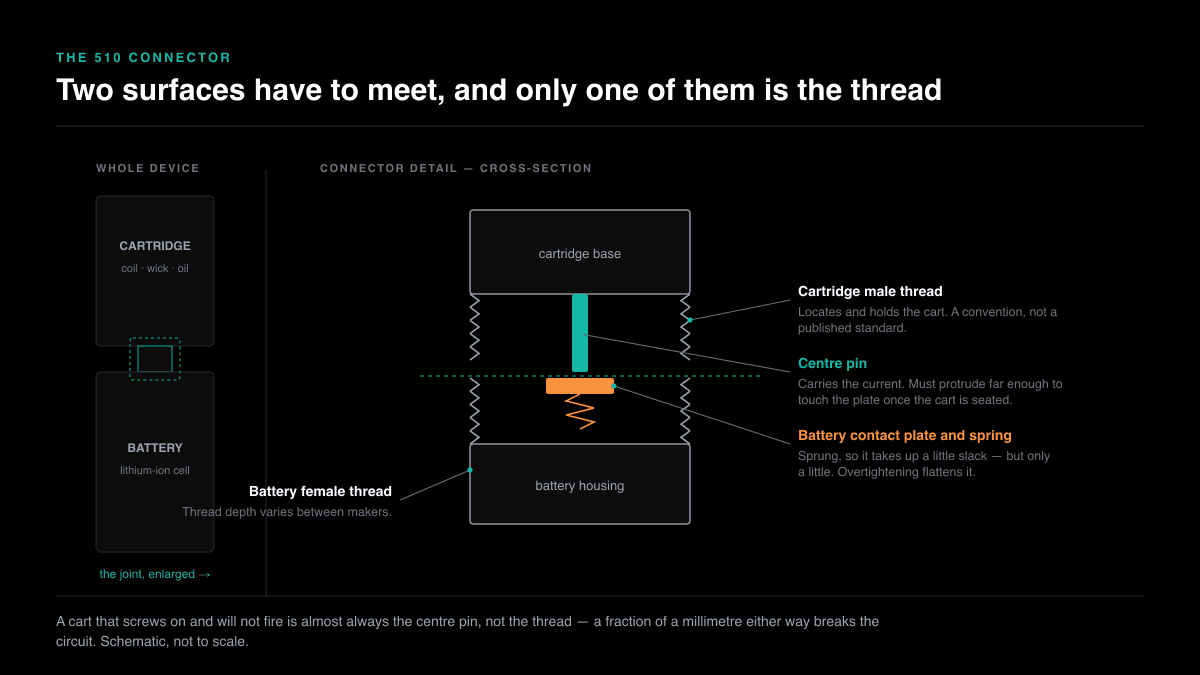
A 510 battery is the simplest object in cannabis and almost everything written about it is wrong in the same two ways. The number is not a specification, and the setting is not a temperature. Here is what has been measured, by whom, and what it means for the cart on the end of it.
Key Takeaways
- “510” is not a published standard. No standards body publishes a specification for the connector. The international committee that does standardise vapour products covers terminology, test methods and product information — not threads.[8]
- Voltage is a poor predictor of coil temperature. Measured across three vaporizer systems during simulated puffs, average coil temperatures ran from 238 to 642 °C, and identical voltages produced very different results.[1]
- A wet coil and a dry coil are different machines. Full-wet coils measured 110–185 °C; dry coils in the same rig reached 322–1008 °C.[2]
- The best evidence on 510 coil temperature was funded by a competitor to the 510 format. We cite it anyway, and we print who paid for it.[1]
- The battery is the least regulated part of your vape. Health Canada’s own words in February 2026: “Currently, there are no specific regulatory requirements for lithium-ion batteries in Canada.”[4]
- Charging is where the documented harm is. A US fire authority recorded 195 e-cigarette fire and explosion incidents over eight years and named the lithium-ion cell as the root cause.[3]
What Is a 510 Thread Battery?
A 510 battery is a rechargeable lithium-ion cell with a threaded connector that a cannabis cartridge screws into. It supplies power to a heating coil inside the cart. Health Canada describes a vaping accessory as “a battery, mouthpiece, heating element, chamber or cartridge.”[5]
That is the whole device. A 510 vape battery has no processor deciding anything about your cannabis, no sensor reading the oil, and in most units no measurement of any kind. A button or a draw sensor closes a circuit, current runs through a coil, and the coil gets hot. What the settings do is change how much current, and for how long.
| Part | Lives in | What it decides |
|---|---|---|
| Lithium-ion cell | Battery | How much power is available, and the fire risk[3] |
| Voltage or wattage control | Battery | How much power is delivered per puff |
| Centre pin and threading | Both | Whether the two make contact at all |
| Heating coil and its resistance | Cartridge | How that power turns into heat |
| Wick or ceramic element | Cartridge | How fast oil reaches the coil |
| The oil itself | Cartridge | Viscosity, and how it behaves when hot |
Four of those six sit in the cart, not the battery. That split is the reason two people running “the same voltage” can have completely different experiences. Our guide to weed vapes, carts and pens covers the hardware categories and what is in the oil.
What Does “510” Actually Mean?
Nothing official. It began as a product designation, not a dimension, and no standards body publishes a specification for it. The widely repeated explanation — “ten threads of 0.5 mm” — is not a thread specification at all.
A thread is specified by a diameter and a thread pitch. A thread count is a consequence of how long the threaded section happens to be: cut the same thread shorter and you get fewer turns without changing the standard. So “ten threads” describes one part someone measured, not a rule any manufacturer is working to.
A correction to our own work: our vapes and carts guide currently repeats the “ten threads of 0.5 mm” line. It is being fixed. Publishing a page that quietly contradicts an older one of ours is worse than admitting the older one was wrong.
Vapour products do have an international standards committee. Its published scope is the “standardization of terminology, test methods and product information for vapour products,”[8] and its work covers emissions testing, e-liquids and device requirements. We could locate no published standard, from that committee or any other, defining the 510 connector.
| The claim | Status | What is actually the case |
|---|---|---|
| It is an industry thread standard | False as stated | A de facto convention. No standards body publishes it[8] |
| “Ten threads of 0.5 mm” | Not a specification | Thread count depends on length; only a pitch is a spec |
| The name describes the dimensions | Undocumented | Traced only to vendor blogs repeating each other |
| Any cart fits any battery | Mostly, not always | Contact depends on pin height and thread depth |
| 510 means the device is regulated | False | No lithium-ion battery requirements exist in Canada[4] |
This matters less for buying and more for reading: a page confident about the etymology of “510” is a page repeating vendor copy, which tells you what else on it to discount.

Do All 510 Carts Fit All 510 Batteries?
Most do, and the exceptions are predictable. Because the connector is a convention rather than a specification, tolerance differences between manufacturers show up as a cart that screws on but does not fire, or one that sits too deep and shorts out.
The threads are rarely the problem. A 510 cartridge that screws on and will not fire — a cart not hitting, in the usual phrasing — is almost always the centre pin. It has to protrude far enough to touch the battery’s contact plate once the cart is fully seated, and a fraction of a millimetre in either direction is enough to break the circuit or to hold the cart proud of the thread.
| Symptom | Likely cause | What to try |
|---|---|---|
| Screws on, nothing happens | Centre pin sits too low to reach the contact | Back the cart off a quarter turn; do not overtighten |
| Battery blinks and cuts out | Short circuit, or the coil is out of the battery’s resistance range | Try another cart. If every cart blinks, it is the battery |
| Fires only when pressed sideways | Intermittent contact at the pin | Clean both contacts dry; replace the cart if it persists |
| Cart will not seat flush | Thread depth mismatch between makers | Nothing to fix — it is a tolerance difference |
| Fits nothing you own | A proprietary pod, not a 510 at all | Check the format before buying, not after |
Overtightening is the most common self-inflicted failure. The thread is small and the contact is sprung; snug is the whole job.
What Does the Voltage Setting Actually Do?
It sets how much electrical power the battery delivers — not how hot the coil gets. Thermography of cannabis cartridges during simulated puffs found average coil temperatures from 238 to 642 °C across three systems, and concluded that “voltage alone was a poor indicator of coil temperature.”[1]
That study tested two variable voltage systems at 2.4 V, 3.2 V and 4.0 V against a temperature-controlled one, using infrared thermography on the coil itself rather than inferring temperature from the setting.[1] The two voltage-controlled systems at maximum averaged 543 ± 95.9 °C and 450 ± 60.8 °C.[1]
Look at those error bars rather than the averages. Nearly 96 °C of standard deviation on one device at a fixed setting is the finding: the same number on the dial does not even reproduce itself, let alone transfer to a different cart.
Who paid for that study, stated plainly: it was funded by PAX Labs and written by PAX Labs employees, and the temperature-controlled system that performed best is theirs.[1] It is peer-reviewed, the method is a real measurement rather than a claim, and it is the only work of its kind we could locate on cannabis cartridges. It is also a commercial argument for the product the sponsor sells. Both things are true and you should hold them together.
| Thing | Does the battery set it? | Evidence |
|---|---|---|
| Power delivered to the coil | Yes, directly | Voltage is the setting; power follows coil resistance |
| Coil temperature | Only loosely | Voltage a poor indicator; wide spread at fixed settings[1] |
| Vapour temperature at your lips | No | Not measured by any device on the market |
| How fast oil reaches the coil | No | A property of the cart’s wick and the oil |
| Puff duration | You do, not the setting | Cut-off timers cap it; they do not control it |
| How much you inhale | No | Airflow, draw strength and habit |
Our concentrates guide makes the same distinction for dab rigs: a setpoint is not a measured temperature, and published toxicant figures are measured somewhere other than where your mouth is.
Is a Temperature Setting Real Temperature Control?
On most 510 batteries, no. A dial marked in degrees, or a coloured preset, is almost always a voltage step wearing a temperature label. Genuine control requires the device to sense the coil and adjust power during the puff.
The distinction is measurable. In the thermography work, “only the temperature-controlled system consistently maintained temperatures less than 400 °C for the full puff duration”[1] — the voltage-controlled devices drifted upward as the puff went on, because nothing was watching.
Independent work on e-cigarette coils points the same way from a different angle. Under full-wet conditions, increasing applied power “only slightly increased heating coil temperature,” while under dry conditions the correlation between power and temperature was much stronger.[2] The setting matters most exactly when the coil is running out of oil.
| What it is called | What it does | Does it measure anything? |
|---|---|---|
| Voltage steps, often colour-coded | Changes power per puff | No |
| A dial marked in °C or °F | Usually maps degrees onto voltage steps | Not unless the maker says how |
| Closed-loop temperature control | Senses coil state and adjusts mid-puff | Yes — and it holds a setpoint[1] |
If a maker prints a temperature and will not say what it is measuring, treat the number as a brand name.
Why Does a Cart Taste Burnt?
Because the coil ran hotter than the oil arriving to cool it. In coil measurements, full-wet coils sat at 110–185 °C while dry coils in the same apparatus reached 322–1008 °C.[2] A burnt hit is a supply problem before it is a settings problem.
That is a dry hit, and it is why chain-hitting produces the taste at settings that were fine a minute earlier. Each puff pulls oil off the wick faster than capillary action replaces it, and the third puff heats a coil the first two left dry. Cold oil is thicker and feeds more slowly, which is the same failure in winter.
It is also why a burnt taste that persists at low voltage usually means the cart is finished rather than mis-set. Residue baked onto a coil does not come off, and our hub’s cart troubleshooting table covers the rest of the symptom list.
What Is Preheat Mode For?
Thinning cold, thick oil so it flows to the coil before you draw. It is a low-power pulse of a few seconds, and it addresses viscosity rather than potency, flavour or anything to do with the cannabis itself.
Viscosity is a real variable in an extract. Terpenes are the second most abundant class of compounds in cannabis concentrates and they “moderate cannabinoid viscosity,”[10] which is why a terpene-rich cart behaves differently in the cold from a stiff distillate one.
An honest limit: we could locate no study measuring what preheat does to a cannabis cartridge — not to flow rate, not to emissions, not to the first draw afterwards. The mechanism is sound and the evidence is absent. Anyone quoting a preheat temperature is quoting a marketing figure.

The Four Things That Set Your Coil Temperature
Four inputs decide how hot a 510 coil gets, and the battery sets exactly one of them. This is our framework rather than any single paper’s result, and it explains why voltage advice transfers so badly between carts.
Separate them and most disagreements about “what voltage should I run” turn out to be people describing different cartridges. The number is the only input you can see, which is why it collects credit for the other three.
| Input | Set by | What is measured | How much it moves the coil |
|---|---|---|---|
| 1. Power delivered | The battery | Voltage, and coil resistance | Real but weak on a wet coil[2] |
| 2. Coil design | The cartridge maker | Resistance, mass, ceramic housing | Large — same voltage, different device, different result[1] |
| 3. Oil supply to the coil | Wick, oil viscosity, temperature | Wet 110–185 °C vs dry 322–1008 °C[2] | The largest single factor |
| 4. Puff duration and airflow | You | Temperature drift across a puff[1] | Grows the longer you pull |
Read the table as a ranking and the standard advice inverts. Buying a nicer battery adjusts input one. Buying a better cart adjusts two and three. Taking shorter draws and letting the coil rewet adjusts four, costs nothing, and is the only one of the four you can change mid-session.
It also explains the metals question without repeating it: operating temperature is one of the variables associated with hardware leaching, and that is a hub topic covered in our vapes guide’s review of the safety evidence[9] rather than something to re-argue here.
How Should You Charge a 510 Battery?
With the charger that came with it, on a hard surface, while you are awake. Health Canada’s consumer guidance is to charge “away from soft surfaces like bedding,” store batteries at room temperature, and check any replacement charger for a Canadian certification mark.[6]
The charger warning is not boilerplate. A US fire authority’s review of e-cigarette incidents states that “plugging an e-cigarette into a ‘standard’ USB port to recharge may result in an explosion and/or fire,” and advises always using the charging appliance supplied with the unit.[3] Health Canada separately advises not over-charging a rechargeable cannabis accessory.[5]
| Practice | Guidance | Source |
|---|---|---|
| Which charger | The one supplied; check for a CSA, cUL or cETL mark on a replacement | Health Canada[6], USFA[3] |
| Where to charge | Away from soft surfaces like bedding | Health Canada[6] |
| Over-charging | Do not over-charge a rechargeable accessory | Health Canada[5] |
| Storage | Store at room temperature | Health Canada[6] |
| Damage | Do not use if swollen or overheating; do not modify or tamper | Health Canada[6] |
| Disposal | Check with your municipality | Health Canada[6] |
A swollen vape pen battery is the one unambiguous stop signal on this page. Nothing about it improves with use.
How Dangerous Is the Battery Itself?
Rarely, and badly. Between January 2009 and December 2016 a US fire authority counted “195 separate incidents of explosion and fire involving an electronic cigarette” reported by media, and concluded the lithium-ion cell was the root cause.[3]
The shape is what makes the failure mode unusual. That report describes what happens when the seal at the end of the battery ruptures: pressure builds inside the cylinder until it fails, and “one or the other, or both, can be propelled across the room like a bullet or small rocket.”[3] A tube-shaped battery aims itself.
Health Canada describes the hazard as a progression running from “overheating, off-gassing and smoke to fire, thermal runaway and explosion,” caused by poor design or manufacturing or by excess mechanical, electrical or thermal stress in use.[4] Damage, heat and the wrong charger are the stresses a consumer controls.
Canadian numbers cover more than vapes but run the same direction. Health Canada received 924 reports of lithium-ion battery incidents between 2013 and 2023, 266 of them involving injuries, including 3 fatalities, alongside 87 recalls affecting over 980,000 units.[4] Health Canada also notes that vaping accessories “have been known to malfunction, and in rare cases, these malfunctions have resulted in injury.”[5]

Not sure you want to manage a battery at all?
Everything above is about a battery you charge, a cart you screw on, and a voltage you choose. A disposable removes all three decisions: the coil and the cell are matched at the factory and the whole thing is thrown away together. It is the opposite trade to a 510 setup — less control, nothing to get wrong.


Prices shown at time of writing. If you do want a 510 setup, the battery and cartridge stock moves — check the vape category for what is on the shelf today.
What Do Canadian Rules Say About Vape Batteries?
Less than you would expect. A battery sold for cannabis use is a “cannabis accessory” under the Cannabis Act — “a thing… that is represented to be used in the consumption of cannabis”[7] — and Canada has no product-safety requirements specific to lithium-ion batteries at all.[4]
That gap is Health Canada’s own description, not ours. Its February 2026 notice of intent states: “Currently, there are no specific regulatory requirements for lithium-ion batteries in Canada,” and proposes mandatory requirements referencing existing CSA and UL standards.[4] Until that lands, a certification mark is a manufacturer’s choice.
| Item | Regulated? | Under what |
|---|---|---|
| The cannabis extract in the cart | Yes, tightly | Cannabis Act and Regulations — see our vapes guide |
| A battery represented for cannabis use | As an accessory | Cannabis Act s. 2(1) definition[7] |
| The lithium-ion cell inside it | No specific requirements | Health Canada, February 2026[4] |
| The 510 connector | No | No published standard located[8] |
| Proposed battery requirements | Consultation stage | Notice of intent, referencing CSA and UL standards[4] |
General information about published requirements, not legal advice. Cannabis is regulated federally and provincially at once, and provinces add their own rules.
Health Canada’s practical advice for the accessory itself is short: buy from an authorized retailer, follow the manufacturer’s instructions, clean it after use, and avoid sharing it.[5] That is the whole official position on the device in your pocket.
Frequently Asked Questions
What is a 510 thread battery?
A rechargeable lithium-ion battery with a threaded connector that a cannabis cartridge screws into, supplying power to a heating coil inside the cart. Health Canada describes a vaping accessory as a battery, mouthpiece, heating element, chamber or cartridge. The 510 threading is a de facto industry convention rather than a published standard.
What voltage should you use for a cart?
Lower than you think, and no published number transfers between devices. Measured coil temperatures across three cannabis vaporizer systems ranged from 238 to 642 degrees Celsius, and the researchers concluded that voltage alone was a poor indicator of coil temperature. Start at the lowest setting that produces vapour and step up only if you need to.
Does a 510 battery control temperature?
Almost never. Most sell voltage steps, sometimes relabelled in degrees. In published thermography, only a genuinely temperature-controlled system consistently held below 400 degrees Celsius for a full puff, while voltage-controlled devices drifted upward as the puff continued because nothing was measuring the coil.
Why does my cart taste burnt?
The coil ran hotter than the oil arriving to cool it. Coil measurements put full-wet coils at 110 to 185 degrees Celsius and dry coils at 322 to 1008 degrees in the same apparatus. Chain-hitting and cold, thick oil both starve the wick. If the taste persists at low voltage, the cartridge is finished.
Do all 510 carts fit all 510 batteries?
Most do. Because the connector is a convention rather than a specification, tolerances differ between manufacturers, and the usual failure is the centre pin sitting too low to touch the battery contact. Backing the cart off a quarter turn fixes many of them. Overtightening causes more problems than it solves.
What does preheat mode do?
It runs the coil at low power for a few seconds to thin cold, thick oil so it flows properly. Terpene content moderates how viscous an extract is, which is why some carts need it and others never do. No study we could locate has measured what preheat does to a cannabis cartridge.
Is it safe to charge a vape pen overnight?
Health Canada advises charging away from soft surfaces such as bedding, storing batteries at room temperature, and checking any replacement charger for a Canadian certification mark. A US fire authority warns that charging through a generic USB port instead of the supplied appliance may result in fire or explosion. Charge it while you are awake.
Can a vape battery explode?
Rarely, and the failure is violent when it happens. A US fire authority counted 195 e-cigarette fire and explosion incidents reported by media between 2009 and 2016, naming the lithium-ion cell as the root cause. Because the battery is a sealed cylinder, a ruptured cell can be propelled like a bullet or small rocket.
Why is my 510 battery blinking?
Blinking usually signals a short circuit, a coil outside the battery’s resistance range, or a low charge, depending on the maker. Try a different cartridge first. If every cartridge blinks, the fault is in the battery. If one particular cart blinks on several batteries, that cart is the problem.
Are vape batteries regulated in Canada?
Barely. A battery represented for cannabis use is a cannabis accessory under the Cannabis Act, but Health Canada stated in February 2026 that there are currently no specific regulatory requirements for lithium-ion batteries in Canada, and has proposed mandatory requirements referencing existing CSA and UL standards.
References
- Oar, M. A., Savage, C. H., Rufer, E. S., Rucker, R. P., & Guzman, J. A. (2022). Thermography of cannabis extract vaporization cartridge heating coils in temperature- and voltage-controlled systems during a simulated human puff. PLOS ONE, 17(1), e0262265. DOI 10.1371/journal.pone.0262265. Source for average heating coil temperatures of 238–642 °C measured by infrared thermography during simulated puffs, for the conclusion that voltage alone was a poor indicator of coil temperature, for the 2.4 V / 3.2 V / 4.0 V settings tested, for the maximum-setting averages of 543 ± 95.9 °C and 450 ± 60.8 °C in the two voltage-controlled systems and 420 ± 9.5 °C in the temperature-controlled one, and for only the temperature-controlled system consistently maintaining temperatures below 400 °C for the full puff duration. Full text read directly on journals.plos.org on 2 September 2026. ⚠️ FUNDING AND COMPETING INTERESTS, STATED IN THE BODY AS WELL AS HERE: the paper’s own statements are that “PAX Labs, Inc. funded this work and was performed by PAX Labs, Inc. Employees” and that the authors “are scientists employed by PAX Labs, Inc.” — the company that makes the temperature-controlled system that performed best. Peer-reviewed, and a commercial argument at the same time. Never cite it without the provenance.
- Chen, W., Wang, P., Ito, K., Fowles, J., Shusterman, D., Jaques, P. A., & Kumagai, K. (2018). Measurement of heating coil temperature for e-cigarettes with a “top-coil” clearomizer. PLOS ONE, 13(4), e0195925. DOI 10.1371/journal.pone.0195925. Source for measured coil temperatures of 110–185 °C under full-wet conditions, 145–334 °C wet-through-wick and 322–1008 °C dry; for the statement that under full-wet conditions “Increase of applied power only slightly increased heating coil temperature” with a positive correlation of R² = 0.70; and for the stronger correlation (R² = 0.89) between applied power and peak temperature under dry conditions. Full text read directly on journals.plos.org on 2 September 2026. ⚠️ This is a nicotine e-cigarette clearomizer, not a cannabis cartridge — it is cited here only for the wet-versus-dry coil mechanism, which is device-independent, and never for a cannabis-specific number.
- U.S. Fire Administration, National Fire Data Center. Electronic Cigarette Fires and Explosions in the United States 2009–2016, July 2017. Source for “Between January 2009 and December 31, 2016, 195 separate incidents of explosion and fire involving an electronic cigarette were reported by the U.S. media”; for the lithium-ion cell being named the root cause; for the rupture description in which the battery or container “can be propelled across the room like a bullet or small rocket”; and for the charging warning that “Plugging an e-cigarette into a ‘standard’ USB port to recharge may result in an explosion and/or fire.” Report PDF read directly on usfa.fema.gov on 2 September 2026. ⚠️ A US source and a media-report count, not a Canadian incident registry and not a rate — it establishes the failure mode, not a probability.
- Health Canada. Notice of intent – Proposed new requirements for lithium-ion batteries and consumer products containing lithium-ion batteries under the Canada Consumer Product Safety Act, 16 February 2026. Source for the verbatim sentence “Currently, there are no specific regulatory requirements for lithium-ion batteries in Canada”; for 924 reports of lithium-ion battery incidents received between 2013 and 2023, 266 (28.8%) involving injuries including 3 fatalities; for 87 product recalls affecting 374 unique product models and over 980,000 units; and for the proposal to establish mandatory safety requirements referencing CSA C22.2 No. 62133-2:20, UL 1642 and UL 2054. Read directly on canada.ca on 2 September 2026. ⚠️ These figures cover all consumer lithium-ion batteries, not vaping devices specifically.
- Health Canada. Cannabis accessories for inhalation: Minimizing your risk when smoking, vaping and dabbing. Date modified 20 September 2024. Source for the description of vaping accessories as consisting of “a battery, mouthpiece, heating element, chamber or cartridge”; for the guidance to buy from an authorized retailer, not to over-charge the batteries of a rechargeable accessory, to clean the accessory after use, to follow manufacturer’s instructions and to avoid sharing; and for the statement that vaping accessories “have been known to malfunction, and in rare cases, these malfunctions have resulted in injury.” Read directly on canada.ca on 2 September 2026.
- Health Canada. Postcard: Lithium-ion Batteries — Don’t Go up in Smoke! Date modified 28 January 2025. Source for the consumer guidance to charge “away from soft surfaces like bedding,” to “Store at room temperature,” not to use a battery “if showing signs of damage like swelling or overheating,” not to “modify or tamper with a battery,” to check a replacement charger “for a Canadian certification mark like CSA, cUL or cETL,” and to check with your municipality on disposal. Read directly on canada.ca on 2 September 2026.
- Government of Canada. Cannabis Act, S.C. 2018, c. 16, s. 2(1). Source for the definition of a cannabis accessory as “a thing, including rolling papers or wraps, holders, pipes, water pipes, bongs and vaporizers, that is represented to be used in the consumption of cannabis.” Statutory text read directly on laws-lois.justice.gc.ca on 2 September 2026. Note the definition turns on representation, so an unbranded battery sold as a general vaporizer battery may sit outside it — a point of law, not a loophole we are recommending.
- International Organization for Standardization. ISO/TC 126/SC 3 — Vape and vapour products. Source for the subcommittee’s published scope, “Standardization of terminology, test methods and product information for vapour products,” and for its working groups covering emissions analysis, e-liquids and device requirements. Committee page read directly on iso.org on 2 September 2026. Used on this page for a negative finding: a search of this subcommittee’s catalogue and of the European committee for electronic cigarettes and e-liquids located no published standard defining a 510 connector, thread or battery interface. An absence located by search is weaker than a documented absence — if a connector standard exists somewhere, we did not find it and would correct this page.
- Gaur et al. Heavy Metals in Cannabis Vapes — A Scoping Review, The Scientific World Journal 2025, PMID 40874048. Source for hardware components being a documented source of heavy metals in cannabis vape products, and for operating temperature being among the variables associated with leaching. Read in full during our 11 August 2026 research pass for article #3 and cited here from our source library with that provenance. The review’s findings are covered in full in our vapes and carts guide and are deliberately not restated on this page.
- Munger, K. R., Anreise, K. M., & Strongin, R. M. (2025). Cannabis concentrate vaping chemistry. Frontiers in Toxicology, 7, 1568207. DOI 10.3389/ftox.2025.1568207. Source for terpenes being the second most abundant class of compounds in cannabis concentrates and for the statement that they “moderate cannabinoid viscosity,” which is the mechanism behind the preheat section. Read in full during our 23 August 2026 research pass for article #13 and cited here from our source library with that provenance.
This article is general information about published research and published Canadian rules. It is not medical, legal, electrical or professional advice, and it makes no therapeutic or health claim about any cannabis product. Cannabis is regulated federally and provincially in Canada; check the rules where you live.