
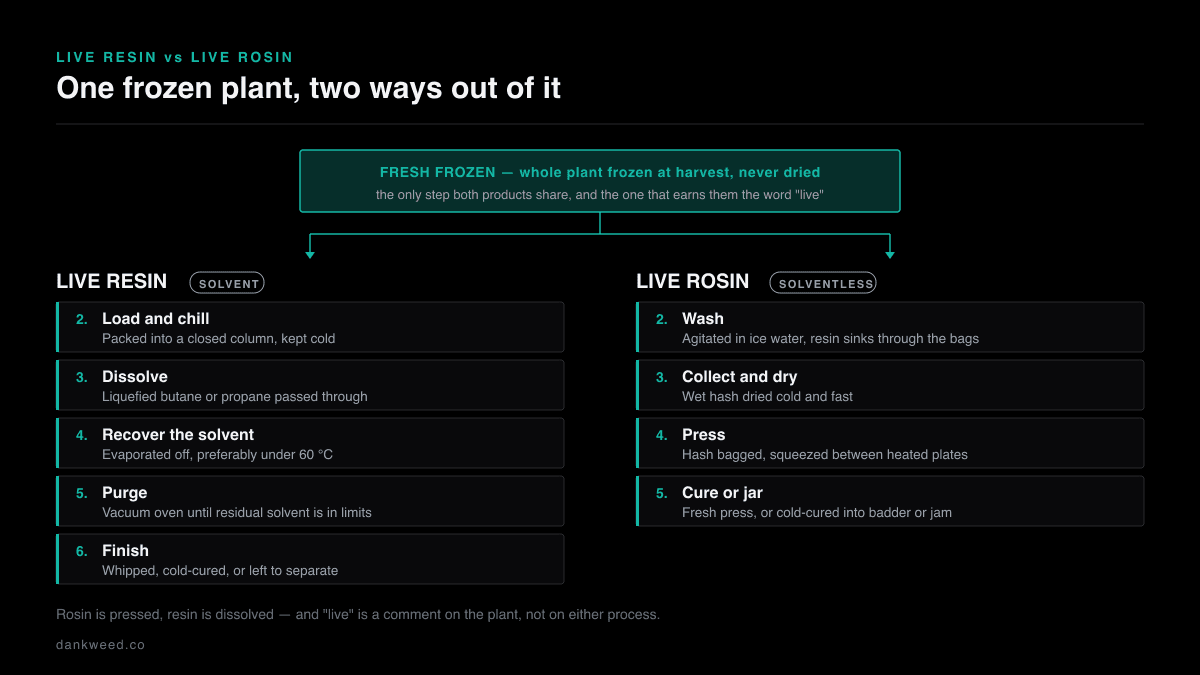
Live resin and live rosin start from the same thing — a cannabis plant cut and frozen instead of dried. After the freezer they part company completely. Live resin is dissolved out with butane or propane. Live rosin is washed in ice water and then pressed. One letter, two entirely separate production philosophies, and a set of trade-offs nobody on page one bothers to explain.
This is the deep version of the live-resin material in our guide to cannabis concentrates, and the companion to our bubble hash guide. It covers what “live” is actually buying you, what has been measured and what has not, and which failure modes belong to which method.

Key Takeaways
- “Live” describes the input, not the extract. It means the plant was frozen fresh instead of dried and cured. It says nothing about the extraction method.
- Live resin uses a solvent. Live rosin does not. That is the whole difference, and everything else follows from it.
- The reason to freeze is published. Monoterpenoids are lost during drying and curing, “ranging from 31 to 55.2% when dried at room temperature.”[1]
- The finished-product claim is not. No peer-reviewed study we could locate measures terpene content in commercial live resin against cured resin, or live rosin against hash rosin.
- Neither term has a legal definition in Canada. They appear nowhere in the Cannabis Regulations or in Health Canada’s composition guidance.
- Residual solvent is the one risk with a mandatory test. Solvent residue testing is required whenever a solvent is used.[10] Pesticide on the flower concentrates into both products equally.
What Is the Difference Between Live Resin and Live Rosin?
Live resin is made with a solvent; live rosin is made with ice water and a press. Both begin with fresh-frozen cannabis. Live resin dissolves the resin into butane or propane, which is then evaporated off. Live rosin washes the resin free mechanically, then squeezes it between heated plates.
| Live resin | Live rosin | |
|---|---|---|
| Starting material | Fresh-frozen plant | Fresh-frozen plant |
| Separation method | Hydrocarbon solvent — butane or propane | Ice water wash, then a heated press |
| Number of separations | One chemical step | Two mechanical steps |
| Purification available afterwards | Yes — filtration, winterisation, purge | None. Mesh size is the only filter |
| Residual solvent possible | Yes — and legally tested for[10] | No solvent is ever used |
| Common textures | Sauce, diamonds, badder, crumble | Badder, jam, cold-cured patty |
| Menu position | Upper shelf | Top of the shelf |
| Where quality is decided | Process control | The input, and the wash |
The names are unhelpful in a specific way: resin and rosin differ by one letter and mean opposite things about solvents. So the question most people actually type — what is live resin — has a two-part answer. It is a solvent extract, and it is made from a plant that was never dried. If you remember one line from this page, make it this one: rosin is pressed, resin is dissolved, and “live” is a comment on the plant rather than on either process.
What Does “Live” Actually Mean?
“Live” means the plant was frozen at harvest instead of dried and cured. Nothing more. It is a statement about the input material, not about the extraction, the texture, the potency or the shelf it sits on. Cured extracts and live extracts can otherwise be made in identical equipment.
| Product | Input | Method |
|---|---|---|
| Cured resin | Dried, cured flower | Hydrocarbon solvent |
| Live resin | Fresh-frozen plant | Hydrocarbon solvent |
| Flower rosin | Dried, cured flower | Press only |
| Hash rosin | Bubble hash from dried flower | Ice water wash, then press |
| Live rosin | Bubble hash from fresh-frozen plant | Ice water wash, then press |
Producers call that input fresh frozen, and the term is literal — cut, bagged and into a freezer, ideally within minutes rather than hours. Everything either method can do afterwards is downstream of how well that step was executed.
Worth saying plainly: neither “live resin” nor “live rosin” has a legal definition in Canada. Neither term appears in the Cannabis Regulations or in Health Canada’s guidance on composition requirements,[12] and no peer-reviewed source located in this research run defines them either. They are trade language, in the same position as the six-star hash scale we covered in the bubble hash guide.
That does not make them meaningless. It means the label is a producer’s claim about their own process, and nobody audits the word.
Why Freeze the Plant at All?
Because drying costs you the lightest, most volatile part of the smell, and that loss has been measured. Freezing the plant at harvest skips the window in which it happens.
A 2021 paper in Molecules states that the lower molecular weight monoterpenoids “are lost during drying and ‘curing’, ranging from 31 to 55.2% when dried at room temperature, depending on the length of the process.”[1] That is the entire case for “live,” and it is a good one.
The same authors describe their own solventless dry-ice technique as concentrating and preserving “monoterpenoids encountered in fresh flower that are usually lost during the conventional cannabis drying and curing process.”[1] Their method is a dry sift rather than an ice water wash, but the reasoning about the input is identical.
A second line of evidence points the same way. Independent work on drying and six-month storage found that freeze drying reduced 45 metabolites including 28 terpenes relative to tray drying, and that drying method reshapes the volatile profile without moving total cannabinoids much.[6]
| Claim | Evidence status |
|---|---|
| Drying and curing lose monoterpenoids | Measured — 31 to 55.2% at room temperature[1] |
| Drying method reshapes the volatile profile | Measured — 45 metabolites affected, 28 of them terpenes[6] |
| Freezing at harvest avoids that loss window | Mechanistically sound, and the stated rationale in the literature[1] |
| Commercial live resin tests higher in terpenes than cured resin | Not located in any peer-reviewed study |
| Commercial live rosin tests higher than hash rosin | Not located in any peer-reviewed study |
| A specific percentage for either gap | Vendor material — treat every circulating figure as such |
One honest footnote on that 31–55% band. A separate 2020 review reports roughly 31%, 45% and 55% monoterpene loss at one week, one month and three months of open storage, citing a 1996 measurement.[7] The two figures match closely enough that they may well be the same underlying work reached by two routes. We are not going to pretend that is two independent confirmations.
How Is Live Resin Made?
Frozen plant material is flooded with liquefied butane or propane, which dissolves the resin and leaves the plant behind. The solvent is then evaporated off under vacuum and heat, and the finished extract is tested for what is left of it before it can be sold legally.
| Stage | What happens | What can go wrong |
|---|---|---|
| 1. Freeze | Whole plant frozen at harvest, never dried | Slow freezing, or a warm gap in the chain |
| 2. Load and chill | Material packed into a closed column, kept cold | Warm columns pull more waxes and lipids |
| 3. Dissolve | Liquefied hydrocarbon passed through the material | Over-extraction of unwanted plant fractions |
| 4. Recover the solvent | Evaporated off, “preferably <60 °C”[3] | Too much heat drives off the aroma you froze to keep |
| 5. Purge | Vacuum oven until residual solvent is within limits | Under-purging — the failure mode with a test behind it |
| 6. Finish | Whipped, cold-cured, or left to separate into sauce and crystal | Nothing structural. Texture is a choice |
Texture is the last decision rather than a property of the method. One batch can be whipped into badder, left to separate into live resin sauce with THCA crystal sitting in it, or purged long and cool into crumble.
The hazard is real and it is the reason this is not a home process. A 2022 review of industrial extraction techniques rates butane at the top of the flammability scale and notes that hydrocarbon extraction is done as “pressurized gas extraction… such as n-butane and n-propane.”[3] Closed-loop equipment exists precisely because open butane extraction burns people’s houses down.
How Is Live Rosin Made?
The frozen plant is washed in ice water to knock the resin heads loose, the hash is dried, and then it is pressed. Two mechanical separations in sequence. No chemistry is involved at any point, and no step exists at which anything can be selectively removed.
The wash works because trichome heads are a size you can screen for. Measured glandular heads run 40 to 110 µm across on stalks several hundred micrometres long,[9] which is why bubble bags stack in the range they do. Our bubble hash guide covers the wash itself.
| Stage | What happens | What can go wrong |
|---|---|---|
| 1. Freeze | Whole plant frozen at harvest | Same as live resin — a warm gap costs aroma |
| 2. Wash | Agitated in ice water, resin sinks through bag stack | Too much agitation drags plant matter through |
| 3. Collect and dry | Wet hash dried cold and fast | Slow drying on wet resin is a microbial problem[11] |
| 4. Press | Hash bagged and squeezed between heated plates | Hot plates buy yield and cost aroma[2] |
| 5. Cure or jar | Used fresh, or cold-cured into badder or jam | Warm rosin left on the bench keeps losing volatiles |
The same fork in the road exists at the end: use it as fresh press straight off the parchment, or jar it for a cold cure and let it firm into badder or jam over several days.
Note the labour. Live rosin is a wash and a press, with a cold drying stage in between, and there is no way to shortcut any of it. That, rather than any exotic ingredient, is why it sits where it sits on a menu.
Correction vs Avoidance: The Real Split
Solvent extraction can correct problems. Solventless extraction can only avoid them. That single asymmetry explains every practical difference between these two products, and it is the framework we use whenever somebody asks which is “better.”
A solvent dissolves the target and then lets you take things back out of the solution: filter the solids, winterise the waxes, purge the solvent, test the result. Every one of those is a subtraction step. A press and a bag subtract nothing — the mesh holds back what is too big to fit through, and that is the end of the list.
| Problem | Live resin | Live rosin |
|---|---|---|
| Plant waxes and lipids in the extract | Winterisation removes them | No removal step exists |
| Plant solids and chlorophyll | Filtration removes them | Held back by mesh size only |
| Residual solvent | Purged, then tested[10] | Not applicable — none used |
| Pesticide residue on the flower | Carried through and concentrated | Carried through and concentrated |
| Microbial load on the input | Reduced by the process | Carried through — drying hygiene matters[11] |
| A mediocre starting plant | Partly recoverable downstream | Not recoverable at all |
Three things follow, and they are the useful ones:
- Live resin fails on process control. Its risks are things a producer does — an under-purge, a hot recovery, a warm column.
- Live rosin fails on input. Its risks arrive with the plant, because nothing after the freezer can take them out again.
- Neither is inherently cleaner. They have different failure surfaces, and testing is what tells you which one actually failed.
This is the two-product extension of the no-purification principle — the mesh holds back what will not fit through, and that is the entire list of what a press can subtract. It is a sibling of the four-variable wash framework in the bubble hash guide.

Does Live Actually Taste Different?
Most people say yes, and the mechanism is sound — but aroma is harder to predict from chemistry than the marketing suggests. A 2025 sensory study using trained panels across 91 samples found that “neither terpene nor volatile sulfur compound profiles strongly predicted sensory perception.”[8]
Read that carefully, because it cuts both ways. It does not say live extracts smell the same as cured ones. It says the leap from a terpene number on a certificate to what your nose reports is not a straight line, and a producer quoting total terpene percentage at you is quoting something that has not been shown to predict the experience.
There is also a processing angle. Traditional hashish carries a marker compound that fresh herb does not, attributed to “the light induced rearrangement of β-myrcene during the manufacture of hashish.”[14] Processing changes aroma chemistry, not only its quantity — which is a reason for cold, dark, fast handling in both methods rather than an argument for either one.
Is Live Rosin Cleaner Than Live Resin?
It removes one risk category outright and leaves the others exactly where they were. No solvent goes in, so no residual solvent can come out. That part is real and categorical. Everything else about purity depends on the plant and on whether the product was tested.
On the legal Canadian market, residual solvent is the one contaminant with an explicit, mandatory test attached. The regulatory impact statement accompanying the extract rules is unambiguous: “Solvent residue testing would continue to be required any time a solvent is used in the preparation of a cannabis product,” with limits drawn from the publications listed in Schedule B to the Food and Drugs Act.[10]
Then the counterweight. A 2015 survey of 57 California concentrates — from a market that predated mandatory testing there — reported that “over 80% of the concentrate samples were contaminated in some form,” by residual solvent or pesticide.[4] Solventless extraction addresses the first half of that sentence and does nothing whatsoever about the second.
Health Canada’s own comparison is the one that settles it: yeast and mould above reference limits in 6% of legal products against 73% of illegal samples, and Aspergillus in 14% versus 37%.[11] Testing is the variable that moves those numbers. Extraction method is not.
Hash Rosin vs Live Rosin: What Changes?
Only the input. Hash rosin is pressed from bubble hash washed out of dried, cured flower; live rosin is pressed from bubble hash washed out of fresh-frozen plants. The wash is the same, the press is the same, and the difference happened before either of them.
| Hash rosin | Live rosin | |
|---|---|---|
| Starting material | Dried, cured flower | Fresh-frozen plant |
| Went through the drying loss window | Yes[1] | No |
| Typically described as | Deeper, rounder | Brighter, closer to the living plant |
| Cold storage | Recommended | Essential |
| Colour as a quality signal | Unreliable | Unreliable — good live rosin can be dark |
| Measured terpene gap between them | Not published. The sensory difference is widely reported; the number is not | |
This pairing is the one place the vocabulary genuinely trips people, because “hash rosin” sounds like a category that excludes live rosin. It does not. All live rosin is hash rosin. Not all hash rosin is live.
How Should You Store and Dab Them?
Cold, dark and sealed for both, and cold storage matters more for live products than for anything else on the shelf. The volatiles you paid for are the ones that leave first. On temperature at the nail, the published data runs one direction only: lower.
- Storage — glass, airtight, in the fridge or freezer, opened as little as possible. Our storage guide covers the physics of why oxygen and warmth do the damage.
- Dab temperature — a 2025 review notes consumers commonly use “aerosolization temperatures between 340 °C and 482 °C,” and reports methacrolein from pure myrcene at 185 ppb at 526 °C, 131 ppb at 403 °C, and “undetectable at 322 °C.”[5]
- Cold start — loading the extract into a cool banger and heating gently is the practical version of that finding.
- Vaporiser inserts — many dry herb devices take a concentrate insert and never approach dab range. Our vapes and carts guide covers hardware.
Start with far less than you would use of flower. Concentrates are where people overshoot most reliably, and a sauce-textured extract makes it very easy to take more than intended.

Which One Should You Buy?
Pick on what you care about, not on which method sounds purer. Both are made from the same frozen plant, both concentrate whatever was on it, and both are worth buying only from a supply chain that tests. Here is the honest version of the choice.
| If you want… | Look at | Why |
|---|---|---|
| No solvent involved at any stage | Live rosin | The one thing solventless genuinely guarantees |
| A tested, documented residual-solvent result | Live resin, legal market | Testing is mandatory whenever a solvent is used[10] |
| Texture variety — sauce, diamonds, crumble | Live resin | Post-extraction processing gives more options |
| The shortest possible path from plant to jar | Live rosin | Two mechanical steps and nothing added |
| Value for money | Neither — look at pressed hash | Both live categories carry a labour premium |
| A guarantee that it tastes better | No product | Sensory outcome is not predicted by profile data[8] |
Naming the tension, since we sell this stuff: we stock solvent-based concentrates and we stock hash, and this page does not tell you one is safe and the other is not. The variable that matters is whether it was tested, and that is true of everything on our shelf and everything on anyone else’s.
Where Canadian Law Sits
Making live resin at home is criminal; pressing live rosin at home is not. Section 12 of the Cannabis Act prohibits altering cannabis by the use of an organic solvent. Butane and propane are organic solvents. Ice water and a heated press are not.[13]
| Rule | What it says |
|---|---|
| Hydrocarbon extraction at home | Prohibited — this is the conduct s. 12 targets[13] |
| Ice water washing and pressing at home | Not an organic solvent, so not caught by that prohibition[13] |
| Residual solvent testing | Required any time a solvent is used in preparation[10] |
| Ingredients in an extract | Carrier substances, flavouring agents and stability substances only[10] |
| Home cultivation | Up to four plants per dwelling-house federally; the cap is per dwelling[13] |
| Provincial variation | Quebec prohibits home cultivation outright[13] |
| Public possession | 30 g dried equivalent in a public place[13] |
| Legal packaged extracts | 1,000 mg THC per immediate container; 7.5 g maximum for inhaled extracts[12] |
The same two caveats as everywhere else on this site. Cannabis law in Canada is federal and provincial at once, and this is general information rather than legal advice. One practical note to go with them: the reason home hydrocarbon extraction is prosecuted is that it detonates buildings, and that risk does not scale down with batch size.
Frequently Asked Questions
What is the difference between live resin and live rosin?
Live resin is extracted with a hydrocarbon solvent, usually butane or propane, which is then purged off. Live rosin is washed out in ice water and pressed between heated plates, with no solvent at any stage. Both start from cannabis that was frozen at harvest rather than dried and cured.
What does live mean in live resin?
It refers only to the starting material. A live extract is made from plants frozen fresh at harvest instead of dried and cured first. The word says nothing about the extraction method, the potency, the texture or the price. Cured and live versions of the same product use identical equipment.
Is live rosin better than live resin?
They fail in different ways rather than one being better. Live rosin never involves a solvent, but nothing can be removed after extraction, so a poor input cannot be corrected. Live resin can be filtered, winterised and purged, but those steps are process controls that a producer has to get right.
Does live resin have more terpenes than cured resin?
The reasoning is sound but the number is not published. Drying and curing lose monoterpenoids at 31 to 55.2 percent when done at room temperature, and freezing skips that window. We could not locate any peer-reviewed study measuring commercial live resin against cured resin from the same material.
Is live resin safe to dab?
On the legal market, residual solvent testing is required any time a solvent is used in preparation, so an untested product is the actual risk rather than the method. Temperature matters more than most people assume. Published work found methacrolein undetectable at 322 degrees Celsius and rising sharply above it.
Why is live rosin harder to make than live resin?
Because it is two processes rather than one. The frozen material has to be washed in ice water, the wet hash has to be dried cold and fast, and only then can it be pressed. There is no way to shortcut any stage, and no way to correct a mistake afterwards.
Is hash rosin the same as live rosin?
All live rosin is hash rosin, but not all hash rosin is live. Both are pressed from bubble hash. Hash rosin is pressed from hash washed out of dried, cured flower, while live rosin is pressed from hash washed out of plants frozen fresh at harvest.
How should you store live resin and live rosin?
Cold, dark, airtight and opened as little as possible. The volatile compounds that make a live extract worth buying are the first things to leave, and warmth, oxygen and light all accelerate that. Glass in a fridge or freezer is the standard, and cold storage matters more for live products.
Does live resin contain butane?
It is made with butane or propane, which is then evaporated off and purged. Whatever remains is what residual solvent testing measures, and that testing is required in Canada whenever a solvent is used in preparation. An untested product is where the actual uncertainty lives, not the method itself.
Can you make live rosin at home in Canada?
The federal home extraction prohibition names organic solvents, and neither ice water nor a heated press is one. The four plant per dwelling cultivation cap still applies, Quebec bans home growing outright, and selling what you make is prohibited. This is general information about the framework, not legal advice.
References
- Russo, E. B., Plumb, J., & Whiteley, V. L. Novel Solventless Extraction Technique to Preserve Cannabinoid and Terpenoid Profiles of Fresh Cannabis Inflorescence. Molecules, 2021, 26(18), 5496. DOI: 10.3390/molecules26185496 Full text read. Source of the verbatim monoterpenoid-loss statement (“ranging from 31 to 55.2% when dried at room temperature, depending on the length of the process”), which the paper attributes to a prior source. Note the paper’s own technique is a dry-ice sift, not an ice water wash — it is cited here for the drying-loss rationale behind processing fresh material, not as a study of live resin or live rosin.
- Pourseyed Lazarjani, M., Young, O., Kebede, L., & Seyfoddin, A. Processing and extraction methods of medicinal cannabis: a narrative review. Journal of Cannabis Research, 2021, 3, 32. DOI: 10.1186/s42238-021-00087-9 A narrative review, not primary measurement. Source of the only peer-reviewed statement on press parameters located across four research runs: “high pressure at low temperatures is not achievable; therefore, the retention of terpenes is limited.”
- López-Olmos, C., García-Valverde, M. T., Hidalgo, J., Ferrerio-Vera, C., & Sánchez de Medina, V. Comprehensive comparison of industrial cannabinoid extraction techniques: Evaluation of the most relevant patents and studies at pilot scale. Frontiers in Natural Products, 2022, 1, 1043147. DOI: 10.3389/fntpr.2022.1043147 Full text read. Source of the butane flammability rating, the description of hydrocarbon extraction as pressurised gas extraction with n-butane and n-propane, and the statement that solvent “is commonly removed by evaporation at temperatures preferably <60°C.” A review of patents and pilot-scale studies, not a bench comparison of live resin against live rosin.
- Raber, J. C., Elzinga, S., & Kaplan, C. Understanding dabs: contamination concerns of cannabis concentrates and cannabinoid transfer during the act of dabbing. The Journal of Toxicological Sciences, 2015, 40(6), 797–803. DOI: 10.2131/jts.40.797 57 samples from the 2015 California medical market, which predates that state’s mandatory testing regime. Cite alongside the Health Canada comparison in reference [11] so it does not read as a verdict on concentrates as a category.
- Munger, K. R., Anreise, K. M., & Strongin, R. M. Cannabis concentrate vaping chemistry. Frontiers in Toxicology, 2025, 7, 1568207. DOI: 10.3389/ftox.2025.1568207 Full text re-read this run. Source of the dabbing temperature range and the methacrolein-by-temperature figures. Confirmed on re-reading that this review defines BHO and rosin but does NOT define “live resin” — noted because it is the strongest recent review in the area.
- Spadafora, N. D., Felletti, S., Chenet, T., Sirangelo, T. M., Cescon, M., Catani, M., De Luca, C., Stevanin, C., Cavazzini, A., & Pasti, L. The influence of drying and storage conditions on the volatilome and cannabinoid content of Cannabis sativa L. inflorescences. Analytical and Bioanalytical Chemistry, 2024, 416(16), 3797–3809. DOI: 10.1007/s00216-024-05321-w Inflorescence, not extract. Cited for the finding that drying method reshapes the volatile profile — freeze drying reduced 45 metabolites including 28 terpenes relative to tray drying.
- Bueno, J., Leuer, E., Kearney, M., Jr., Green, E. H., & Greenbaum, E. A. The preservation and augmentation of volatile terpenes in cannabis inflorescence. Journal of Cannabis Research, 2020, 2, 27. DOI: 10.1186/s42238-020-00035-z Carries the Ross & ElSohly 1996 baseline of roughly 31%, 45% and 55% monoterpene loss at one week, one month and three months of open storage. Cited here only to note that this band and the band in reference [1] may share an origin, which is why they are not presented as independent confirmation.
- Isaacson, S. E., Wilson-Poe, A. R., Ye, T., Qian, Y. L., & Shellhammer, T. H. Beyond potency: A proposed lexicon for sensory differentiation of Cannabis sativa L. aroma. PLOS ONE, 2025, 20(10), e0335125. DOI: 10.1371/journal.pone.0335125 Trained sensory panels on 91 samples with parallel terpene and volatile sulfur compound analysis. Source of the verbatim finding that “neither terpene nor volatile sulfur compound profiles strongly predicted sensory perception.” This is a study of flower, and it is cited for the general limit on predicting aroma from profile data.
- Punja, Z. K., Sutton, D. B., & Kim, T. Glandular trichome development, morphology, and maturation are influenced by plant age and genotype in high THC-containing cannabis (Cannabis sativa L.) inflorescences. Journal of Cannabis Research, 2023, 5, 12. DOI: 10.1186/s42238-023-00178-9 Source of the 40–110 µm glandular head range and the several-hundred-micrometre stalk lengths behind bubble bag micron sizing.
- Government of Canada. Canada Gazette, Part I, Volume 152, Number 51: Regulations Amending the Cannabis Regulations (New Classes of Cannabis) — Regulatory Impact Analysis Statement. 22 December 2018. gazette.gc.ca Source of the verbatim requirement that “Solvent residue testing would continue to be required any time a solvent is used in the preparation of a cannabis product,” of the statement that limits are those in the publications listed in Schedule B to the Food and Drugs Act, and of the permitted-ingredient rule for extracts. Note that Health Canada’s standalone “Limits for Residual Solvents in Cannabis Products” page states it is no longer incorporated by reference as of 17 October 2019 — its ppm figures are archived and are deliberately not quoted here.
- Health Canada. Cannabis Data Gathering Program: A comparison of legal and illegal dried cannabis products. Government of Canada, 21 February 2025. canada.ca Yeast and mould above reference limits in 6% of legal products versus 73% of illegal samples; Aspergillus spp. in 14% versus 37%. Figures are for dried flower, which is the input to both products discussed here.
- Health Canada. Guide on composition requirements for cannabis products. Government of Canada. Extracts capped at 1,000 mg THC per immediate container; inhaled extracts capped at 7.5 g net weight. Checked this run for any definition of “live resin” or “live rosin” — neither term appears.
- Cannabis Act (S.C. 2018, c. 16), ss. 8(1)(a), 10(1) and 12; Cannabis Regulation Act (Quebec), CQLR c. C-5.3, s. 10. Provenance note: laws-lois.justice.gc.ca did not return a residual-solvent provision and the Act pages were not reachable from this run, so the statutory wording is taken from our own verified source library entry, confirmed against the official consolidation on 21 August 2026. Verify against the current consolidation before print use.
- Marchini, M., Charvoz, C., Dujourdy, L., Baldovini, N., & Filippi, J.-J. Multidimensional analysis of cannabis volatile constituents: Identification of 5,5-dimethyl-1-vinylbicyclo[2.1.1]hexane as a volatile marker of hashish, the resin of Cannabis sativa L. Journal of Chromatography A, 2014, 1370, 43–53. DOI: 10.1016/j.chroma.2014.10.045 Traditional hashish, not ice water hash. Cited only for the finding that a marker compound arises from “the light induced rearrangement of β-myrcene during the manufacture of hashish” — that is, that processing changes aroma chemistry rather than only reducing it.
This article is for informational and harm-reduction purposes only and is not medical advice. Cannabis affects individuals differently. Concentrates are significantly more potent than flower — begin with a very small amount. Follow the cannabis laws applicable in your jurisdiction.