
Bubble hash is cannabis resin separated from the plant in ice water rather than with a solvent. It is the input material for hash rosin, the benchmark product of the solventless category, and the concentrate with the widest quality spread on any menu — the same two words cover budget cooking material and the most expensive thing on the shelf.
This is the deep version of the bubble hash section in our guide to cannabis concentrates. It covers the wash itself, what the micron numbers on bubble bags actually correspond to, what the six-star scale does and does not tell you, why bubble hash smells unlike traditional hash, and where Canadian law sits on making it at home.

Key Takeaways
- Bubble hash is a mechanical separation, not a chemical one. Cold makes trichome heads brittle; agitation knocks them off; mesh sorts them by size.
- The micron numbers are real. Glandular trichome heads have been measured at 40–110 µm in diameter, which is the range a standard bag stack brackets.[1]
- The six-star scale is a producer convention, not a published standard. Melt behaviour is a genuine purity proxy; the star number is not a specification.
- Drying is where home washes fail. Wet resin left warm is a microbial problem, not only a quality one.
- Solventless is not a synonym for clean. Ice water removes the solvent risk. It does nothing about pesticide residue that was already on the flower.[3]
- Bubble hash should not smell like traditional hash. Much of that classic aroma is a light-driven processing artifact.[2]
What Is Bubble Hash?
Bubble hash is cannabis resin separated from plant material using ice water, agitation and a stack of mesh filter bags. Nothing is added and nothing is dissolved — the trichome heads are simply knocked off cold and strained out by size.
It is also sold as ice water hash, water hash, ice wax or IWE. The names are interchangeable. “Bubble” refers to the way high-grade material bubbles and melts on a hot surface instead of smouldering.
A 2021 review in the Journal of Cannabis Research puts the method plainly: water extraction “produces roughly the same potency of THC as the dry sieve method, although it also depends on the potency of the starting material,” and like dry sifting it is “difficult to upscale.”[6] Bubble hash is not potent because water is clever. It is potent because you have thrown away everything that is not resin.
How Is Bubble Hash Made?
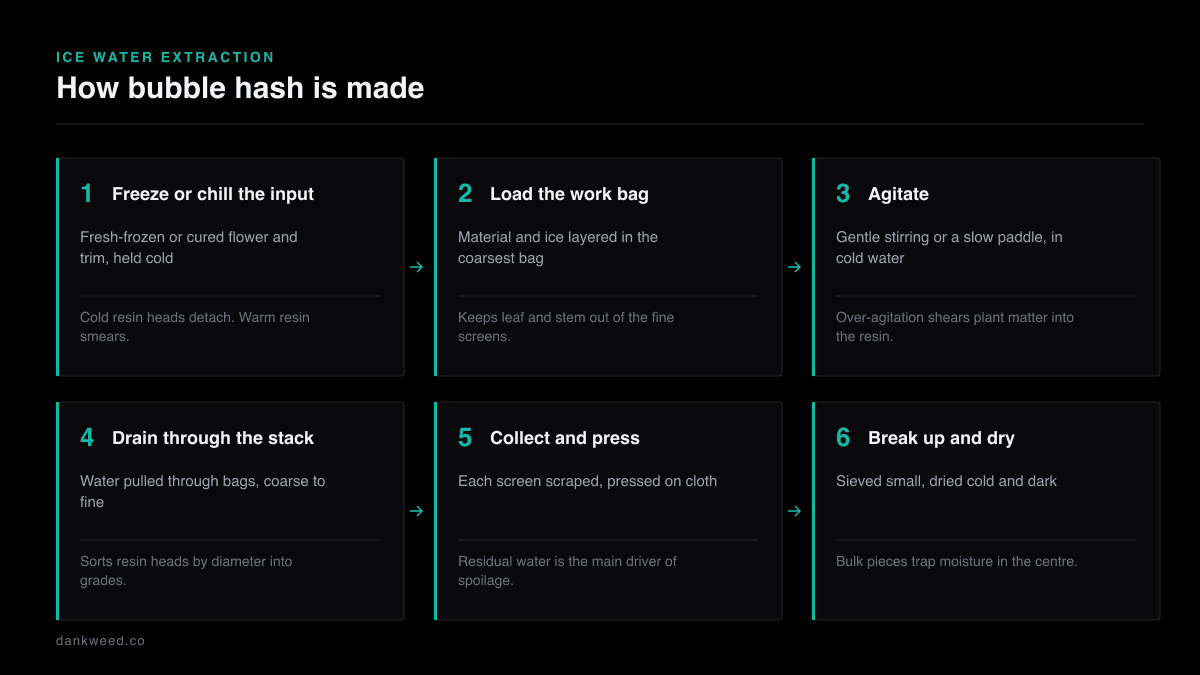
Cannabis is agitated in ice water so brittle trichome heads snap off, then the slurry is poured through progressively finer mesh bags. Each bag catches a different grade. The collected resin is pressed of water, broken up and dried before it can be stored.
| Stage | What happens | Why it matters |
|---|---|---|
| 1. Freeze or chill the input | Fresh-frozen or cured flower and trim, held cold | Cold resin heads detach; warm resin smears and emulsifies |
| 2. Load the work bag | Material and ice layered inside the coarsest bag | Keeps leaf and stem out of the finer screens downstream |
| 3. Agitate | Gentle stirring or a slow paddle, in cold water | Over-agitation shears plant matter into the resin |
| 4. Drain through the stack | Water pulled through bags from coarse to fine | Sorts resin heads by diameter into separate grades |
| 5. Collect and press water out | Each screen scraped, pressed on cloth | Residual water is the main driver of spoilage |
| 6. Break up and dry | Sieved into small pieces, dried cold and dark | Bulk pieces trap moisture in the centre |
The four variables that decide a wash
Almost every argument about how to make bubble hash collapses into four variables. This is the framework we use when assessing a producer’s process, and it is worth more than any equipment list:
- Starting material. Resin content and trichome integrity are set before the water is poured. Washing cannot add what the plant did not grow, and it cannot repair heads that trimming already knocked off.[1]
- Temperature. Cold is what makes heads snap rather than smear. It is also what keeps terpenes in the resin instead of in the room.
- Agitation energy. The only variable a home washer usually gets wrong. More stirring means more yield and more contamination, in that order.
- Drying. Covered below, and the stage that ruins more washes than the other three combined.
Note what is not on that list: bag brand, bucket size, and whether you used a washing machine. Those matter at the margins. The four above set the ceiling.
What Do the Micron Numbers on Bubble Bags Mean?
The number is the mesh opening in micrometres, and it works because trichome heads have a measurable size. Punja and colleagues measured glandular heads at 40 to 110 µm across two cultivars, which is close to the range a standard bag stack brackets.[1]
That study also reported mean head diameter differing by genotype — 90 µm in one cultivar against 75 µm in another at six weeks — with stalks running 300 to 500 µm and, at bract edges, up to 1,000 µm.[1] Separate microscopy work put drug-type glandular trichomes at roughly 400 µm total length with an approximately 80 µm secretory cavity.[7]
So the logic of the stack is sound: the coarse bags catch stalks and plant debris, the middle bags catch whole heads, and the finest bags catch broken heads and fine sediment.
| Bag | Typically catches | Usual fate |
|---|---|---|
| 220 µm (work bag) | Plant material, stalks, debris | Discarded |
| 160–120 µm | Large heads plus contamination | Food grade — press to rosin or infuse |
| 90–73 µm | Intact mature heads, the bulk of the yield | The melt fraction, where full melt usually comes from |
| 45 µm | Small and immature heads | Variable — sometimes excellent, often sandy |
| 25 µm | Fragments and fine sediment | Usually food grade |
The measured head-diameter range is published. The specific claim that 73 µm and 90 µm are “the melt bags” is producer convention — no peer-reviewed study locatable pairs bag micron size with measured melt behaviour or potency in the same samples. Treat the table as a strong working rule, not a law.
What Does the Six-Star Hash Scale Actually Mean?
It is a producer convention, not a standard. The star scale ranks how cleanly hash melts and dabs, from one star to six. No published specification or standards-body definition of it could be located, so the same grade can mean different things at different producers.
| Grade | Behaviour on heat | What it is for |
|---|---|---|
| 1–2 star | Does not melt, leaves ash | Cooking, infusion, edibles |
| 3–4 star | Partial melt, some residue | Bowls, joints, pressing to rosin |
| 5 star | Melts almost completely | Dabbing, rosin input |
| 6 star (full melt) | Vaporises with no residue | Dabbing at low temperature |
Compare that to the parts of the industry that are specified. Water activity in dry cannabis flower has an ASTM specification with a numeric range.[9] Cannabinoid content has a defined test method. Hash grading has neither — which is exactly why the certificate of analysis matters more than the star count on the jar.
What Makes Hash “Full Melt”?
Full melt hash is bubble hash clean enough to vaporise completely and leave nothing behind. Melt behaviour is a purity proxy: intact resin heads melt, while plant fragments, broken stalks and residual water char instead and leave a ring in the banger.
This is why full melt is difficult rather than expensive-by-decree. Every step that raises yield — warmer water, harder agitation, longer washes, coarser screening — also raises the contamination that stops material melting. Full melt is what is left when a producer optimises for purity and accepts the yield loss.

How Is Bubble Hash Dried?
Wet hash is broken into small pieces and dried cold and dark, either in open air or in a freeze dryer. Drying is where most home washes are lost — wet resin at room temperature is a microbial risk, not just a quality one.
The microbial part is not hypothetical. Over 100 fungal species have been documented on cannabis and hemp flowers, including Aspergillus species associated with case reports of pulmonary and disseminated aspergillosis.[11] Adding water to resin and then leaving it warm is the one thing a producer can do to make that worse.
| Method | How it works | Honest status |
|---|---|---|
| Open-air on parchment | Sieved into small pieces, dried cold and dark for several days | Slowest, and the most exposure to oxygen and warmth |
| Freeze dryer | Sublimates water from frozen resin under vacuum, typically overnight | Now the producer default — but see the note below |
| Desiccant or vented fridge | Cold air movement over a large surface area | A compromise; slower than a freeze dryer, colder than a room |
Every quantitative claim we could locate for freeze-dried versus air-dried hash traces back to equipment vendors, so no figure is quoted here. The one peer-reviewed freeze-drying comparison we found is on cannabis inflorescence rather than hash, and it went the other way — freeze drying reduced 45 metabolites including 28 terpenes relative to tray drying at 18 °C.[10] That result does not transfer to resin, and we are not claiming it does. It is a reason to treat “freeze drying is strictly better” as unmeasured rather than settled.
For a target endpoint: the ASTM specification for dry cannabis flower puts water activity at 0.55 to 0.65,[9] and published drying work on flower pairs 12–14% moisture content with a water activity of 0.65–0.70.[8] Both are flower specifications. No equivalent published spec for hash could be located.
Why Does Bubble Hash Smell Different From Traditional Hash?
Because the classic hash aroma is partly a processing artifact, not an intrinsic property of resin. A 2014 chromatography study found hashish headspace dominated by a monoterpene that forms when light rearranges myrcene — and it is barely present in fresh or dried herb.[2]
Marchini and colleagues analysed 11 hashish samples and 10 cannabis herb samples by two-dimensional gas chromatography. The compound — 5,5-dimethyl-1-vinylbicyclo[2.1.1]hexane, informally called hashishene — made up 1.1% to 14.9% of hashish headspace volatiles, median 10.2%. In fresh and dried herb it appeared “either at trace levels or in low amounts.”[2]
The authors attribute it to “the light induced rearrangement of β-myrcene during the manufacture of hashish.”[2] In other words: a large part of what people recognise as “hash smell” is sunlight acting on a terpene the plant already made.
The inference, stated as an inference. Bubble hash is washed cold, in the dark, and dried without light exposure. On the mechanism above it should therefore carry far less hashishene and smell like its input flower rather than like traditional resin — which matches what people report. But Marchini analysed traditional resin, not ice water hash. We could find no published headspace comparison of the two. This is a mechanistic prediction, not a measured result, and we are not going to dress it up as one.
The practical consequence is a buying rule: judge bubble hash against the flower it was washed from, not against a memory of imported hash. Bright, plant-like and specific is the target. Generic “hash” character in a fresh ice water product usually means heat, light or age got to it.
Bubble Hash vs Dry Sift vs Kief
All three are the same thing — trichome resin — separated by different means. Kief and dry sift come off dry screens; bubble hash is separated in ice water, which carries off water-soluble material that dry screening leaves behind.
| Kief | Dry sift | Bubble hash | |
|---|---|---|---|
| Separation medium | Grinder screen | Graduated dry mesh | Ice water plus mesh |
| Typical purity | Lowest | Middle | Highest achievable |
| Published potency note | Dry sieve kief reported at roughly 35–50% THC[6] | Water extraction reported at roughly the same potency as dry sieve[6] | |
| Water involved | No | No | Yes — must be dried |
| Spoilage risk | Low | Low | Real, if dried badly |
| Can reach full melt | No | Occasionally | Yes |
The headline is that bubble hash has the highest ceiling and the widest variance. Dry sift at its best is very good; bubble hash at its best is better, and bubble hash at its worst is a wet, sandy disappointment that dry sift cannot produce because there was never any water in it.
Is Bubble Hash Cleaner Than Solvent Extracts?
Solventless removes one risk category, not all of them. A 2015 survey of 57 California concentrates found over 80% contaminated in some form, by residual solvent or pesticide.[3] Ice water eliminates the solvent half of that. It does nothing about what was already on the plant.
| Contaminant | Ice water wash | Solvent extraction |
|---|---|---|
| Residual solvent | None possible | Purged, and tested for on the legal market |
| Pesticide residue on the flower | Carried through, and concentrated | Carried through, and concentrated |
| Plant material and chlorophyll | Largely removed by screening | Largely removed by extraction |
| Microbial load | Can increase if dried badly | Reduced by the process |
| Water-soluble contaminants | Partly washed away | Not addressed |
The second half of this is about where you buy it. A 2019 study of cannabis resin bought on the streets of Madrid reported 25% of samples deliberately adulterated and found that 88.3% “were not suitable for consumption,” with E. coli in 93% of hand-rolled “acorn” format samples.[4]
That is Madrid street resin, not a verdict on hash as a category, and it should not be read as one. The Canadian comparison is narrower and more useful: Health Canada found yeast and mould above reference limits in 6% of legal products against 73% of illegal samples, and Aspergillus in 14% versus 37%.[5] Testing is the variable, not the extraction method.
How Do You Use Bubble Hash?
Low grades are smoked; high grades are dabbed or vaporised. One- to three-star hash goes into a bowl, a joint or a pipe. Five- and six-star full melt is worth dabbing at low temperature, where its terpene content actually survives.
- Bowl topper — crumble dry, lower-grade hash over ground flower. Simple and forgiving.
- Dab rig or e-nail — for five- and six-star only. Temperature matters for safety as well as flavour; the concentrates guide covers the published data on that.
- Press it to rosin — hash rosin is bubble hash squeezed between heated plates, and full melt is the input that makes it worth doing.
- Vaporiser — a concentrate insert or pad in a dry-herb vaporiser, for grades that melt but are not worth a rig.
Start with a fraction of what you would use of flower. Concentrates are the category where beginners most reliably overshoot.
Can You Make Bubble Hash at Home in Canada?
Ice water extraction is not the process the Cannabis Act prohibits at home. Section 12 bars altering cannabis using an organic solvent, and water and ice are not organic solvents. The four-plant household cap and the ban on selling still apply.[12]
| Rule | What it says |
|---|---|
| Organic solvent extraction at home | Prohibited — butane and propane extraction is criminal[12] |
| Home cultivation | Up to four plants per dwelling-house federally; the cap is per dwelling, not per person[12] |
| Provincial variation | Quebec prohibits home cultivation outright; other provinces add their own conditions[12] |
| Selling what you made | Prohibited without authorisation, with no small-quantity exception[12] |
| Public possession | 30 g dried equivalent in a public place[12] |
| Legal packaged extracts | Capped at 1,000 mg THC per immediate container; 7.5 g maximum net weight for inhaled extracts[12] |
Two honest caveats. Cannabis law is federal and provincial at once, and this is general information rather than legal advice. And the household plant cap is the real constraint on home washing — four plants does not produce much input material, which is a large part of why most people buy hash rather than wash it.

Frequently Asked Questions
What is bubble hash?
Bubble hash is cannabis resin separated from plant material in ice water and strained through a stack of mesh bags. It is fully solventless, since nothing is added and nothing is dissolved. The name comes from the way high-grade material bubbles and melts on a hot surface rather than smouldering like lower grades do.
How do you make bubble hash?
Chilled or frozen cannabis is agitated gently in ice water so the brittle resin heads snap off. The slurry is drained through mesh bags of decreasing size, each catching a different grade. Every collection is pressed free of water, broken into small pieces and dried cold and dark before storage.
What micron bag makes the best bubble hash?
The 90 and 73 micron screens usually carry the melt fraction. That convention has a real basis: measured glandular trichome heads run about 40 to 110 micrometres across. But no published study pairs a specific bag size with measured melt quality, so treat it as a strong working rule rather than a specification.
What does 6 star hash mean?
Six star is the top of a producer grading convention that ranks hash by how cleanly it melts. Six star, or full melt, vaporises completely and leaves no residue. There is no published standard or standards-body definition behind the scale, so the same star count can mean different things at different producers.
Is bubble hash the same as ice water hash?
Yes. Bubble hash, ice water hash, water hash, ice wax and IWE all describe resin separated in cold water through mesh screens. The terms are used interchangeably on menus and in production. Any difference you see between two products under those names comes from grade and process quality, not from the name itself.
Is bubble hash stronger than kief?
Usually, because it is purer rather than because water does something clever. A 2021 review reported dry sieve kief at roughly 35 to 50 percent THC, and water extraction at roughly the same potency as dry sieving. The real gap is contamination: ice water removes material that dry screening leaves in.
Why does bubble hash smell different from Moroccan hash?
Much of the classic hash aroma is a processing artifact. Chromatography work identified a monoterpene formed when light rearranges myrcene at a median of about 10 percent of hashish headspace volatiles, but only traces in herb. Bubble hash is washed cold and dark, so it should smell more like the flower it came from.
Do you need a freeze dryer to make bubble hash?
No, but drying is the stage that ruins most home washes. Wet resin left warm risks spoilage as well as quality loss. Freeze dryers are now the producer default, though every quantitative comparison we could locate came from equipment vendors rather than from published research, so treat the advantage as unmeasured.
Can you make bubble hash at home in Canada?
The federal prohibition on home extraction names organic solvents, and water and ice are not organic solvents. The four plant per dwelling cultivation cap still applies, Quebec bans home growing entirely, and selling what you make is prohibited. This is general information about the framework, not legal advice for your situation.
Is bubble hash cleaner than shatter or live resin?
It removes one risk and not the others. A 2015 survey of 57 concentrates found over 80 percent contaminated by residual solvent or pesticide. Ice water rules out residual solvent entirely, but pesticide residue on the flower is carried through and concentrated exactly as it is in solvent extraction. Lab testing is the real variable.
References
- Punja, Z. K., Sutton, D. B., & Kim, T. Glandular trichome development, morphology, and maturation are influenced by plant age and genotype in high THC-containing cannabis (Cannabis sativa L.) inflorescences. Journal of Cannabis Research, 2023, 5, 12. DOI: 10.1186/s42238-023-00178-9 Full text read. Source of the 40–110 µm head-diameter range, the 90 µm vs 75 µm genotype comparison and the 300–500 µm stalk lengths. Cannabinoid content was not measured in this study.
- Marchini, M., Charvoz, C., Dujourdy, L., Baldovini, N., & Filippi, J.-J. Multidimensional analysis of cannabis volatile constituents: Identification of 5,5-dimethyl-1-vinylbicyclo[2.1.1]hexane as a volatile marker of hashish, the resin of Cannabis sativa L. Journal of Chromatography A, 2014, 1370, 43–53. DOI: 10.1016/j.chroma.2014.10.045 11 hashish and 10 herb samples. The study analysed traditional resin, not ice water hash.
- Raber, J. C., Elzinga, S., & Kaplan, C. Understanding dabs: contamination concerns of cannabis concentrates and cannabinoid transfer during the act of dabbing. The Journal of Toxicological Sciences, 2015, 40(6), 797–803. DOI: 10.2131/jts.40.797 57 samples from the 2015 California medical market, which predates that state’s mandatory testing regime.
- Pérez-Moreno, M., Pérez-Lloret, P., González-Soriano, J., & Santos-Álvarez, I. Cannabis resin in the region of Madrid: Adulteration and contamination. Forensic Science International, 2019, 298, 34–38. DOI: 10.1016/j.forsciint.2019.02.049 Abstract read via the Universidad Complutense de Madrid institutional repository; publisher full text not accessed. Street-market sampling in one city.
- Health Canada. Cannabis Data Gathering Program: A comparison of legal and illegal dried cannabis products. Government of Canada, 21 February 2025. canada.ca
- Pourseyed Lazarjani, M., Young, O., Kebede, L., & Seyfoddin, A. Processing and extraction methods of medicinal cannabis: a narrative review. Journal of Cannabis Research, 2021, 3, 32. DOI: 10.1186/s42238-021-00087-9 Narrative review, not primary measurement. Source of the dry-sieve 35–50% figure and the water-versus-dry-sieve potency comparison.
- Ebersbach, P., Stehle, F., Kayser, O., & Freier, E. Chemical fingerprinting of single glandular trichomes of Cannabis sativa by Coherent anti-Stokes Raman scattering (CARS) microscopy. BMC Plant Biology, 2018, 18, 275. DOI: 10.1186/s12870-018-1481-4
- Punja, Z. K., Ni, L., Lung, S., & Buirs, L. Total yeast and mold levels in high THC-containing cannabis (Cannabis sativa L.) inflorescences are influenced by genotype, environment, and pre- and post-harvest handling practices. Frontiers in Microbiology, 2023, 14, 1192035. DOI: 10.3389/fmicb.2023.1192035 Flower, not hash.
- ASTM International. ASTM D8197 — Standard Specification for Maintaining Acceptable Water Activity (aw) Range (0.55 to 0.65) for Dry Cannabis Flower Intended for Human/Animal Use. store.astm.org Specifies the range and scope only; it states no microbial mechanism.
- Spadafora, N. D., Felletti, S., Chenet, T., et al. The influence of drying and storage conditions on the volatilome and cannabinoid content of Cannabis sativa L. inflorescences. Analytical and Bioanalytical Chemistry, 2024, 416(16), 3797–3809. DOI: 10.1007/s00216-024-05321-w Inflorescence, not resin. Cited only to show the freeze-drying question is open.
- Gwinn, K. D., Leung, M. C. K., Stephens, A. B., & Punja, Z. K. Fungal and mycotoxin contaminants in cannabis and hemp flowers: implications for consumer health and directions for further research. Frontiers in Microbiology, 2023, 14, 1278189. DOI: 10.3389/fmicb.2023.1278189
- Cannabis Act (S.C. 2018, c. 16), ss. 2(1), 8(1)(a), 10(1) and 12; Cannabis Regulation Act (Quebec), CQLR c. C-5.3, s. 10; Health Canada, Guide on composition requirements for cannabis products. Provenance note: laws-lois.justice.gc.ca was unreachable from this run, so the statutory wording is taken from our own verified source library entry, confirmed against the official consolidation on 21 August 2026. Verify against the current consolidation before print use.
This article is for informational and harm-reduction purposes only and is not medical advice. Cannabis affects individuals differently. Concentrates are significantly more potent than flower — begin with a very small amount. Follow the cannabis laws applicable in your jurisdiction.