
How to Store Cannabis Concentrates (Canada, 2026)
Published · Updated · Katie S.
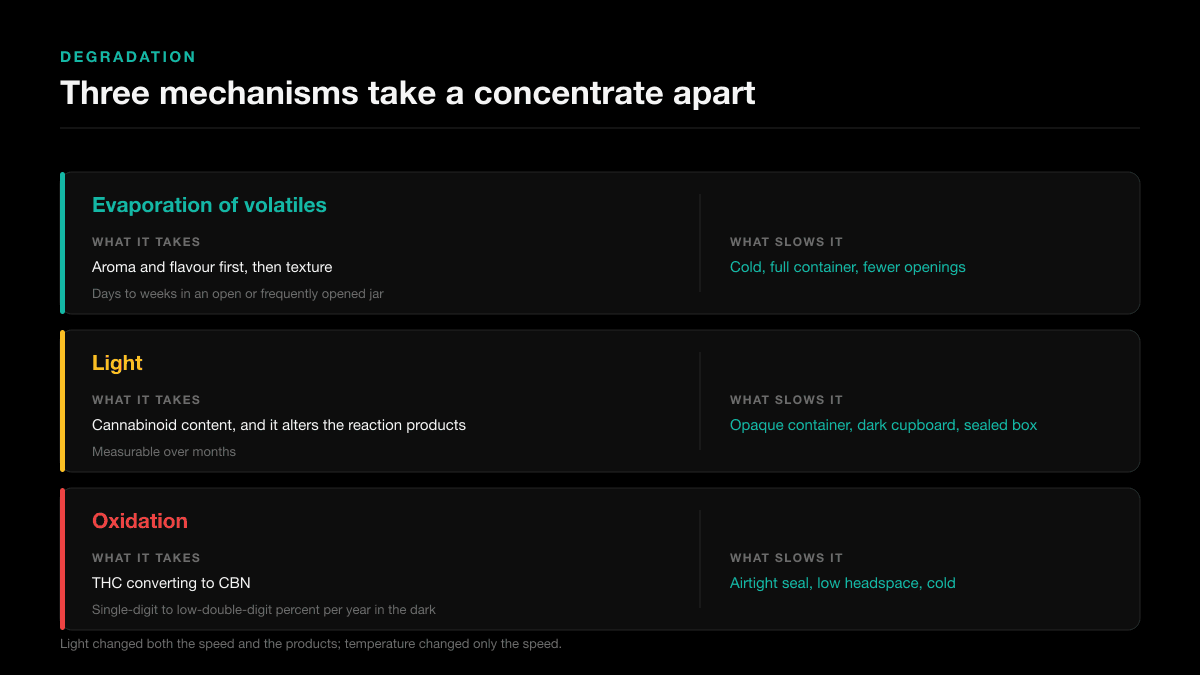
Cannabis concentrates degrade on four separate clocks, and almost every storage guide online only addresses one of them. This is what the measurements actually show — including a four-year experiment that found light does something to your extract that heat does not.
Key Takeaways
- Light is the variable with the best evidence behind it. A four-year controlled storage study reported that temperature changed only the speed of THC breakdown while light changed the speed and the stoichiometry — what the THC turned into.[1]
- Cold, dark, airtight, and left alone. Refrigerate most extracts, freeze live products, and stop opening the jar. Every extra opening is a fresh headspace of oxygen and a fresh round of condensation risk.
- Glass for storage, silicone and parchment for handling. No peer-reviewed study of container material for cannabis concentrates was located, so this is mechanism and laboratory practice — not a measured result. We say so rather than inventing a number.
- Published loss rates are slower than the internet thinks. Cannabis stored dark at 20–22 °C lost 16.6% of its THC in the first year and 41.4% over four.[2] That is flower, not extract, and it is the closest long-run measurement there is.
- Shatter turning to budder is not spoilage. Volatile content sets texture and volatiles only leave, so the change runs one way. See our texture comparison for why.
- THC really does convert to CBN. CBN making you sleepy is a different claim, and it is not supported.[9][10]
- Once you decant, Canadian packaging law stops applying. Section 108 binds the licensed seller’s container, not your jar.[13]
What Actually Degrades a Cannabis Concentrate?
Heat, light and oxygen. Terpenes evaporate first, texture shifts next, and THC slowly oxidises to CBN last. The three run at different speeds, and only one of them has been measured directly in stored cannabis resin.
That last part is the honest headline. A jar of extract is a chemistry experiment that nobody has run properly. There is a real forensic literature on stored cannabis and stored hashish, because police laboratories need to know how much a seized sample has changed before trial. There is almost nothing on a gram of live rosin in a fridge.
So this page is built on the storage science that exists — resin, hashish and flower — with the scope of each source stated where it is used. Where the evidence stops, we say it stops. It is the depth companion to our cannabis concentrates guide, which covers what each format actually is.

| Mechanism | What it takes from the extract | How fast | What slows it |
|---|---|---|---|
| Evaporation of volatiles | Aroma and flavour first, then texture | Days to weeks in an open or frequently opened jar | Cold, full container, fewer openings |
| Light | Cannabinoid content, and it alters the reaction products[1] | Measurable over months; near-total THC loss reported at four years at room temperature[1] | Opaque container, dark cupboard, sealed box |
| Oxidation | THC converting to CBN | Single-digit to low-double-digit percent per year in dark room-temperature storage[2] | Airtight seal, low headspace, cold |
Does Light or Temperature Matter More When Storing Concentrates?
Light. A four-year forensic study stored cannabis and hashish under four regimens and reported that temperature changed only the speed of THC breakdown, while light changed the speed and the chemistry of it.
Zamengo and colleagues took six high-potency cannabis products — herbal material and resin — and split each into four samples held under controlled conditions for four years, measuring THC, CBN and CBD by GC-FID roughly every 100 days.[1] That design is rare enough to be worth reading carefully.
| Condition | Light | Temperature | What the paper reports |
|---|---|---|---|
| A | Light, 24 h | 22 °C | Significant THC degradation and CBN formation; “almost 100% of THC was degraded after four years” |
| B | Darkness, 24 h | 22 °C | Significant THC degradation and CBN formation |
| C | Darkness | 4 °C (refrigerated) | Not among the conditions where significant change was reported |
| D | Darkness | −20 °C (frozen) | Not among the conditions where significant change was reported |
The sentence worth memorising is the authors’ own: “temperature changed only the speed, light changed both the speed and the stoichiometry of this conversion.”[1] Stoichiometry is the ratio of what goes in to what comes out. Cooling a sample slows the reaction down. Putting it in the dark changes what the reaction produces.
Nobody selling you a storage container mentions this, and it is the most actionable finding in the whole literature. An opaque container costs nothing. It is doing more work than the fridge.
There is a second, stranger piece of evidence that light rewrites resin chemistry. The compound that gives traditional hashish its characteristic smell is attributed to “the light induced rearrangement of β-myrcene during the manufacture of hashish.”[6] Light does not simply remove things from cannabis resin. It makes new ones.
Scope, stated plainly: this study used herbal cannabis and hashish, not butane extracts or rosin. The mechanism — photo-oxidation of cannabinoids — is not specific to a format, but the four-year numbers describe those materials, not a jar of shatter.
How Long Do Cannabis Concentrates Last?
Stored cold, dark and airtight, shatter and pressed hash stay good for a year or more; live products are best used within a few months, even frozen. The published loss rates are slower than most people assume.

The longest careful measurement of cannabis potency in ordinary storage comes from a United Nations Bulletin on Narcotics paper. Material held “in closed barrels in the dark in a secured air-conditioned vault,” between 20 °C and 22 °C, lost “16.6% ±7.4 of its original value after one year and 26.8% ±7.3, 34.5% ±7.6 and 41.4% ±6.5 after two, three and four years, respectively.”[2]
That is flower, in the dark, at room temperature, with no special effort. It is not catastrophic. It is also the ceiling on how well you can do without cold or light control, and it is the reason “my shatter is a year old, is it ruined” is almost always answered no.
At the other end, a 2025 study of Moroccan cannabis resin held up to eight years in opaque bags and cardboard boxes in dark, dry rooms found THC falling and CBN rising steeply with storage age.[4] One caveat matters: those are separate seizure cohorts of different ages, not one batch followed over time, so differences between groups are confounded with whatever the material started at. Treat the direction as real and the magnitudes as indicative.
Which is why concentrate storage is really four questions rather than one. How to store shatter, how to store hash, how to store rosin and how to store live resin have different answers, because the formats differ enormously in surface area and in how much volatile content they are carrying to begin with.
| Product | Where it belongs | Practical window | Why |
|---|---|---|---|
| Shatter | Cool, dark, airtight; fridge for long holds | A year or more | Lowest surface area of the solvent textures, glassy and stable |
| Pressed hash | Cool, dark, airtight | A year or more | Compression limits air contact — the same reason hash outlasts kief |
| Budder, badder, crumble | Fridge, sealed glass | Months | High surface area, whipped in air, volatile-rich |
| Live resin, live rosin | Freezer, portioned, sealed | A few months, even frozen | The volatiles that make them worth buying are the first thing to go |
| Kief and dry sift | Cool, dark, airtight | Months | Loose powder, maximum surface area exposed to oxygen |
Should You Refrigerate or Freeze Cannabis Concentrates?
Refrigerate most extracts and freeze live products. In the only four-year storage experiment located, significant cannabinoid change was reported at room temperature in both light and darkness — and not in the refrigerated or frozen arms.[1]

The refrigerator earns its place. The freezer earns its place for anything sold on its aroma, because that is where the freshness argument for live products came from in the first place — freezing the plant at harvest to keep monoterpenes that drying removes.
Cold storage has one cost, and it is the reason people get burned. Take a cold jar into a warm room, open it, and water condenses onto the extract. That water does nothing good for texture and nothing good for what grows on the surface later. Let a sealed jar come to room temperature before you open it, every time.
Which sets up the real trap: cold storage and frequent access do not combine. If you are going to visit a jar daily, keep that jar out of the fridge and put the rest away properly. Portioning is the fix, not willpower.
Why Does Shatter Turn Into Budder in the Jar?
Because volatile content sets texture, and volatiles only leave. Warmth, agitation and temperature cycling accelerate it. The change is a manufacturing readout moving on — not spoilage — and it runs in one direction only.
Terpenes are the second most abundant compound class in cannabis concentrates and they moderate cannabinoid viscosity: a volatile-rich extract is softer, a volatile-poor one is harder and more brittle.[8] As volatiles escape, the material stiffens and cannabinoid acids get room to crystallise, which is what “sugaring” is. Our shatter, wax and crumble guide takes that apart in full.
| What you see | What is happening | Problem? |
|---|---|---|
| Shatter goes cloudy, then soft | Nucleation and crystallisation beginning | No — cosmetic and expected |
| Badder goes grainy or sandy | Cannabinoid acids crystallising out | No |
| Extract darkens in a jar you already own | Oxidation with time and exposure | Age signal — but see below |
| Extract is dark at the point of sale | Starting material, method, post-processing | Tells you nothing about care |
| Weeping, separating, or gone soupy | Warmth, or residual volatiles migrating out | Yes — it has been stored warm |
| Condensation beading on the surface | A cold jar was opened in a warm room | Yes, and avoidable |
Darkening deserves the careful version. In a jar you have owned for six months, darkening is an age and exposure signal. At the point of purchase it is not a quality signal at all — some excellent live rosin is dark, and some very pale shatter has been colour-remediated. Those are two different questions that look like one, and our concentrates guide covers the buying-side version.
What Should You Store Cannabis Concentrates In?
Glass with a tight lid, kept dark. Silicone and parchment are handling materials, not storage materials. No peer-reviewed study of container material for cannabis concentrates was located, so this is mechanism and laboratory practice rather than a measured result.
Here is the state of the evidence, honestly. Every quantitative claim about concentrate containers located in this research traces to a company selling containers — the same shape as the activated-carbon literature behind smell control and the press-parameter charts behind rosin. Under our sourcing rules that is not evidence.
What does exist is adjacent and worth knowing. THC binds to polypropylene surfaces: in a study of spiked oral fluid, recovery from polypropylene tubes ran 61.0% to 75.9% depending on volume, with losses “ranging from 22.8% to 29.3%” and the loss scaling with the ratio of surface area to sample.[5] That is an aqueous matrix at nanograms per millilitre and the numbers do not transfer to a gram of resin. The mechanism — lipophilic cannabinoids partitioning onto polymer surfaces — is why analytical laboratories default to glass.
| Material | Best used for | Weakness | Evidence status for concentrates |
|---|---|---|---|
| Glass jar, tight lid | Storage of anything, short or long | Transparent unless you keep it dark or use amber | None directly; the default in analytical practice |
| Silicone container | Transport and daily handling | Flexible polymer in prolonged contact with a very fatty substance | None located. No measurement either way |
| Parchment paper | Short-term contact, folding, transfer | Not airtight, not a seal, not light-proof | None located |
| Thin plastic clamshell | Nothing, past the trip home | Surface binding, poor seal, light | Surface binding demonstrated in another matrix[5] |
| Vacuum sealing | Marginal gains over a full sealed jar | Volatiles outgas from the material itself, not only from headspace[7] | Measured on flower, not extract |
On vacuum sealing and inert gas specifically: in a six-week flower storage trial, argon displacement alone did not prevent terpene loss, because a large part of the loss is outgassing from the plant material rather than reaction with headspace oxygen.[7] Removing air does not stop a volatile compound from being volatile. A full, cold, sealed jar gets you most of the benefit.

Does Old Concentrate Turn Into CBN and Make You Sleepy?
The conversion is real and measured. The sedation is not. THC oxidises to CBN on a published timescale, but the one human trial comparing them found subjects felt drugged and drowsy under THC and not under CBN.
The chemistry first. CBN is the oxidation product of THC, it accumulates as THC declines, and the ratio between them is reliable enough that forensic chemists use it to estimate how long a sample has been sitting. Ratios below 0.013 indicate material under six months old; averages rose from 2.5 ±0.9 at one year to 14.2 ±1.2 at four.[2] Your extract keeps its own clock.
The effect claim is where the popular version fails. In a controlled human study, volunteers reported feeling “drugged, drunk, dizzy, and drowsy under the delta9-THC condition, but not under the CBN condition.”[9] A later review found no published clinical trials using validated sleep questionnaires or polysomnography and concluded there is “insufficient published evidence to support sleep-related claims.”[10]
So old extract is genuinely weaker in THC and genuinely higher in CBN. What that does to the experience is not established, and the confident version — that aged cannabis is sedating because of CBN — is folklore attached to a real chemical fact. We covered the same ground in our harvest and cure guide, where the same claim is used to justify harvesting late.
Which Kind of Degradation Are You Actually Trying to Stop?
Four processes run at once on four different clocks: terpene loss in days, texture migration in weeks, oxidation in months to years, and microbial spoilage essentially never. Each has a different dominant variable, so no single rule optimises all four.
This is the framework we use, and it explains why storage advice contradicts itself. “Keep it in the fridge” and “don’t temperature-cycle it” are both correct and they fight each other. They are answers to different clocks.
| Clock | Timescale | Dominant variable | What you notice | What actually helps |
|---|---|---|---|---|
| 1. Volatile loss | Days to weeks | Headspace and openings | It smells like less | Small full containers, opened rarely, kept cold |
| 2. Texture migration | Weeks to months | Temperature cycling | Shatter softens; badder sugars | One stable temperature — cycling is worse than warm |
| 3. Oxidative conversion | Months to years | Light, then temperature[1] | Darkening; less THC, more CBN | Opaque container first, cold second, airtight third |
| 4. Microbial spoilage | Effectively never | Water content | Nothing, in a dry extract | Nothing — it is not the risk here |
Three things fall out of laying it out this way. First, the clocks have different owners: clock 1 is a habit problem, clock 2 is a location problem, clock 3 is a container problem. Second, they cannot all be won — an opaque jar in a freezer that you open every evening is optimised for clock 3 and losing badly on clock 1.
Third, and this is the useful one: decide which clock you are on before you buy anything. A gram you will finish this month has no clock 3 problem at all, and buying an expensive vault for it is theatre. A jar of live rosin you are saving has no clock 1 problem if you never open it — but it has clock 2 and clock 3 in full, and the fix for both is portion once, seal, freeze, forget.
This is the storage-side sibling of the smell-loss stack in our flower storage guide. That page covers cannabis flower, where moisture is a live variable and humidity packs do real work. Concentrates are a different physics problem, which the next section explains.
Can Cannabis Concentrates Go Mouldy?
Almost never on their own. Concentrates carry too little water to support microbial growth, which is why the published water-activity specification covers dried flower and has no concentrate equivalent. Contamination that appears in an extract usually arrived with the input.
ASTM’s cannabis committee publishes a water-activity specification of 0.55 to 0.65 for dry cannabis flower intended for human use.[12] No equivalent published specification for hash or other concentrates could be located. That absence is not an oversight — a well-purged extract has so little free water that the question mostly does not arise.
What does arise is what came in with the material. Screening of 57 concentrates from the pre-regulation California market found “over 80% of the concentrate samples were contaminated in some form” by residual solvent or pesticide.[11] Storage does not create that and storage cannot fix it. Testing is the variable, not the jar.
The one storage-created risk is condensation: repeatedly introducing liquid water to a surface at room temperature is a different situation from a dry extract in a sealed jar. Warm the jar before opening and the situation does not arise.
How Do You Store Concentrates for a Year or More?
Portion once, seal in glass, exclude light, freeze, and do not open it again until you mean to use it. The expensive mistake is not the freezer — it is taking the same jar in and out of it.
- Portion before you store, not after. Split into the amounts you will actually use, so the archive jar is opened once, ever. This is the single highest-value step and it costs ten minutes.
- Glass, filled, tightly sealed. Less headspace means less oxygen and less room for volatiles to leave the material.
- Make it opaque. Amber glass, or a plain jar inside a sealed opaque box. This is the step with four years of data behind it.[1]
- Freezer for live products, fridge for the rest. Cold slows every clock except texture cycling, which you have already solved by portioning.
- Label the date. You cannot judge age by looking, and the CBN clock is running whether you track it or not.
- Warm a portion fully before opening it. Every time, no exceptions.
Hash is the outlier worth naming. Pressed, low-surface-area material has always been the format that travels and keeps — that is the reason it exists — and it is the one concentrate where a cool dark cupboard is genuinely enough. Our bubble hash guide covers the drying side, which is where hash storage really begins.

What Are the Most Expensive Storage Mistakes?
Leaving it in the light, opening a cold jar before it warms, and keeping everything in one container you visit daily. Each maps onto a different clock, and the first one is the only one with four years of data behind it.
| Belief | Status | Why |
|---|---|---|
| “A dark cupboard is as good as an opaque jar” | Broadly true | What matters is that light does not reach it; the mechanism is the same either way[1] |
| “Temperature is the main thing” | Overstated | Temperature changed the speed; light changed the speed and the products[1] |
| “Concentrates go off in a few months” | Not supported | Dark room-temperature storage lost 16.6% of THC in year one, in flower[2] |
| “Vacuum sealing preserves everything” | Overstated | Argon displacement alone did not prevent terpene loss on flower[7] |
| “Aged extract is more sedating because of CBN” | Not supported | The one human comparison found drowsiness under THC and not CBN[9] |
| “Silicone leaches into your concentrate” | Unmeasured | No study either way was located; vendor claims run in both directions |
| “There is a published shelf life for extracts” | Misleading | See the note below on extrapolated shelf-life numbers |
Why we do not quote a shelf-life number. The one published kinetic model of cannabis resin degradation ran at 50–80 °C and extrapolated down with the Arrhenius equation, producing a 25 °C shelf life of 3 days for CBD and 8 days for THC.[3] Direct measurements of stored cannabis show single-digit annual losses.[2] The two disagree by orders of magnitude.
The fitted activation energies in that model are low enough that it barely predicts any benefit from cooling — which the four-year storage experiment contradicts outright.[1] Accelerated thermal testing is a manufacturing tool, not a description of your cupboard. That reading is ours: it is reasoning across three papers rather than a result any one of them reports.
The format that outlasts the rest
Four clocks run on an extract and surface area drives all of them. Pressed hash has the least of it, which is why it keeps when whipped textures do not.


Prices shown at time of writing. More in hash.
What Do Canadian Rules Say About Storing Cannabis Extracts?
They govern the container your extract arrives in, not the jar you move it to. Section 108 of the Cannabis Regulations binds licensed sellers: opaque or translucent, child-resistant, and no more than the equivalent of 30 grams of dried cannabis.[13]
That is a more interesting rule than it looks, because of where it stops. The packaging and labelling regime binds people authorised to sell cannabis. The moment you decant an extract into your own jar, none of it applies to you — including the child-resistant closure the law required of the seller. Nothing replaces it unless you do.
| Rule | What it says | Who it binds |
|---|---|---|
| Cannabis Regulations, s. 108[13] | Immediate container must be opaque or translucent, prevent contamination, carry a security feature, be child-resistant, and hold no more than 30 g dried equivalent | Licensed sellers |
| Health Canada composition guidance[13] | Extracts capped at 1,000 mg THC per immediate container; inhaled extracts capped at 7.5 g net weight | Licensed producers |
| Cannabis Act, s. 8(1)(a)[14] | 30 g dried equivalent in a public place; no federal cap on what is kept at home | Individuals |
| Cannabis Act, s. 10(1)[14] | Selling without authorisation is prohibited outright — sharing a stored stash for money is not a storage question | Individuals |
| Cannabis Act, s. 12(1)(b) with s. 12(3)[14] | Altering cannabis using an organic solvent at home is prohibited — relevant if “storage” turns into re-processing | Individuals |
Two hedges, as always. Cannabis is regulated federally and provincially at the same time, and provinces set their own rules on possession, age and where cannabis may be kept or consumed. And this is general information about published rules, not legal advice.
The practical read: the opaque container the law makes producers use is not a formality, it is the same variable the four-year storage study identified. When you decant, keep the opacity and add back the child resistance yourself.
Frequently Asked Questions
How should you store cannabis concentrates?
Cold, dark, airtight, and opened as little as possible. Use a glass container with a tight lid, keep it opaque or inside something opaque, refrigerate most extracts and freeze live products. Portion before storing so the main container is opened once. Let any cold container reach room temperature before you open it.
Do cannabis concentrates need to be refrigerated?
For anything beyond a few weeks, yes. In a four-year controlled study, significant cannabinoid change was reported at room temperature in both light and darkness, and not in the refrigerated or frozen arms. For a gram you will finish this month, a cool dark cupboard is fine and avoids condensation risk entirely.
Can you freeze cannabis concentrates?
Yes, and it is the right call for live resin and live rosin. Freeze in sealed glass, portioned, so you never thaw the whole amount. The risk is not the cold, it is condensation: open a frozen container in a warm room and water forms on the extract. Warm it sealed first.
How long does shatter last?
Stored cold, dark and airtight, a year or more. Shatter has the lowest surface area of the solvent textures, which is why it outlasts whipped formats. It will gradually soften and cloud as volatiles leave and cannabinoid acids crystallise, but that is a texture change rather than spoilage, and it is expected.
Is silicone bad for storing concentrates?
Nobody has measured it. No peer-reviewed study of silicone containers with cannabis extracts was located, and the confident claims in both directions come from companies selling containers. Glass is the safer default because it is inert and non-absorbing, which is why analytical laboratories use it. Silicone is a handling and transport material.
Does cannabis concentrate go bad or expire?
It degrades rather than spoils. Terpenes evaporate first, texture shifts next, and THC slowly oxidises to CBN over months and years. Cannabis stored dark at room temperature lost about 17% of its THC in the first year in one long-run measurement. Cold, dark, airtight storage extends usable life considerably.
Why did my shatter turn into budder?
Volatile content sets texture, and volatiles only leave. Warmth, agitation and repeated temperature cycling all speed it up, and the change runs one way — you cannot turn budder back into shatter without changing what is in it. It is a manufacturing readout continuing to move, not a sign of a bad product.
Does old concentrate get more sedating as THC turns to CBN?
The conversion is real and measurable. The sedation is not established. In the human study most often cited for it, volunteers felt drugged, dizzy and drowsy under THC and not under CBN, and a later review found no clinical trials using validated sleep measures. Old extract is weaker, not different in kind.
Should you vacuum seal cannabis concentrates?
The gain over a full, cold, tightly sealed glass jar is small. In a six-week flower trial, argon displacement alone did not prevent terpene loss, because much of the loss is outgassing from the material itself rather than reaction with headspace oxygen. Removing air does not stop a volatile compound being volatile.
Can cannabis concentrates grow mould?
Rarely, and not on their own. A purged extract holds too little water to support microbial growth, which is why the published water-activity specification covers dried flower and has no concentrate equivalent. The realistic risks are contamination that arrived with the input material, and repeatedly condensing water onto a cold extract.
References
- Zamengo, L., Bettin, C., Badocco, D., Di Marco, V., Miolo, G., & Frison, G. (2019). The role of time and storage conditions on the composition of hashish and marijuana samples: A four-year study. Forensic Science International, 298, 131–137. DOI 10.1016/j.forsciint.2019.02.058. Six high-potency herbal and resin products, four samples each, four storage conditions over four years, measured by GC-FID roughly every 100 days. Abstract read verbatim via the FAO AGRIS bibliographic record on 27 August 2026; ScienceDirect is not reachable from this environment, so the full text was not read and no figure beyond the abstract is quoted.
- Ross, S. A., & ElSohly, M. A. CBN and Δ9-THC concentration ratio as an indicator of the age of stored marijuana samples. Bulletin on Narcotics, United Nations Office on Drugs and Crime. Read in full on unodc.org. Volume, issue and page numbers could not be confirmed from the online edition and are deliberately not stated. Material was stored “in closed barrels in the dark in a secured air-conditioned vault” at 20–22 °C. This is herbal cannabis, not extract.
- Jaidee, W., Siridechakorn, I., Nessopa, S., Wisuitiprot, V., Chaiwangrach, N., Ingkaninan, K., & Waranuch, N. (2022). Kinetics of CBD, Δ9-THC degradation and cannabinol formation in cannabis resin at various temperature and pH conditions. Cannabis and Cannabinoid Research, 7(4), 537–547. DOI 10.1089/can.2021.0004. Thermal degradation studied at 50, 60, 70 and 80 °C in dried resin, with shelf-life values extrapolated to 25 °C. ⚠️ Those extrapolated figures are an accelerated-stability model, not an observed shelf life, and this article uses them only to show that the extrapolation disagrees with direct storage measurements.
- Fettoukh, N., Fadil, M., Stambouli, H., EL Bouri, A., Bouyoun, T., Annemer, S., Boukhaled, A., & Farah, A. (2025). Chemometric and predictive modeling of long term cannabinoid transformation in stored Cannabis sativa resin. Scientific Reports, 15, 33827. DOI 10.1038/s41598-025-03888-7. Resin held up to eight years at 20–25 °C in opaque polyethylene bags or cardboard boxes in dark, dry rooms. ⚠️ The groups are separate cohorts of differing storage age rather than one batch followed over time, so between-group differences are confounded with original potency. Direction used; magnitudes described as indicative.
- Molnar, A., Lewis, J., & Fu, S. (2013). Recovery of spiked Δ9-tetrahydrocannabinol in oral fluid from polypropylene containers. Forensic Science International, 69–73. DOI 10.1016/j.forsciint.2012.11.006. Full accepted manuscript read via the University of Technology Sydney institutional repository; the volume number could not be confirmed and is deliberately not stated. ⚠️ Oral fluid at ng/mL — a demonstration of surface binding, not a transferable figure for extracts, and labelled as such in the body.
- Marchini, M., Charvoz, C., Dujourdy, L., Baldovini, N., & Filippi, J.-J. (2014). Multidimensional analysis of cannabis volatile constituents. Journal of Chromatography A, 1370, 43–53. DOI 10.1016/j.chroma.2014.10.045. Attributes the hashish marker compound to “the light induced rearrangement of β-myrcene during the manufacture of hashish” — direct evidence that light alters resin volatile chemistry. Read in full during our 22 August 2026 research pass; ScienceDirect is not reachable from this environment.
- Bueno, J., Leuer, E., Kearney, M., Jr., Green, E. H., & Greenbaum, E. A. (2020). The preservation and augmentation of volatile terpenes in cannabis inflorescence. Journal of Cannabis Research, 2, 27. DOI 10.1186/s42238-020-00035-z. Six-week storage trial. Argon displacement alone did not prevent terpene loss; outgassing from the plant material is a large part of the loss. Also carries the Ross & ElSohly 1996 open-storage monoterpene-loss baseline. Read in full on 20 August 2026; Springer returned a provenance block on two URL forms this run, so this entry is cited from our own source library with that provenance printed. ⚠️ Inflorescence, not extract.
- Munger, K. R., Anreise, K. M., & Strongin, R. M. (2025). Cannabis concentrate vaping chemistry. Frontiers in Toxicology, 7, 1568207. DOI 10.3389/ftox.2025.1568207. Source for terpenes being the second most abundant compound class in cannabis concentrates and for their moderating cannabinoid viscosity. Read in full on 23 and 24 August 2026; cited here from our source library with that provenance. Its dabbing-temperature figures belong to the hub’s dab-temperature section and are deliberately not restated here.
- Karniol, I. G., Shirakawa, I., Takahashi, R. N., Knobel, E., & Musty, R. E. (1975). Effects of delta9-tetrahydrocannabinol and cannabinol in man. Pharmacology, 13(6), 502–512. DOI 10.1159/000136944. Five volunteers, oral placebo, CBN, THC and both. Subjects reported feeling “drugged, drunk, dizzy, and drowsy under the delta9-THC condition, but not under the CBN condition.” Abstract read verbatim; full text not accessed. Note the journal is Pharmacology, not European Journal of Pharmacology.
- Corroon, J. (2021). Cannabinol and sleep: separating fact from fiction. Cannabis and Cannabinoid Research, 6(5), 366–371. DOI 10.1089/can.2021.0006. Narrative review. No clinical trials using validated sleep questionnaires or polysomnography were identified; concludes there is “insufficient published evidence to support sleep-related claims.” Abstract read verbatim; full text blocked.
- Raber, J. C., Elzinga, S., & Kaplan, C. (2015). Understanding dabs: contamination concerns of cannabis concentrates and cannabinoid transfer during the act of dabbing. The Journal of Toxicological Sciences, 40(6), 797–803. DOI 10.2131/jts.40.797. 57 concentrate samples; “over 80% of the concentrate samples were contaminated in some form.” Context caveat: 2015 California, before that state’s mandatory testing regime. Read in full on 22 August 2026 via J-STAGE; cited here from our source library with that provenance.
- ASTM International. Standard Specification for Maintaining Acceptable Water Activity (aw) Range (0.55 to 0.65) for Dry Cannabis Flower Intended for Human/Animal Use (D8197). A flower specification. No equivalent published water-activity specification for hash or other concentrates could be located in this or any prior research pass, which is the point it is cited for. Store record read 21 August 2026.
- Health Canada. Cannabis Regulations (SOR/2018-144), s. 108 (immediate container), and Guide on composition requirements for cannabis products. Section 108 requires the immediate container to be opaque or translucent, prevent contamination, keep dried cannabis dry, carry a security feature, meet the child-resistant standard in subsections C.01.001(2) to (4) of the Food and Drug Regulations, and contain no more than the equivalent of 30 g of dried cannabis. The composition guide caps extracts at 1,000 mg THC per immediate container and inhaled extracts at 7.5 g. Read directly on 20 August 2026; laws-lois.justice.gc.ca and canada.ca both returned provenance blocks this run, so both are cited from our source library with that provenance printed.
- Government of Canada. Cannabis Act (S.C. 2018, c. 16), ss. 8(1)(a), 10(1) and 12. Section 8(1)(a) sets a 30 g dried-equivalent limit in a public place with no federal cap on what is kept at home; s. 10(1) prohibits unauthorised selling outright; s. 12(1)(b) with s. 12(3) prohibits altering cannabis by the use of an organic solvent. Read in full on 26 August 2026; cited here from our source library with that provenance, as the host returned a provenance block this run. Provinces legislate separately on possession, age and where cannabis may be kept.
This article is general information about published research and published Canadian rules. It is not medical, legal or professional advice, and it makes no health or therapeutic claim about any cannabis product. Cannabis is regulated federally and provincially in Canada; check the rules where you live.