
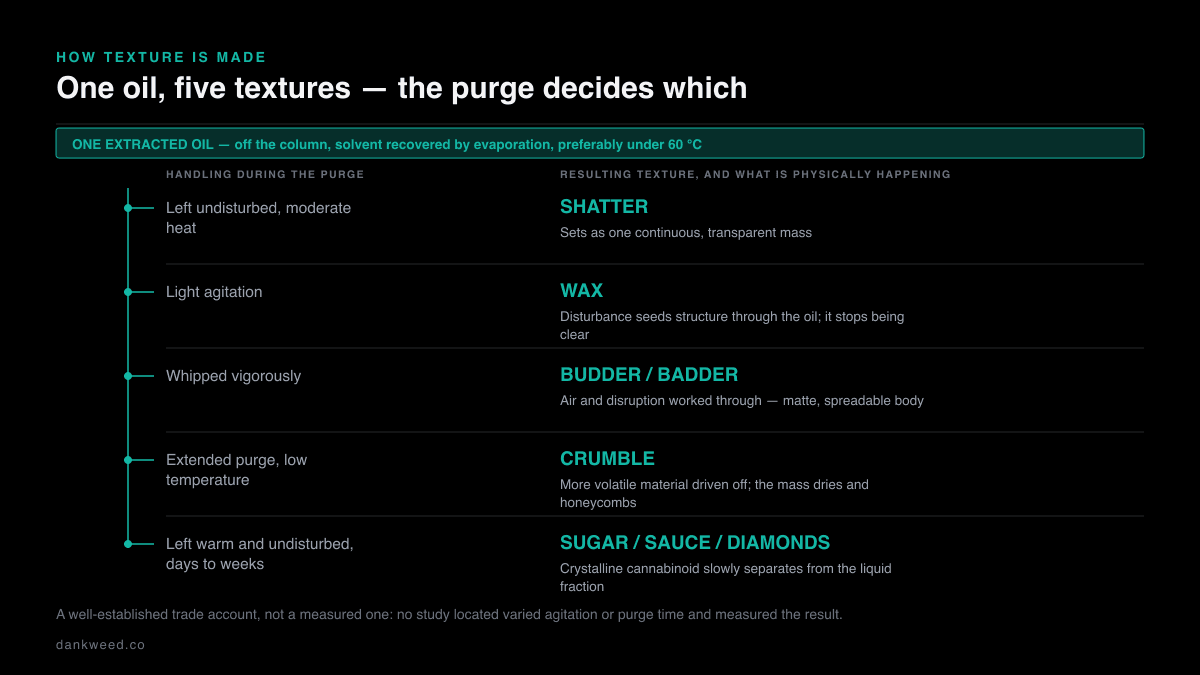
Shatter, wax, budder and crumble are usually the same oil. They come out of the same extraction, and then somebody decides how much to disturb them, how warm to run the purge and how long to leave them under vacuum. What you end up holding is a record of those decisions — not a grade, not a tier, and not a reliable signal of how strong the thing is.
This is the deep version of the texture material in our guide to cannabis concentrates, and a companion to the live resin and live rosin comparison. It covers what makes each texture form, what texture does and does not predict, and why your shatter turned into sugar in the jar.

Key Takeaways
- Texture is a processing outcome. Undisturbed purge gives shatter, agitation gives wax, whipping gives budder, an extended low-temperature purge gives crumble.
- None of these words has a legal or scientific definition. They appear nowhere in the Cannabis Regulations, nowhere in Health Canada’s composition guidance,[11] and in none of the three peer-reviewed extraction reviews we checked.[2][3][4]
- Terpenes are the reason texture and potency move together. Terpenes “moderate cannabinoid viscosity,”[2] so a softer extract is usually one holding more volatile material by weight.
- “Wax” is not plant wax. Plant waxes and lipids are what winterisation removes from an extract.[3] The name describes how it looks.
- Sugaring is crystallisation, not spoilage. THCA forms real crystals — its structure was solved in 1975 from crystals grown by slow evaporation.[1]
- No dataset ranks textures by cleanliness. Testing is the variable that matters, not the consistency in the jar.[6]
What Is the Difference Between Shatter, Wax and Crumble?
Handling, not ingredients. All three usually begin as the same solvent-extracted cannabis oil. Shatter is left undisturbed while the solvent is purged, so it sets as a glassy sheet. Wax and budder are agitated. Crumble is purged low and long until it dries out.
| Texture | What it looks like | How it handles | Best suited to |
|---|---|---|---|
| Shatter | Translucent amber sheet, glassy | Snaps cold, sticky and stringy warm | Storage and clean portioning |
| Wax | Opaque, soft, slightly greasy | Scoops easily, holds shape | Everyday dabbing |
| Budder / badder | Cake-frosting, pale and matte | Spreads, does not shatter or flake | Loading a tool without fuss |
| Crumble | Dry, honeycombed, granular | Breaks apart, sprinkles | Topping flower, joints, bowls |
| Sugar / sauce | Wet crystals in a viscous liquid | Runny, needs a cold tool | Aroma-led dabbing |
| Diamonds | Visible discrete crystals | Hard, dosed by the piece | Pairing back with a terpene fraction |
Two of those are genuinely different from the rest. Sugar, sauce and diamonds are not simply a consistency — they are a real phase separation, where crystalline material has come out of the liquid it was dissolved in. Everything else on the list is one continuous material that has been stirred, warmed and dried to different degrees.
If you take one line from this page, take this one: texture tells you how an extract was handled and how much volatile material it still holds. It does not tell you how strong it is, how clean it is, or how good the plant was.
How Does the Purge Create Each Texture?
The purge is the step where a solvent is driven off under heat and vacuum, and it is also where texture is decided. How much the oil is disturbed while that happens determines whether it sets as a single glassy mass or breaks up into an opaque, aerated one.
| Handling during purge | Result | What is physically happening |
|---|---|---|
| Left undisturbed, moderate heat | Shatter | Material sets as one continuous, transparent mass |
| Light agitation | Wax | Disturbance seeds structure through the oil; it stops being clear |
| Whipped vigorously | Budder / badder | Air and disruption worked through, producing a matte, spreadable body |
| Extended purge at low temperature | Crumble | More volatile material driven off over time; the mass dries and honeycombs |
| Left warm and undisturbed for days or weeks | Sugar, sauce, diamonds | Crystalline cannabinoid slowly separates from the liquid fraction |
The solvent itself is unremarkable in this. Industrial hydrocarbon extraction uses pressurised n-butane or n-propane, and the solvent “is commonly removed by evaporation at temperatures preferably <60 °C to produce a concentrated extract.”[3] Nothing in that sentence specifies a texture. Texture is what the operator does next.
One honest limit on this section. The purge-to-texture mapping above is consistent across the trade and matches what the hub already publishes, but we could not locate a peer-reviewed study that varied agitation, temperature or purge duration and measured the resulting consistency. It is a well-established working account, not a measured one.
Why Does Terpene Content Change the Texture?
Because terpenes are the liquid part. A 2025 review of concentrate chemistry states plainly that terpenes are the second most abundant class of compounds in cannabis concentrates and that they “moderate cannabinoid viscosity.”[2] More volatile material means a softer, wetter extract.
That single fact does a lot of work. An extract that keeps a large volatile fraction stays soft, sticky and prone to moving in the jar. One that has been purged harder or longer loses that fraction, firms up, and becomes easier to snap, flake or crumble.
It also explains why textures drift after they are packaged. Volatiles keep leaving slowly at room temperature, so the same jar keeps getting firmer and more granular with age — which is a real process, and separate from the crystallisation described below.
| Extract holds… | Typical texture | Typical aroma |
|---|---|---|
| A large volatile fraction | Soft, wet, sauce or badder | Loud, specific to the input |
| A moderate fraction | Wax, budder | Present, rounder |
| A small fraction | Shatter, crumble | Quieter, more generic |
| Almost none | Crystalline or brittle | Faint; sold with a separate liquid fraction |
Is Shatter Stronger Than Wax or Crumble?
Not because of the texture. Where a firmer extract tests higher, it is usually because it holds less volatile material by weight, so cannabinoids make up a larger share of what is on the scale. The texture is a symptom of that, not a cause of it.
This matters for a practical reason. Two extracts a few percentage points apart will not feel meaningfully different, and our concentrates guide keeps the published potency ranges for each format alongside the caveat that batches vary considerably. Read the certificate of analysis for the batch in front of you, not the shape of the product.
| Claim about texture | Evidence status |
|---|---|
| Terpenes moderate the viscosity of a concentrate | Stated in the peer-reviewed literature[2] |
| Concentrates span a wide potency range | Measured — one survey of 57 samples reported a broad spread[6] |
| A published dataset pairing texture with potency | Not located in any peer-reviewed source |
| A published dataset pairing texture with residual solvent | Not located |
| “Shatter is the strongest concentrate” | Unsupported as stated — texture is not the variable |
| Colour or clarity indicates quality | Unreliable — very light shatter can be colour-remediated |
Why Did My Shatter Turn Into Sugar?
Because THCA is a crystallisable solid, and it slowly came out of solution. That is a phase change, not decay. The extract has separated into crystalline material sitting in a liquid fraction — the same process producers run deliberately when they make sugar, sauce or diamonds.
The crystallography backs the mechanism up. The crystal and molecular structure of Δ9-tetrahydrocannabinolic acid B was solved in 1975, using a prismatic crystal obtained “only after slow evaporation of a chloroform solution.”[7] Slow evaporation of a solvent is, in outline, what a jar of shatter does over months.
A 2021 review of electron diffraction in cannabinoid research adds two useful details: many cannabinoids are “relatively lower melting solids,” which makes growing large crystals awkward, and “even seemingly amorphous powders often contained enough microcrystals” to be analysed.[1] Clear-looking material is not necessarily crystal-free material.
Scope, stated plainly: those are findings from analytical crystallography, not measurements on commercial extracts. We are using them for the mechanism — cannabinoid acids form real crystals, and clarity is not proof that none are present — and not as a study of shatter.
| What you see | What it is | Should you worry? |
|---|---|---|
| Clear sheet clouding over | Crystallisation beginning | No — it is a phase change |
| Grainy or sandy patches | Crystal growth through the mass | No, though aroma often fades alongside |
| Liquid pooling around solids | Separation into two phases | No — this is what sauce is |
| Extract gone soupy or weeping | Warmth, or moisture picked up | Yes — a storage problem |
| Green tint, dark flecks, fibres | Plant material carried through | Yes — a production problem |
| Chemical or solvent note on opening | Possible under-purge | Yes — check the batch test |
Is Cannabis Wax Made of Plant Wax?
No, and the coincidence of names is a genuinely confusing one. Plant waxes are what producers try to get out of an extract. Non-polar solvents “remove lipid-soluble material such as fats and waxes from the biomass,” and “a winterization step may be required to remove waxes.”[3]
So winterisation exists to strip waxes, while the product called wax is named for looking like one. A jar labelled wax may have been winterised or not; the word tells you nothing either way.
The same applies to “hash oil,” which our hub treats as a legacy umbrella term rather than a distinct product. If a label gives you a texture and nothing else, the useful questions are what the extraction method was and whether there is a batch-specific certificate behind it.
The Texture Stack: What Decides Which One You Get
Four variables set the texture of a solvent extract, and they act in order. Everything else — brand, jar, marketing language — is downstream of these. We use this stack whenever somebody asks why two jars from the same producer look nothing alike.
| # | Variable | What it controls |
|---|---|---|
| 1 | Volatile content of the extract | The baseline. Terpene-rich material cannot be made to sit still[2] |
| 2 | Agitation during the purge | Whether the mass stays continuous and clear or breaks up and turns opaque |
| 3 | Heat, vacuum and time | How much volatile material leaves, and therefore how dry and firm it ends up |
| 4 | Storage temperature and age | Whether it holds that texture, or keeps moving in the jar |
Three consequences follow, and they are the useful ones:
- Texture is a manufacturing readout, not a grade. Every variable in that stack is a processing decision or a storage condition. None of them is a measure of the plant.
- Variable 1 is the ceiling. You cannot whip a dry extract into badder or dry a wet one into shatter without changing what is in it.
- Variable 4 never stops. Texture at the point of sale is a snapshot, which is why the same product looks different two months later.
This is the solvent-side sibling of the no-purification principle that governs pressed extracts, and of the correction-versus-avoidance split in the live resin comparison. Same habit of mind: work out which step actually sets the outcome, then ignore the arguments about everything else.

Is One Texture Cleaner Than Another?
There is no published evidence that it is. The common belief that crumble is purged harder and therefore holds less residual solvent is plausible and entirely unmeasured. We could not locate any dataset that reports residual solvent broken down by finished texture.
What has been measured is less comforting and more useful. A 2015 survey of 57 concentrates from a market that predated mandatory testing reported that “over 80% of the concentrate samples were contaminated in some form,” by residual solvent or pesticide.[6] The paper does not sort that result by consistency, because consistency was never the variable.
On the legal Canadian market, solvent residue testing “would continue to be required any time a solvent is used in the preparation of a cannabis product,” with limits drawn from the publications listed in Schedule B to the Food and Drugs Act.[9] That requirement attaches to the use of a solvent, not to what the finished product looks like.
And the number that actually moves: Health Canada found yeast and mould above reference limits in 6% of legal products against 73% of illegal samples, and Aspergillus in 14% versus 37%.[10] Testing is the variable. Texture is not.
Why Is Live Resin Shatter Uncommon?
Because fresh-frozen input is volatile-rich, and volatile-rich extracts resist setting as a stable glass. Live material is frozen precisely to keep the compounds that drying would drive off — and those are the same compounds that keep an extract soft.
The loss that freezing avoids is published: monoterpenoids are lost during drying and curing, “ranging from 31 to 55.2% when dried at room temperature, depending on the length of the process.”[8] Keep that fraction, and you have material that wants to be sauce or badder rather than a sheet.
Live resin shatter does exist. Producers make it by purging longer or warmer, which costs some of the aroma the freezing was for — the same trade-off the hub notes for live resin crumble. Our live resin and live rosin guide covers what “live” buys you and what it does not.
Labelled as what it is: the link from volatile content to glass stability is a mechanistic explanation drawn from the viscosity statement in reference [2], not a measured result. No study we located pressed the same material into different textures and compared them. Do not let a future edit upgrade this to a finding.
Which Texture Should You Buy?
Buy on how you intend to use it, because that is the only thing texture reliably predicts. Handling, portioning and shelf stability genuinely differ. Potency, cleanliness and input quality do not follow from the shape in the jar.
| If you want… | Look at | Why |
|---|---|---|
| Something that keeps well on a shelf | Shatter | Low surface area and little left to evaporate |
| To scoop and portion without tools | Crumble or budder | Breaks and spreads instead of stringing |
| To add it to flower | Crumble | Distributes evenly over a bowl or into a joint |
| Maximum aroma | Sauce or badder | The volatile fraction is still there |
| Easy everyday dabbing | Wax or budder | Forgiving on a warm tool, no snapping or running |
| Proof it is clean | No texture | Read the batch certificate instead[9] |
Naming the tension, since we sell this: we stock several of these textures and this page does not tell you one of them is better. It says texture is a handling choice. If that costs us an upsell on the glossiest jar on the shelf, so be it — the alternative is a page that contradicts our own concentrates guide.
How Should You Store and Dab Them?
Cold, dark and sealed, and opened as little as you can manage. The volatile fraction is the first thing to leave, and it takes both aroma and the texture you paid for with it. Temperature cycling is the specific thing to avoid.
- Storage — glass, airtight, cool and dark. Let a jar come up to room temperature before opening so condensation does not form on the extract.
- Temperature cycling — repeated warming and cooling accelerates texture change. Our storage guide covers why oxygen and warmth do the damage.
- Dab temperature — lower is better. Published work reports methacrolein “undetectable at 322 °C” and rising sharply above it, against forum-typical use “between 340 °C and 482 °C.”[2]
- Portioning — a cold tool and a cool banger for anything wet, a slightly warmed tool for anything glassy. That is most of the practical difference between these formats.
Start with far less than you would use of flower. In a survey of 5,922 concentrate users drawn from a sample of 181,870, respondents reported that the concentrate produced “more negative effects and fewer positive effects” than herbal cannabis.[5] Self-reported and cross-sectional, but it points the same way every dosing conversation does.

Where Canadian Law Sits
Texture is invisible to Canadian cannabis law. The rules govern how much THC a container may hold, how big it may be, what may be added and whether a solvent was used. Nothing in them describes or restricts a consistency.
| Rule | What it says |
|---|---|
| Texture terms in the regulations | None. Shatter, wax, budder and crumble appear nowhere[11] |
| THC per immediate container | 1,000 mg for cannabis extracts[11] |
| Net weight, inhaled extracts | 7.5 g maximum per immediate container[11] |
| Ingredients permitted in an extract | Carrier substances, flavouring agents and stability substances only[9] |
| Residual solvent testing | Required any time a solvent is used in preparation[9] |
| Hydrocarbon extraction at home | Prohibited — altering cannabis with an organic solvent[12] |
| Public possession | 30 g dried equivalent in a public place[12] |
| Provincial variation | Quebec prohibits home cultivation outright[12] |
The same two caveats as everywhere else on this site. Cannabis law in Canada is federal and provincial at once, and this is general information rather than legal advice. One practical note alongside them: butane is rated at the top of the fire scale in the industrial extraction literature,[3] which is why closed-loop equipment exists and why this is not a kitchen project.
Frequently Asked Questions
What is the difference between shatter, wax and crumble?
They are usually the same solvent-extracted oil handled differently during the purge. Shatter is left undisturbed and sets as a glassy sheet. Wax and budder are agitated or whipped, which makes them opaque and soft. Crumble gets an extended low-temperature purge until it dries out and breaks apart.
Is shatter stronger than wax?
Not because it is shatter. Where a firmer extract tests higher, it is generally holding less volatile material by weight, so cannabinoids make up more of the total. Texture is a symptom of that rather than a cause. Read the batch certificate instead of judging by consistency.
Why did my shatter turn into sugar?
It crystallised. Cannabinoid acids form genuine crystals, and over time they come out of the liquid fraction they were dissolved in, clouding a clear sheet and then turning it grainy. That is a phase change rather than spoilage, and it is the same process producers use deliberately to make sauce.
What are crumble dabs?
Dabs taken from crumble-texture extract. The dry, granular consistency is the easiest of these formats to portion without a tool, which is why it also gets sprinkled over flower. Nothing about the texture changes how it should be dabbed — lower temperatures still produce fewer degradation products.
Is cannabis wax made from plant wax?
No. Plant waxes and lipids are what a winterisation step exists to remove from an extract, and the product called wax is named for how it looks rather than what it contains. A jar labelled wax may or may not have been winterised, and the word itself tells you neither way.
Is crumble cleaner than shatter?
There is no published evidence for that. The belief comes from crumble receiving a longer purge, which is plausible, but we could not locate any dataset reporting residual solvent by finished texture. On the legal market, testing is required whenever a solvent is used, and that is the real variable.
What is live resin shatter?
Shatter made from fresh-frozen plant material rather than dried and cured flower. It is uncommon because freezing preserves the volatile fraction, and volatile-rich extracts resist setting as a stable glass. Producers who make it purge longer or warmer, which gives back some of the aroma the freezing was meant to keep.
Does texture tell you anything about quality?
It reliably predicts handling and shelf stability, and very little else. Colour and clarity are not quality signals either — some very light shatter has been colour remediated. The useful signals are a batch-specific certificate of analysis, an aroma that smells like a plant, and a stable consistency.
Do shatter, wax and crumble have legal definitions in Canada?
No. None of those words appears in the Cannabis Regulations or in Health Canada’s guidance on composition requirements, and none of the peer-reviewed extraction reviews we checked uses them either. They are trade and consumer vocabulary, describing appearance, and nobody audits the terms.
How should you store shatter, wax and crumble?
Cold, dark, airtight and opened as little as possible, in glass rather than plastic. Let a jar warm to room temperature before opening so condensation does not form on the extract. Repeated warming and cooling is the specific thing to avoid, because it accelerates texture change.
References
- Filer, C. N. MicroED and cannabinoid research. Journal of Cannabis Research, 2021, 3, 14. DOI: 10.1186/s42238-021-00070-4 Full text read this run. Source of the statements that many cannabinoids are “relatively lower melting solids” for which obtaining large crystals “has been a practical limitation,” and that “even seemingly amorphous powders often contained enough microcrystals of a substance to support this new method.” This is analytical crystallography, not a study of commercial extracts — it is cited here for the mechanism only.
- Munger, K. R., Anreise, K. M., & Strongin, R. M. Cannabis concentrate vaping chemistry. Frontiers in Toxicology, 2025, 7, 1568207. DOI: 10.3389/ftox.2025.1568207 Full text re-read this run. Source of the verbatim statement that terpenes are the second most abundant class of compounds in cannabis concentrates and “moderate cannabinoid viscosity,” of the dabbing temperature range (“between 340°C and 482°C”) and of the methacrolein series (185 ppb at 526 °C, 157 at 455 °C, 131 at 403 °C, undetectable at 322 °C), which is the same underlying measurement as Meehan-Atrash, Luo & Strongin, ACS Omega 2017, from the same laboratory. Checked this run for definitions of shatter, wax, budder or crumble: the review defines BHO and rosin and does not use any of those four words.
- López-Olmos, C., García-Valverde, M. T., Hidalgo, J., Ferrerio-Vera, C., & Sánchez de Medina, V. Comprehensive comparison of industrial cannabinoid extraction techniques: Evaluation of the most relevant patents and studies at pilot scale. Frontiers in Natural Products, 2022, 1, 1043147. DOI: 10.3389/fntpr.2022.1043147 Full text re-read this run. Source of the verbatim statements that “non-polar solvents remove lipid-soluble material such as fats and waxes from the biomass,” that “a winterization step may be required to remove waxes,” that solvent “is commonly removed by evaporation at temperatures preferably < 60°C,” and of the butane NFPA Fire Rating 4 classification. A review of patents and pilot-scale studies. Checked this run: it does not use the words shatter, wax, budder or crumble as product names.
- Pourseyed Lazarjani, M., Young, O., Kebede, L., & Seyfoddin, A. Processing and extraction methods of medicinal cannabis: a narrative review. Journal of Cannabis Research, 2021, 3, 32. DOI: 10.1186/s42238-021-00087-9 Full text re-read this run specifically to check its vocabulary. The review covers drying, conventional extraction, ultrasonic and microwave assistance and supercritical CO₂, and contains no occurrence of shatter, wax, budder, crumble, winterization, dewaxing, purging or vacuum oven. A narrative review, not primary measurement.
- Chan, G. C. K., Hall, W., Freeman, T. P., Ferris, J., Kelly, A. B., & Winstock, A. User characteristics and effect profile of Butane Hash Oil: An extremely high-potency cannabis concentrate. Drug and Alcohol Dependence, 2017, 178, 32–38. DOI: 10.1016/j.drugalcdep.2017.04.014 Accepted manuscript read in full via a university institutional repository; ScienceDirect is unreachable from this run. Global Drug Survey 2014–2015, 181,870 respondents, of whom 5,922 reported BHO use. Source of the self-reported finding that BHO produced “more negative effects and fewer positive effects” than herbal cannabis, and of the observation that the product is “commonly referred to as ‘earwax’, ‘dabs’, ‘butter’ and ‘shatter'” — the only peer-reviewed use of this vocabulary located in this run. The paper also reports higher rates of self-reported lifetime depression and anxiety diagnoses among BHO users; that is cross-sectional self-report which cannot establish direction or cause, and it is deliberately not used in the body of this article.
- Raber, J. C., Elzinga, S., & Kaplan, C. Understanding dabs: contamination concerns of cannabis concentrates and cannabinoid transfer during the act of dabbing. The Journal of Toxicological Sciences, 2015, 40(6), 797–803. DOI: 10.2131/jts.40.797 57 samples from the 2015 California medical market, which predates that state’s mandatory testing regime. Source of the verbatim finding that “over 80% of the concentrate samples were contaminated in some form.” The study does not break its results down by finished texture. Provenance note: jstage.jst.go.jp was unreachable on two URL forms this run, so this entry is cited from our own verified source library, where it was recorded from the publisher full text on 22 August 2026.
- Rosenqvist, E., & Ottersen, T. The crystal and molecular structure of Δ9-tetrahydrocannabinolic acid B. Acta Chemica Scandinavica B, 1975, 29, 379–384. ⚠️ Cited VIA reference [1], not read directly — actachemscand.org is robots-disallowed from this run. Reference [1] reports the citation and the verbatim detail that “a suitable prismatic crystal of dimensions 0.45 × 0.30 × 0.12 mm was required” and was obtained “only after slow evaporation of a chloroform solution.” Used here solely to establish that the acid form crystallises; no other finding is drawn from it.
- Russo, E. B., Plumb, J., & Whiteley, V. L. Novel Solventless Extraction Technique to Preserve Cannabinoid and Terpenoid Profiles of Fresh Cannabis Inflorescence. Molecules, 2021, 26(18), 5496. DOI: 10.3390/molecules26185496 Source of the verbatim monoterpenoid-loss statement, “ranging from 31 to 55.2% when dried at room temperature, depending on the length of the process,” which the paper attributes to a prior source. Cited here for why fresh-frozen input is volatile-rich. Note that a separate 2020 review reports a closely similar band for open storage, citing a 1996 measurement — the two may share an origin and are never presented here as independent confirmation. Provenance: recorded from the publisher full text on 24 August 2026.
- Government of Canada. Canada Gazette, Part I, Volume 152, Number 51: Regulations Amending the Cannabis Regulations (New Classes of Cannabis) — Regulatory Impact Analysis Statement. 22 December 2018. gazette.gc.ca Source of the verbatim requirement that “Solvent residue testing would continue to be required any time a solvent is used in the preparation of a cannabis product,” of the statement that limits are those in the publications listed in Schedule B to the Food and Drugs Act, and of the permitted-ingredient rule for extracts. Provenance note: gazette.gc.ca was unreachable on two URL forms this run, so this entry is cited from our own verified source library, where it was recorded from the page on 24 August 2026. Health Canada’s standalone residual-solvent limits page is archived and its ppm figures are deliberately not quoted anywhere here.
- Health Canada. Cannabis Data Gathering Program: A comparison of legal and illegal dried cannabis products. Government of Canada, 21 February 2025. canada.ca Yeast and mould above reference limits in 6% of legal products versus 73% of illegal samples; Aspergillus spp. in 14% versus 37%. Figures are for dried flower, which is the input to the extracts discussed here. Provenance note: canada.ca was unreachable this run; cited from our verified source library.
- Health Canada. Guide on composition requirements for cannabis products. Government of Canada. Extracts capped at 1,000 mg THC per immediate container; inhaled extracts capped at 7.5 g net weight. Checked against our library record for any occurrence of shatter, wax, budder, crumble or a consistency requirement — none appears. Provenance note: canada.ca was unreachable on two URL forms this run, so this entry is cited from our verified source library, where the guidance was recorded from the publisher page and last confirmed on 24 August 2026.
- Cannabis Act (S.C. 2018, c. 16), ss. 8(1)(a), 10(1) and 12; Cannabis Regulation Act (Quebec), CQLR c. C-5.3, s. 10. Provenance note: laws-lois.justice.gc.ca was not reachable from this run, so the statutory wording is taken from our own verified source library entry, confirmed against the official consolidation on 21 August 2026. Section 12(1)(b) with s. 12(3) prohibits altering cannabis by the use of an organic solvent, which is what catches home hydrocarbon extraction. Verify against the current consolidation before print use.
This article is for informational and harm-reduction purposes only and is not medical advice. Cannabis affects individuals differently. Concentrates are significantly more potent than flower — begin with a very small amount. Follow the cannabis laws applicable in your jurisdiction.