
Harvesting, drying, trimming and curing decide more about how cannabis smells and smokes than almost anything that happens earlier. Most of the advice online is folklore that has never been checked against a measurement. Some of it turns out to be looking at the wrong part of the plant.
This guide covers when to harvest weed and what the evidence actually supports, whether trichome colour predicts potency, how to trim it and when, how to dry weed without stripping the smell out of it, how to cure weed without growing mould, and what Canadian law says about growing weed at home. Where the popular rule is unsupported, it says so and shows the study.

Key Takeaways
- The clear-cloudy-amber trichome rule was finally tested against measured cannabinoid content in 2026 — and the milky stage, the one every grow guide tells you to cut at, tracked almost nothing. Amber coverage tracked declining content; one CBDA-dominant cultivar, so read it as a first result rather than a law.[21]
- Stigma colour has been validated more broadly. Across 25 genotypes, 22 peaked in cannabinoid concentration at the “mostly amber” to “fully amber” stigma stages.[2]
- “Amber means CBN means couchlock” fails twice. Nobody has measured CBN in amber heads on a living plant, and the CBN-sedation claim is judged unsupported by the only dedicated review of it.[4]
- Within a normal harvest window, yield moves and potency mostly does not. One trial found concentration statistically flat from week 5 to week 11 while flower dry weight more than tripled.[5]
- Leaving it too long costs you. Total THC has been measured rising to a maximum and then declining toward senescence.[6]
- Wet trim and dry trim are a real trade-off. Mild pre-drying trimming gave the highest cannabinoid concentration; post-drying trimming gave the highest terpene content.[7]
- Drying method barely changes total cannabinoids but strongly changes mould risk. Hot-air drying cut yeast and mould by up to 2 log versus ambient drying.[9]
- Four cannabis plants per dwelling-house, not per person — Cannabis Act s. 12. Quebec still prohibits home cultivation outright; Manitoba’s ban ended 1 May 2025.[13]
When Should You Harvest Cannabis?
Somewhere in a window several weeks wide, and the exact week is cultivar-specific rather than universal. Peer-reviewed harvest-timing trials consistently show that different chemotypes reach peak cannabinoid production at different times, so no single flowering-week number is correct.
A weekly time-course study across seven plants of three chemotypes reported that the THCA/CBDA ratio was fixed from the outset and stable through growth, but that CBD-dominant and mixed chemotypes needed more time than THC-dominant ones to reach peak cannabinoid and monoterpene production.[8] The date is a property of the plant, not of the calendar.
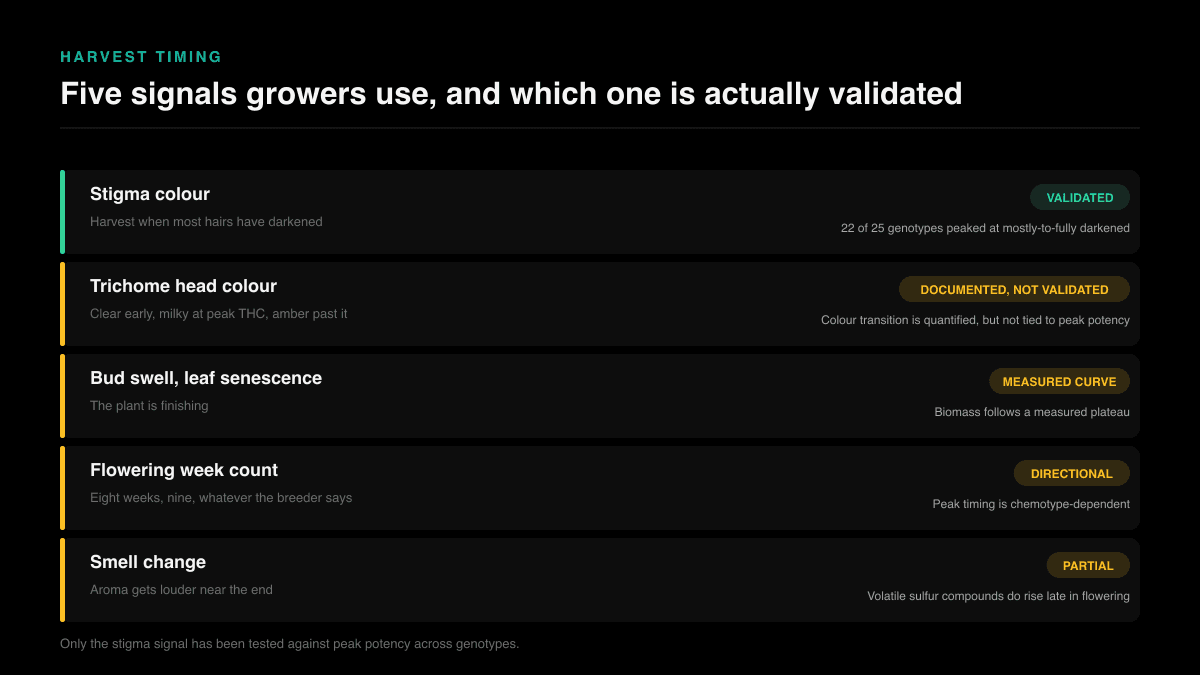
Anyone searching for when to harvest cannabis wants a week number, and the literature does not supply one. The more useful framing is that harvesting cannabis is a compromise between four things, three of which have actually been measured. That framework is in the section below. First, the two visual rules everybody uses, and what the literature does and does not say about them.
| Harvest signal | What growers say it means | Evidence status |
|---|---|---|
| Trichome head colour (clear, milky, amber) | Clear is early, milky is peak THC, amber is past peak | Colour transition documented and quantified;[1] tested against measured content once, in 2026 — the “amber is past peak” half held, the “milky is peak” half did not[21] |
| Stigma colour (the “hairs” going white to amber) | Roughly, harvest when most have darkened | Validated — 22 of 25 genotypes peaked at mostly-to-fully amber stigmas[2] |
| Flowering week count | Eight weeks, nine weeks, whatever the breeder says | Directionally useful; peak timing is chemotype-dependent[8] |
| Bud swell and leaf senescence | Plant is finishing | Biomass accumulation follows a measured plateau curve[6] |
| Smell change | Aroma gets louder near the end | Volatile sulfur compounds do rise late in flowering and peak during curing[12] |
Do Trichome Colours Actually Tell You When to Harvest?
The colour change is real and measurable. Until 2026 the link to cannabinoid potency had never been tested. It now has been, once — and the milky stage that every grow guide tells you to cut at was the colour that tracked nothing.
The best quantitative work on the transition itself is Punja, Sutton and Kim’s 2023 study of glandular trichome development. Working in CIELAB colour space, they reported “a significant decrease in translucency values accompanied by a significant increase in red score values progressing from weeks 3, 5, and 7 of flowering time.”[1] Heads were visibly brown by week 8. The progression is not folklore.
The gap, and how it closed: that study did not measure cannabinoid concentration during development, so on its own it cannot link a colour to a potency. A 2026 study finally measured both in the same flowers. It found amber coverage tracking falling cannabinoid content, clear coverage tracking rising content, and the milky proportion explaining almost none of the variation.[21] The figures, the staging scheme and the scope limits are in our guide to when to harvest cannabis.
Read the scope before the result, because it is narrow. That was a single CBDA-dominant cultivar, measuring CBDA rather than THC, reporting an association rather than a cause, and its authors state that their harvest window should not be generalised to other chemotypes without further validation.[21] Nobody has run the equivalent experiment on a THC-dominant plant.
The 2023 authors also attribute the browning to a physical process rather than a chemical one. From around week five the heads exude resin droplets, clump together, and their cuticles collapse.[1] That is head senescence and mechanical change, which is a different thing from the resin inside having converted into something else.
What has been validated more broadly: stigma colour
Tran and colleagues scored 25 genotypes across four stigma stages — fully white, some amber, mostly amber, fully amber — validated the manual scores with automated colour analysis, and measured 14 cannabinoids by LC-MS in the same material. Twenty-two of the 25 peaked in cannabinoid concentration between the mostly-amber and fully-amber stages.[2]
That is the rule with evidence behind it across many genotypes, and it is about the stigmas, not the resin heads. The authors note that trichome colour is used elsewhere as a maturity indicator but did not analyse it themselves.[2] Three genotypes out of 25 peaked earlier, so even the validated rule is a strong default rather than a law.
| Stigma stage | Description | Genotypes peaking here[2] |
|---|---|---|
| Stage 1 | Fully white | A small minority |
| Stage 2 | Some amber | A small minority |
| Stage 3 | Mostly amber | 22 of 25 combined across stages 3 and 4 |
| Stage 4 | Fully amber |
Three of the 25 genotypes peaked in stages 1 or 2, which is why the paper recommends per-genotype optimisation rather than a universal stage.
Do Amber Trichomes Mean More CBN and a Heavier Effect?
Two claims are stacked here and both are unsupported. Nobody has measured CBN in amber versus milky heads on a living plant, and the belief that CBN produces sedation is contradicted by the human study most often cited for it.
Take the second claim first, because it is the load-bearing one. Karniol and colleagues gave five volunteers placebo, CBN alone, THC alone, and both together. Subjects reported feeling “drugged, drunk, dizzy, and drowsy under the delta9-THC condition, but not under the CBN condition.” CBN alone did not raise heart rate and did not alter time perception.[3]
The only dedicated review of CBN and sleep reached the same place. It found the human literature “dated and limited,” identified no published clinical trials using validated sleep questionnaires or polysomnography, and concluded there is “insufficient published evidence to support sleep-related claims.”[4]
The newest data does not rescue the claim either. A 2026 randomised, placebo-controlled crossover trial of single-dose CBN at 30 mg and 300 mg in adults with insomnia disorder did not meet its primary endpoint.[14] Note the doses — hundreds of milligrams, which is not a quantity present in aged flower.
| Popular claim | What the evidence shows |
|---|---|
| Amber heads are THC that has oxidised into CBN | No study measures CBN by head colour on a living plant — the 2026 study that did measure content by colour measured CBDA.[21] Browning is attributed to resin exudation and cuticle collapse[1] |
| CBN is the sedating cannabinoid | In the classic human study, drowsiness was reported under THC and not under CBN[3] |
| CBN is why late-harvest flower feels heavier | Review found insufficient published evidence for sleep-related claims[4] |
| Harvest later for a more relaxing effect profile | No study has linked harvest timing to reported effects in humans. This is untested, not disproven |
| Harvest earlier for a brighter, more energetic effect | Same. Terpene profile does shift with timing,[8] but the effect claim is unmeasured |
It is worth being precise about what is being said. The claim is not proven false — it is untested. Late-harvest flower plausibly has a different terpene profile, and terpene profiles plausibly matter. But nobody has run the experiment, and a confident claim built on two unmeasured links is not a finding.
What Actually Changes If You Harvest Late?
Yield rises and then plateaus. Concentration stays remarkably flat across the practical window. Push past the window and measured cannabinoid content starts to fall. Mould risk rises the whole time.
Massuela and colleagues harvested a CBD-type genotype at 5, 7, 9 and 11 weeks of flowering. Inflorescence dry weight climbed from 7.7 g to 25.1 g per plant. Total CBD concentration stayed between 7.62% and 8.88% with no significant differences between harvest dates.[5] Total CBD yield rose from 415 mg to 1,335 mg per plant, but week 9 already delivered 1,242 mg.
That is a four-week window in which what changed was how much flower there was, not how strong it was. It is a CBD-dominant genotype and a single trial, so read it as direction rather than as a constant — but the direction is clear and it is not what the grow guides imply.
The other half of the picture is what happens if you keep waiting. Linder and colleagues harvested two hemp cultivars every two weeks over twelve weeks and measured total THC rising to a maximum and then decreasing as the plants approached senescence.[6] These are low-THC hemp cultivars, so the absolute numbers do not transfer, but the shape of the curve is the point.
| What changes with a later harvest | Direction | Evidence |
|---|---|---|
| Flower biomass | Rises, then plateaus | 7.7 g to 25.1 g dry weight across weeks 5 to 11[5]; biomass plateau measured at roughly 74 days after floral initiation[6] |
| Cannabinoid concentration | Roughly flat, then falls | No significant difference weeks 5-11;[5] total THC peaks then declines toward senescence[6] |
| Total cannabinoid yield | Rises, then plateaus | 415 mg to 1,335 mg per plant; week 9 already at 1,242 mg[5] |
| Terpene and sulfur profile | Shifts | Monoterpene accumulation follows a different schedule from cannabinoids[8] |
| Mould and pathogen risk | Rises | More time on the plant, denser flower, more trapped moisture[10] |
| Position on the plant | Always uneven | Top fraction 9.9% CBD, mid 8.2%, low 7.7% in the same plants[5] |
What Are You Really Trading Off at Harvest?
Four things, and only three of them have ever been measured. Yield, cannabinoid concentration, and terpene profile are all documented against harvest timing. Effect profile — the thing the folklore is actually about — is not.
We call this the harvest trade-off stack. It is the cultivation sibling of the frameworks we use elsewhere on this site: the dose-uncertainty stack in the edibles guide and the smell-loss stack in the storage guide. Same idea, different failure mode.
| # | Axis | How it behaves | Measured? |
|---|---|---|---|
| 1 | Yield | Rises steeply, then plateaus. The single biggest thing a late harvest buys you | Yes[5][6] |
| 2 | Cannabinoid concentration | Nearly flat across the practical window; declines at senescence | Yes[5][6] |
| 3 | Terpene and VSC profile | Accumulates on its own schedule and starts leaving the moment you cut | Yes[8][12] |
| 4 | Microbial risk | Rises with time on the plant and with how slowly you dry | Yes[9][10] |
| — | Effect profile | The reason people obsess over trichome colour | No |
The practical upshot: optimise for the axes that have numbers. Harvest inside the window your cultivar indicates, dry it carefully, and accept that the “cut at 20% amber for a heavier finish” advice is a preference dressed as a specification. Choosing a harvest date to hit an unmeasured target is guessing with extra steps.
Should You Trim Before or After Drying?
Trim before drying for cannabinoid concentration, after drying for aroma. That is not a slogan — it is what a controlled comparison found, and the two goals genuinely pull in opposite directions.
Brikenstein and colleagues compared mild wet trimming, aggressive wet trimming and dry trimming on a single hybrid chemovar. Mild pre-drying trimming produced the highest cannabinoid concentration. Post-drying trimming produced the highest terpene content. Their conclusion was that growers “face a decision,” because “optimizing for both simultaneously appears to be difficult.”[7]
There is a third consideration the trimming paper does not cover, and it points the same way as dry trimming. In a separate study of over 2,000 samples, hang-drying whole stems produced significantly lower yeast and mould counts than machine wet-trimming onto racks.[10] Slower airflow around trimmed, exposed flower is not an advantage.
| Approach | What it is | Measured advantage | Measured cost |
|---|---|---|---|
| Mild wet trim | Stems removed, sugar leaves trimmed part way, before drying | Highest cannabinoid concentration[7] | Lower terpene content than dry trimming |
| Aggressive wet trim | All sugar leaves removed before drying | Fastest drying; cleanest look | Lower cannabinoids than mild wet trim[7]; higher yeast and mould than hang-drying[10] |
| Dry trim | Hang whole, trim after drying | Highest terpene content[7]; lower microbial load[10] | Slightly lower cannabinoid concentration; slower, messier work |
The trimming comparison used one cultivar under one drying regime with relative humidity below 10%. Read the direction, not the decimal.
Does Hand Trimming Beat Machine Trimming?
On the visual evidence, yes — but nobody has put a number on the cost. Scanning electron microscopy shows machine-trimmed flower with glandular heads detached and collapsed where hand-trimmed flower has them intact.
The comparison is unusually direct. Punja, Sutton and Kim imaged both under SEM and reported that in hand-trimmed samples “glandular heads were intact and there was little evidence of physical damage,” while in machine-trimmed samples “many glandular heads had become detached or were collapsed, leaving behind the bare stalks.”[1]
Where the evidence stops: that finding is descriptive. There are no counts, no percentages, no statistical test, and no cannabinoid assay tied to trimming method. Anyone quoting you a figure like “machine trimming costs 15% of your THC” is inventing it. What the images support is that machine trimming visibly detaches resin heads. That is enough to act on without inflating it.
The same logic applies to everything downstream. Handling knocks resin heads off, which is why over-handling dried flower is a slow leak, and why the way you break it up matters — covered in the grinder guide rather than restated here.

How Do You Dry Cannabis Properly?
Slowly, in the dark, with air movement, at a controlled temperature and humidity. Published trials of conventional drying cluster around 15 to 25 °C at 45 to 55% relative humidity, over roughly five days to two weeks.
Those are not folk numbers. Punja and colleagues dried at 21 to 23 °C and 50 to 55% relative humidity over five to seven days, with the sharpest moisture decline between days four and six.[10] Birenboim and colleagues state their open-air reference ran at 15 °C in a room at 50 to 55% relative humidity for 14 days.[11]
Two other published conditions bracket the range usefully. Spadafora and colleagues tray-dried at 18 °C and 55% relative humidity for six days.[16] Baek and colleagues ran ambient drying at 25 °C and 45% relative humidity over one week, taking moisture from roughly 77 to 81% down to under 7%.[9]
| Published drying condition | Temperature | Relative humidity | Duration |
|---|---|---|---|
| Commercial hang-dry, whole stems[10] | 21-23 °C | 50-55% | 5-7 days |
| Open-air reference[11] | 15 °C | 50-55% | 14 days, plus 1 day curing |
| Tray drying[16] | 18 °C | 55% | 6 days |
| Ambient air[9] | 25 °C | 45% | 7 days |
| Hot air[9] | 75 °C | ~45% | 8 hours |
| Controlled atmosphere, nitrogen[11] | 15 °C | Below 10% | 6 days |
These are research conditions, reported so you can see the real spread. The consistent features across all of them are darkness, air movement, and controlled humidity. Drying cannabis is a humidity problem before it is a time problem, which is why “how long to dry” has no fixed answer.
The endpoint you are drying to
The finish line is a moisture level, not a day count. The ASTM specification for dry cannabis flower is a water activity of 0.55 to 0.65,[15] which is the same range two-way humidity packs are built around. One large survey pairs that with a moisture content of roughly 12 to 14% and warns that inadequate drying significantly raises yeast and mould counts.[10]
Does the Drying Method Change Potency?
Barely. A three-way comparison of hot-air, ambient and freeze drying found no significant difference in total cannabinoid content. What the method does change is decarboxylation, aroma and microbial load — and those changes are large.

Baek and colleagues reported that “the drying methods did not significantly influence the total cannabinoid contents (p > 0.01).”[9] Hot air at 75 °C decarboxylated 8.5 to 9.0% of the acid cannabinoids and achieved up to a 2-log reduction in yeast and mould. Ambient and freeze drying left the cannabinoids largely in acid form.
Aroma is where the methods separate hardest. Spadafora and colleagues compared freeze drying against tray drying and found freeze drying reduced 45 metabolites including 28 terpenes — myrcene, pinene, limonene and terpinolene all came out lower than in tray-dried material.[16] Freeze drying preserves cannabinoids and prevents decarboxylation; it costs you smell.
| Method | Total cannabinoids | Decarboxylation | Aroma | Mould control |
|---|---|---|---|---|
| Ambient / hang dry | No significant difference[9] | Low; under 2% further change in cure[9] | Best preserved of the three[16] | Weakest — highest counts of the three[9] |
| Hot air, 75 °C | No significant difference[9] | 8.5-9.0%[9] | Not reported in that trial | Up to 2-log reduction[9] |
| Freeze drying | No significant difference[9] | Prevented[16] | 45 metabolites reduced, incl. 28 terpenes[16] | Better than ambient[9] |
| Controlled atmosphere | Larger THC increase than open air[11] | 40-70% THC increase vs 3.5-fold open air[11] | Best monoterpene retention of the arms tested[11] | No visible mould, vs ~80% of one open-air chemovar infested[11] |
The honest summary for a home grower with a spare closet: you are not going to beat the potency of a careful ambient dry by getting clever, and the two things genuinely worth controlling are humidity and airflow. Everything else on that table requires equipment.
What Does Curing Actually Do?
Curing cannabis is a slow moisture equalisation in a sealed container after drying. Measurably, it finishes the aroma, redistributes moisture from the interior of the flower outward, and adds only a small amount of further decarboxylation.
The aroma point is the one with the best data behind it. In the study that identified the compounds behind the skunk note, plants were hung to cure and dry for 11 days at roughly 22 °C and 45% relative humidity, and the volatile sulfur compounds “reached a maximum at the end of this process.”[12] The loudest a flower will ever smell is the end of its cure.
Then it starts leaving. The same work jarred the flower at room temperature and measured a final data point ten days later, which “showed a substantial decrease in all VSC concentrations.”[12] Curing builds the smell; storage is a holding action against losing it, which is the subject of our storage guide.
The moisture side is more mundane and more useful, and it is widely misread. Curing moves moisture toward an equilibrium with the surrounding air rather than simply adding water. Across the treatments in a controlled three-week sealed cure of industrial hemp, the increases ranged from 3.3% to 13.6% — a span of increase magnitudes across arms, not a start point and an end point. The hot-air-dried material went from 5.8% up to 12.1% in Mylar bags and 15.8% in glass jars. The ambient air-dried arm moved the other way, showing a decrease from 16.5% to 13.6%, because it was jarred wetter than the equilibrium.[9]
The authors attribute the gains to “the slow moisture pick up by the dried hemp from the air to reach the equilibrium moisture content,” which is why flower jarred too wet comes out drier than it went in. The findings worth keeping from that cure are the other two: total cannabinoid content stayed stable, and further decarboxylation stayed under 2%. The paper reports the influence of curing method as not significant, though within the hot-air arm the glass jars finished higher than the Mylar bags.[9]
| Claim about curing | Evidence status |
|---|---|
| Curing evens out moisture through the flower | Measured — moisture moves toward an equilibrium: increases of 3.3% to 13.6% across treatments, and one arm went in at 16.5% and came out at 13.6%[9] |
| Aroma peaks at the end of the cure | Measured — VSCs reached a maximum at the end of an 11-day cure[12] |
| Curing continues to convert THCA to THC | Measured, and small — under 2% additional decarboxylation[9] |
| Curing raises total cannabinoid content | Not supported — total cannabinoids did not change during curing[9] |
| Curing breaks down chlorophyll, which is why it smokes smoother | Unmeasured. A near-universal grower belief with no peer-reviewed measurement behind it that we could locate. Every source tracing back to a vendor blog |
| Glass jars beat Mylar bags for curing | Not supported — no significant difference between them[9] |
How Long Should You Cure Cannabis?
There is no published answer. Nobody has run a dose-response study of cure duration against chemical or sensory quality. The confident numbers you see — two weeks minimum, four weeks better, peaks at thirty days — have no study behind them.
What exists are the durations individual studies happened to use. Baek and colleagues cured for three weeks in sealed jars and reported stable cannabinoids and rising moisture.[9] Oswald and colleagues hung for 11 days.[12] Birenboim and colleagues used a single day with desiccant after controlled-atmosphere drying.[11] None of those is an optimum; they are just what the protocol called for.
So the honest guidance is procedural rather than numeric. Cure in a sealed opaque container in the dark. Open it briefly each day for the first week or so — the practice usually called burping — to release accumulated moisture and check for any smell of ammonia or damp, which means the flower went into the jar too wet.
| Cure step | What you are doing | What to watch for |
|---|---|---|
| Jar at the right dryness | Target water activity 0.55-0.65[15] | Stems that bend rather than snap mean it is still too wet for a sealed jar |
| Fill sensibly | Roughly three-quarters full, loose, not packed | Compressed flower traps moisture in the middle |
| Burp daily, week one | Open for a few minutes, let humid air out | Any ammonia smell means anaerobic activity — open it up and dry further |
| Burp less often, week two onward | Every few days, then weekly | Humidity in the jar should settle and stop climbing after each close |
| Verify, do not guess | A cheap hygrometer in the jar[15] | Readings drifting above roughly 65% mean mould risk, not a good cure |
| Hand off to storage | Sealed, opaque, cool, dark, humidity pack | See the storage guide for everything past this point |

How Do You Avoid Mould When Drying and Curing?
Dry faster in moving air, hang whole stems rather than trimming onto racks, and get the moisture down to spec before sealing anything. Mould is the one failure mode in this whole process with a documented health consequence.
The handling difference is measurable. Across more than 2,000 samples over three years, hang-drying entire stems produced significantly lower yeast and mould counts than the wet-trim method, and fan air circulation during flower maturation also significantly reduced counts.[10] Fresh samples ran 10,000 to 100,000 CFU/g; properly dried samples mostly under 5,000.
Drying speed matters too. In the three-way method comparison, hot-air drying achieved up to a 2-log reduction in yeast and mould relative to the ambient and freeze-dried arms, which had the highest contamination.[9] Slow and gentle is good for aroma and worse for microbiology. That is a real tension, not a solvable one. Drying weed too slowly, in still air, is the most common way a home crop is lost.
Why it matters: a review of fungal contaminants in cannabis and hemp documents Aspergillus and Penicillium species as common inhabitants of inflorescences, records case reports of pulmonary and disseminated aspergillosis, and cites a national study finding cannabis users considerably more likely than non-users to develop a fungal infection.[17]
| Practice | Effect on microbial load |
|---|---|
| Hang whole stems rather than wet-trimming onto racks | Significantly lower yeast and mould[10] |
| Fan air circulation during maturation and drying | Significantly lower counts[10] |
| Faster drying at elevated temperature | Up to 2-log reduction, at the cost of decarboxylation[9] |
| Controlled-atmosphere drying | No visible mould, versus roughly 80% infestation in one open-air chemovar[11] |
| Sealing before the moisture target is met | Raises risk sharply — inadequate drying significantly raises counts[10] |
| Buying legal rather than illicit | 6% of legal Canadian products exceeded yeast and mould reference limits, versus 73% of illegal samples[18] |
That last row is worth sitting with, and we would say it even if it cut the other way. Health Canada’s testing programme found Aspergillus species in 14% of legal products and 37% of illegal ones.[18] A careful home grower can beat both numbers. A careless one will not beat either — which is the honest argument for graded flower on the months you are not going to do this properly.
Or let someone else run the week
Everything above is a week of drying and a month of jars, with mould as the failure mode at both ends. Craft-grade flower is that work already done.


Prices shown at time of writing. More in craft weed.
How Many Plants Can You Legally Grow in Canada?
Four cannabis plants per dwelling-house, not per person, under section 12 of the Cannabis Act. Quebec prohibits home cultivation outright. Provinces set their own age limits and can add restrictions on top of the federal rule.
Section 12(4) makes it an offence for an adult to cultivate, propagate or harvest “more than four cannabis plants at any one time in their dwelling-house.”[13] Section 12(5) closes the obvious loophole: where two or more adults live in the same dwelling-house, none of them may grow if doing so puts the household over four.
One common misstatement is worth correcting. The federal Act does not require you to buy seed from a licensed retailer — s. 12(4)(a) prohibits growing from seed or plant material “that they know is illicit cannabis,” which is a knowledge test.[13] Several provinces do impose a licensed-retailer sourcing rule, but that is provincial law, not federal.
| Jurisdiction | Home grow | Plants | Notable additional restriction |
|---|---|---|---|
| Federal baseline | Yes, 18+ | 4 per dwelling-house | Dwelling-house includes the yard or garden;[13] no organic-solvent extraction at home |
| Quebec | No | 0 | Possessing a plant is itself an offence; $250-$750 fine; upheld unanimously by the Supreme Court in 2023[19] |
| Manitoba | Yes, since 1 May 2025 | 4 | Indoors only, locked or inaccessible to under-19s; starter material from licensed Manitoba retailers[20] |
| British Columbia | Yes | 4 | Must not be visible from a public place; prohibited in a home licensed for child care |
| Ontario, Alberta | Yes | 4 | Starting material must come from an authorised retailer; leases and condo rules can still bar it |
| New Brunswick, PEI | Yes | 4 | Outdoor plants need a locked enclosure at least 1.52 m high; PEI renters need written permission |
| Newfoundland & Labrador | Yes | 4 | Indoors only — outdoor growing is prohibited |
| Sask., N.S., Yukon, NWT | Yes | 4 | Federal rule adopted with local variations; NWT communities may restrict by plebiscite |
Nunavut is deliberately omitted: we could not confirm a current territorial government statement of its home-cultivation rules from this research, and we will not guess at a plant count. Check with the territory directly. Provincial rules change — this table reflects sources checked in August 2026.
What you may do with the harvest
Sharing is permitted within limits: s. 9(1) caps distribution at the equivalent of 30 g of dried cannabis and prohibits distributing to anyone under 18.[13] Selling is flatly prohibited without authorisation, with no small-quantity exception. The 30 g possession limit in s. 8(1)(a) applies in a public place only; federally there is no cap on what you keep at home, though Quebec sets a 150 g residential limit.[19]
Two more points. Personally cultivated cannabis is outside the packaging and labelling regime, which binds people authorised to sell rather than people who grow for themselves. And s. 12(1)(b) prohibits altering cannabis “by the use of an organic solvent” — which means butane and propane extraction at home is a criminal matter, whatever the internet says. Solventless methods are covered in our concentrates guide, and the finished versions are in the concentrates category.
One caveat on cultivar names. Whatever the seed packet says, the name does not reliably predict the chemistry you end up with — that is covered in our sativa versus indica guide. Harvest on what the plant is doing, not on what the label promised it would do.
Frequently Asked Questions
When should you harvest weed?
Inside a window several weeks wide that depends on the cultivar, not on a universal week number. The best-evidenced visual rule is stigma colour: across 25 genotypes, 22 peaked in cannabinoid concentration once the stigmas were mostly to fully amber. Trichome colour has now been tested against measured content once, in a single cultivar.
Do cloudy trichomes really mean peak THC?
No, and this is now a measured answer rather than an absence of one. A 2026 study scored trichome colour and cannabinoid content in the same flowers: the milky proportion explained almost none of the variation, while amber tracked decline and clear tracked rise. One CBDA-dominant cultivar, so treat it as the first direct test.
Should you trim before or after drying?
It depends what you are optimising for. In a controlled comparison, mild trimming before drying gave the highest cannabinoid concentration, while trimming after drying gave the highest terpene content. Dry trimming also comes with lower yeast and mould counts, because hanging whole stems dries better than laying trimmed flower on racks.
How long does it take to dry cannabis?
Published trials of conventional drying run roughly five days to two weeks, at temperatures between about 15 and 25 degrees Celsius and relative humidity around 45 to 55 percent. The finish line is a moisture target rather than a date. The ASTM specification for dry cannabis flower is a water activity of 0.55 to 0.65.
What does curing weed actually do?
Three measured things. It equalises moisture, moving it toward the surrounding air rather than always adding it: across treatments in a three-week sealed cure, the increases ran from 3.3 to 13.6 percent, while one arm went in at 16.5 percent and came out at 13.6. It brings aroma to its maximum. And it adds under two percent further decarboxylation.
How long should you cure cannabis?
There is no published answer, because no one has run a study of cure duration against quality. Individual trials have used eleven days, three weeks, and a single day with desiccant, none of them as an optimum. The practical guidance is procedural: sealed, opaque, dark, burped daily for the first week.
Do amber trichomes make weed more sedating?
There is no evidence for this. The claim runs through CBN, and the human study most often cited for CBN sedation found subjects reported drowsiness under THC and not under CBN. A dedicated review concluded the published evidence is insufficient to support sleep-related claims, and a 2026 randomised trial missed its primary endpoint.
Does machine trimming ruin your flower?
Electron microscopy shows machine-trimmed samples with many glandular heads detached or collapsed, where hand-trimmed samples had them intact with little physical damage. That finding is descriptive only. There are no counts, no percentages and no potency assay attached, so anyone quoting you a specific percentage loss is making it up.
How do you stop weed going mouldy while drying?
Move air, hang whole stems instead of trimming onto racks, and reach the moisture target before sealing anything. In a survey of over two thousand samples, hang-drying whole stems produced significantly lower yeast and mould counts than wet-trimming, and fan circulation during drying significantly reduced counts as well.
How many cannabis plants can you grow in Canada?
Four per dwelling-house, not per person, under section 12 of the Cannabis Act. If several adults share a home, the household total is still four. Quebec prohibits home cultivation entirely and makes possessing a plant an offence. Manitoba’s ban ended on 1 May 2025. Provinces also add their own age and security rules.
References
- Punja, Z. K., Sutton, D. B., & Kim, T. Glandular trichome development, morphology, and maturation are influenced by plant age and genotype in high THC-containing cannabis (Cannabis sativa L.) inflorescences. Journal of Cannabis Research, 2023, 5, 12. DOI: 10.1186/s42238-023-00178-9 (Quantifies trichome head colour in CIELAB space across flowering weeks 3, 5 and 7; attributes browning to resin exudation and cuticle collapse; SEM comparison of hand-trimmed and machine-trimmed inflorescences. Full text read. Note: cannabinoid concentration was not measured during development, so this paper cannot on its own validate the colour-to-potency rule — see reference 21 for the 2026 study that measured both.)
- Tran, J., Dimech, A. M., Vassiliadis, S., Elkins, A. C., Cogan, N. O. I., Naim-Feil, E., & Rochfort, S. J. Determination of Optimal Harvest Time in Cannabis sativa L. Based upon Stigma Color Transition. Plants, 2025, 14(10), 1532. DOI: 10.3390/plants14101532 (25 genotypes across four stigma colour stages with 14 cannabinoids measured by LC-MS; 22 of 25 peaked between the mostly-amber and fully-amber stages. The authors note trichome colour is used elsewhere as a maturity indicator but did not analyse it.)
- Karniol, I. G., Shirakawa, I., Takahashi, R. N., Knobel, E., & Musty, R. E. Effects of delta9-tetrahydrocannabinol and cannabinol in man. Pharmacology, 1975, 13(6), 502-512. DOI: 10.1159/000136944 (Five volunteers, oral placebo / CBN / THC / both. Subjects reported feeling “drugged, drunk, dizzy, and drowsy under the delta9-THC condition, but not under the CBN condition.” Abstract read; full text not accessed.)
- Corroon, J. Cannabinol and Sleep: Separating Fact from Fiction. Cannabis and Cannabinoid Research, 2021, 6(5), 366-371. DOI: 10.1089/can.2021.0006 (Narrative review; no clinical trials using validated sleep questionnaires or polysomnography were identified; concludes there is “insufficient published evidence to support sleep-related claims.” Abstract read verbatim; full text blocked from this run.)
- Massuela, D. C., Hartung, J., Munz, S., Erpenbach, F., & Graeff-Hönninger, S. Impact of Harvest Time and Pruning Technique on Total CBD Concentration and Yield of Medicinal Cannabis. Plants, 2022, 11(1), 140. DOI: 10.3390/plants11010140 (Harvests at 5, 7, 9 and 11 flowering weeks. Inflorescence dry weight 7.7 g to 25.1 g; total CBD concentration 7.62-8.88% with no significant difference between harvest dates; CBD yield 415.0 to 1,334.9 mg per plant, with 1,241.6 mg already reached at week 9. Chemotype III genotype.)
- Linder, E. R., Young, S., Li, X., Henriquez Inoa, S., & Suchoff, D. H. The Effect of Harvest Date on Temporal Cannabinoid and Biomass Production in the Floral Hemp (Cannabis sativa L.) Cultivars BaOx and Cherry Wine. Horticulturae, 2022, 8(10), 959. DOI: 10.3390/horticulturae8100959 (Six harvests every two weeks over 12 weeks, two sites, two seasons. Total THC rose to a maximum and then decreased approaching senescence; biomass followed a linear-plateau curve maximising around 74 days after floral initiation. Low-THC hemp cultivars, so absolute values do not transfer.)
- Brikenstein, N., Birenboim, M., Kenigsbuch, D., & Shimshoni, J. A. Optimization of Trimming Techniques for Enhancing Cannabinoid and Terpene Content in Medical Cannabis Inflorescences. Medical Cannabis and Cannabinoids, 2024, 7(1), 111-118. DOI: 10.1159/000539192 (Mild wet trim, aggressive wet trim and dry trim on one hybrid chemovar. Pre-drying mild trimming gave the highest cannabinoid concentration; post-drying trimming gave the highest terpene content; the authors conclude optimising for both “appears to be difficult.” Abstract and article page read; full PDF not read, so sample sizes and statistics are unverified.)
- Aizpurua-Olaizola, O., Soydaner, U., Öztürk, E., Schibano, D., Simsir, Y., Navarro, P., Etxebarria, N., & Usobiaga, A. Evolution of the Cannabinoid and Terpene Content during the Growth of Cannabis sativa Plants from Different Chemotypes. Journal of Natural Products, 2016, 79(2), 324-331. DOI: 10.1021/acs.jnatprod.5b00949 (Weekly time course across three chemotypes; chemotype ratio fixed from the outset, but chemotypes II and III needed more time than chemotype I to reach peak cannabinoid and monoterpene production. Abstract read via an institutional repository record; publisher full text not accessed.)
- Baek, Y., Grab, H., & Chen, C. Postharvest Drying and Curing Affect Cannabinoid Contents and Microbial Levels in Industrial Hemp (Cannabis sativa L.). Plants, 2025, 14(3), 414. DOI: 10.3390/plants14030414 (Hot air 75 °C for 8 h, ambient 25 °C / 45% RH for one week, freeze drying for 24 h, followed by a three-week cure in sealed glass jars or Mylar bags in the dark. “The drying methods did not significantly influence the total cannabinoid contents (p > 0.01).” Hot air decarboxylated 8.5-9.0% and achieved up to a 2-log reduction in yeast and mould. Curing increased moisture by 3.3% to 13.6% depending on treatment — hot-air-dried material went from 5.8% to 12.1% in Mylar and to 15.8% in glass jars, freeze-dried from 6.1% to 11.5%, while the ambient air-dried arm showed a decrease from 16.5% to 13.6%. Industrial hemp cultivars.)
- Punja, Z. K., Ni, L., Lung, S., & Buirs, L. Total yeast and mold levels in high THC-containing cannabis (Cannabis sativa L.) inflorescences are influenced by genotype, environment, and pre- and post-harvest handling practices. Frontiers in Microbiology, 2023, 14, 1192035. DOI: 10.3389/fmicb.2023.1192035 (Over 2,000 samples across three years. Drying at 21-23 °C and 50-55% RH over 5-7 days. Hang-drying whole stems gave significantly lower yeast and mould counts than wet trimming; fan air circulation also reduced counts significantly. Pairs 12-14% moisture content with a water activity of 0.65-0.70.)
- Birenboim, M., Brikenstein, N., Duanis-Assaf, D., Maurer, D., Chalupowicz, D., Kenigsbuch, D., & Shimshoni, J. A. In Pursuit of Optimal Quality: Cultivar-Specific Drying Approaches for Medicinal Cannabis. Plants, 2024, 13(7), 1049. DOI: 10.3390/plants13071049 (Controlled-atmosphere drying against an open-air reference at 15 °C in a room at 50-55% RH for 14 days plus one day of curing. Open-air drying cut THCA by 20% and raised THC 3.5-fold; controlled atmosphere gave 40-70% THC increases and no visible mould, against roughly 80% infestation in one open-air chemovar.)
- Oswald, I. W. H., Ojeda, M. A., Pobanz, R. J., Koby, K. A., Buchanan, A. J., Del Rosso, J., Guzman, M. A., & Martin, T. J. Identification of a New Family of Prenylated Volatile Sulfur Compounds in Cannabis Revealed by Comprehensive Two-Dimensional Gas Chromatography. ACS Omega, 2021, 6(47), 31667-31676. DOI: 10.1021/acsomega.1c04196 (Plants “hung to cure and dry for 11 days at a temperature and relative humidity of approximately 22 °C and approximately 45%”; the volatile sulfur compounds “reached a maximum at the end of this process.” Flower was then stored in glass mason jars at room temperature and a final data point ten days later “showed a substantial decrease in all VSC concentrations.” Full text read via PMC.)
- Cannabis Act (S.C. 2018, c. 16), ss. 8(1)(a), 9(1), 12. Possession, distribution, and cultivation, propagation and harvesting. Justice Laws Website, last amended 2026-03-26. laws-lois.justice.gc.ca (s. 12(4)(b): prohibited to cultivate, propagate or harvest “more than four cannabis plants at any one time in their dwelling-house”; s. 12(5) applies the same cap to a shared dwelling-house; s. 12(4)(a) is a knowledge test about illicit source, not a retail-purchase requirement; s. 12(8) includes the yard or garden in “dwelling-house”; s. 12(1)(b) prohibits altering cannabis by the use of an organic solvent; s. 9(1) caps distribution at 30 g dried equivalent; s. 8(1)(a) applies the 30 g limit in a public place.)
- Lavender, I. G., et al. Cannabinol for Acute Treatment of Insomnia Disorder in a Randomized Placebo-Controlled Crossover Trial. Journal of Sleep Research, 2026. DOI: 10.1111/jsr.70284 (Single-dose crossover of CBN 30 mg, CBN 300 mg and placebo in adults with insomnia disorder; the primary endpoint, wake after sleep onset, was not met. Provenance caveat: the paper itself was not reachable from this run. Title, journal, year and DOI are from consistent publisher and index listings; the result is as reported by the American Psychiatric Association’s Psychiatric News Alert, 16 February 2026. The full author list, volume and article number could not be confirmed and are deliberately not stated.)
- ASTM International. ASTM D8197 – Standard Specification for Maintaining Acceptable Water Activity (aw) Range (0.55 to 0.65) for Dry Cannabis Flower Intended for Human/Animal Use. ASTM International, current edition. store.astm.org (Specifies a water activity of 0.55 to 0.65 for dry cannabis flower. Scope page read; the standard itself is paywalled and does not state a microbial mechanism, so the aw-to-mould link here is sourced to the peer-reviewed literature instead.)
- Spadafora, N. D., Felletti, S., Chenet, T., Sirangelo, T. M., Cescon, M., Catani, M., De Luca, C., Stevanin, C., Cavazzini, A., & Pasti, L. The influence of drying and storage conditions on the volatilome and cannabinoid content of Cannabis sativa L. inflorescences. Analytical and Bioanalytical Chemistry, 2024, 416(16), 3797-3809. DOI: 10.1007/s00216-024-05321-w (Tray drying at 18 °C and 55% RH for six days against freeze drying, then six months of storage. Freeze drying reduced 45 metabolites including 28 terpenes, and prevented decarboxylation; tray drying promoted formation of neutral CBD, CBG and THC.)
- Gwinn, K. D., Leung, M. C. K., Stephens, A. B., & Punja, Z. K. Fungal and mycotoxin contaminants in cannabis and hemp flowers: implications for consumer health and directions for further research. Frontiers in Microbiology, 2023, 14, 1278189. DOI: 10.3389/fmicb.2023.1278189 (Over 100 fungal species associated with cannabis and hemp; documents Aspergillus and Penicillium species in inflorescences, case reports of pulmonary and disseminated aspergillosis, and a national study finding cannabis users considerably more likely than non-users to develop a fungal infection.)
- Health Canada. Cannabis Data Gathering Program: A comparison of legal and illegal dried cannabis products. Government of Canada, 21 February 2025. canada.ca (Yeast and mould above reference limits in 6% of legal products against 73% of illegal samples; Aspergillus species detected in 14% of legal and 37% of illegal samples.)
- Cannabis Regulation Act, CQLR c. C-5.3, ss. 5 and 10; Murray-Hall v. Quebec (Attorney General), 2023 SCC 10. Quebec prohibition on personal cultivation and possession of cannabis plants. legisquebec.gouv.qc.ca (s. 10: “It is prohibited to cultivate cannabis for personal purposes,” with a fine of $250 to $750; s. 5 prohibits possessing a cannabis plant at all. The Supreme Court of Canada dismissed the challenge unanimously on 14 April 2023, holding the provincial prohibition constitutional. Consolidation checked to 1 April 2026 – Quebec’s ban was upheld, not struck down.)
- Manitoba Regulation 33/2025 (Cannabis Regulation, amendment), registered 22 April 2025; Liquor, Gaming and Cannabis Control Amendment Act, S.M. 2024, c. 22. Manitoba home cultivation. web2.gov.mb.ca (A person 19 or older may cultivate up to four cannabis plants in their ordinary residence, indoors, in a room or container that is securely locked or otherwise inaccessible to young persons. In force 1 May 2025. Manitoba’s earlier ban was repealed by the legislature; it was not struck down by a court.)
- Lee, S. H., Yoon, H. I., Ryu, D., Choi, H., Park, S. H., Yang, J.-S., Kim, H.-Y., & Jung, J. H. Integrating trichome traits, CBDA accumulation, and hyperspectral signatures for harvest-stage assessment in CBDA-dominant medicinal cannabis. Industrial Crops and Products, 2026, 250, 123953. DOI: 10.1016/j.indcrop.2026.123953 (The first study located by this programme to measure glandular trichome colour proportions and cannabinoid content in the same material. Trichome colour scored across defined maturation stages of a single CBDA-dominant cultivar with CBDA measured by UHPLC. Amber proportion was associated with falling CBDA, clear proportion with rising CBDA, and the milky proportion explained almost none of the variation. The authors state their harvest window should not be directly generalised to other cannabis chemotypes without additional validation. Provenance caveat: the publisher article page is disallowed by robots.txt from a scheduled cloud run, so this run verified the title, journal and ScienceDirect identifier independently but could not re-read the paper. The per-colour coefficients, the ten-stage scheme and the peak CBDA figure were read directly from the article page on 2026-09-21 and are stated in our guide to when to harvest cannabis rather than restated here.)
This article is for informational purposes only and is not medical advice. Cultivation rules differ by province and territory and can change — check the rules that apply where you live before growing anything. Do not drive after using cannabis. Keep all cannabis products locked away from children and pets.