
For years the honest answer was that nobody had checked. The clear-cloudy-amber rule was repeated everywhere and validated nowhere. A study published this year finally measured trichome colour and cannabinoid content in the same flowers — and the part of the rule everybody uses is the part that failed.
This is the detail page for the harvest decision — the question people type as when to harvest weed and get answered with folklore. Trimming, drying, curing and the provincial law each sit downstream of it, and each is its own subject. What follows is the timing call, the evidence behind each signal, and how the people who published that evidence actually looked at the plant.

Key Takeaways
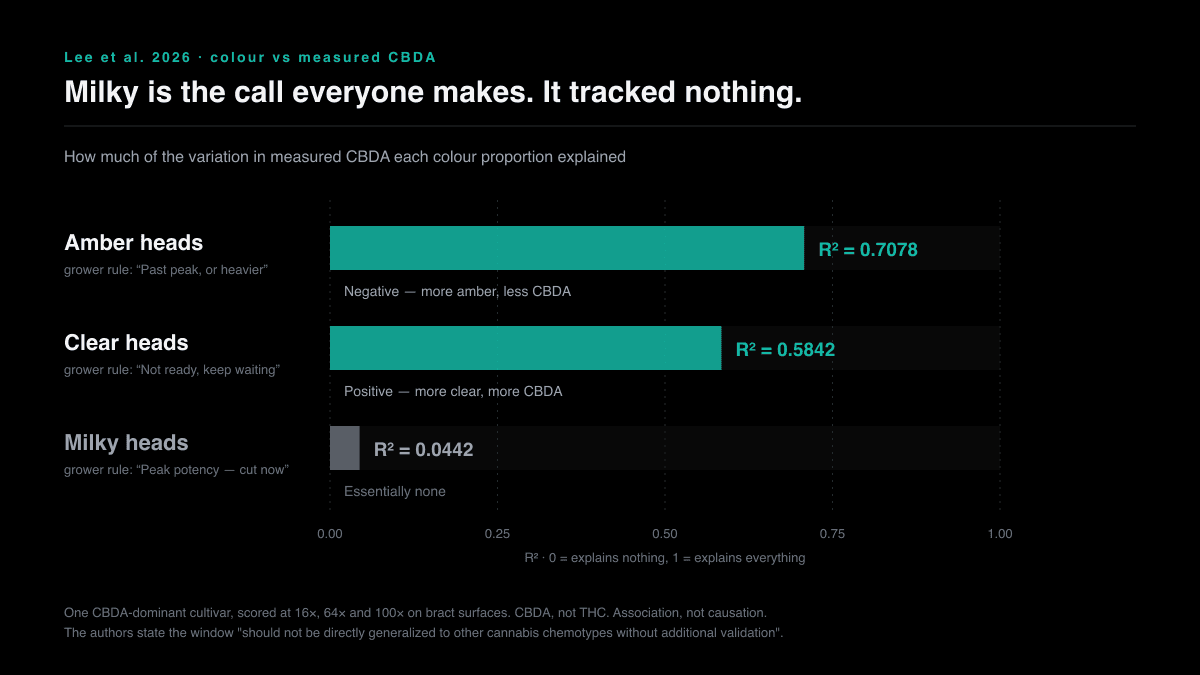
- The milky stage predicted almost nothing. In the first study to measure trichome colour and cannabinoid content together, milky coverage explained essentially none of the variation in CBDA (R² = 0.0442).[1]
- Amber coverage did predict something — decline. Amber proportion tracked falling CBDA strongly (R² = 0.7078), and clear proportion tracked rising CBDA moderately (R² = 0.5842).[1]
- One cultivar, one acid cannabinoid. That work used a single CBDA-dominant plant and its authors say the window “should not be directly generalized to other cannabis chemotypes without additional validation.”[1]
- Stigma colour is still the better-evidenced signal. Across 25 genotypes and 14 measured cannabinoids, 22 peaked once the stigmas were mostly to fully amber.[2]
- Every published rule was established with an instrument you do not own — 16× to 100× magnification, colour-space software, a deep-learning model, a mass spectrometer.[1][3]
- Within the practical window, what moves is yield, not concentration. One trial found cannabinoid concentration statistically flat while flower weight more than tripled.[5]
When should you harvest cannabis?
Inside a window several weeks wide that your cultivar sets, not the calendar. The visual rule with the most published validation behind it is stigma colour — and the first study to match trichome colour against measured cannabinoid content says the milky stage predicts nothing.
That is a genuinely new position. Until this year the honest summary was that the trichome rule had never been checked against potency at all. It has now been checked once, in one cultivar, and the result is more specific and more awkward than either the rule or its critics expected.
| Signal | What growers say | Evidence status in 2026 |
|---|---|---|
| Clear trichome heads | Too early, wait | Associated with higher cannabinoid content in the one study that measured both[1] |
| Milky trichome heads | Peak potency — cut now | Unsupported. Explained almost none of the variation[1] |
| Amber trichome heads | Past peak, or a heavier effect | The “past peak” half now has support; the effect half has none[1][9] |
| Stigma colour | Harvest when most have darkened | Validated across 25 genotypes[2] |
| Flowering week count | Whatever the breeder printed | Directionally useful; peak timing is chemotype-dependent[7] |
Does trichome colour actually predict potency?
Partly, and not in the direction the rule claims. In the first published work to measure both in the same flowers, amber coverage tracked falling cannabinoid content strongly, clear coverage tracked rising content moderately, and the milky stage tracked almost nothing at all.
Lee and colleagues scored the proportions of clear trichomes, milky heads and amber heads on bract surfaces across ten defined maturation stages of a CBDA-dominant cultivar, and measured CBDA by UHPLC in the same material.[1] Three associations came out of it, and they do not line up with the folklore.
| Trichome head colour | Association with measured CBDA[1] | Direction | What the folk rule says |
|---|---|---|---|
| Amber | R² = 0.7078 | Negative — more amber, less CBDA | Past peak, or “heavier” |
| Clear | R² = 0.5842 | Positive — more clear, more CBDA | Not ready, keep waiting |
| Milky | R² = 0.0442 | Essentially none | Peak potency — cut now |
Read the scope before you read the numbers. This is one CBDA-dominant cultivar, one acid cannabinoid, and an association rather than a cause. The authors state that their harvest window “should not be directly generalized to other cannabis chemotypes without additional validation.”[1] Nobody has run the equivalent experiment on a THC-dominant plant.
The same paper reported CBDA peaking at 10.98% of dry weight at its fourth stage, holding at roughly 79–86% of that maximum through the next three stages, then falling sharply to between 4.09% and 4.58% across the last three.[1] The cliff is real, and it arrives after the amber coverage does.
Do milky trichomes mean peak THC?
No published study demonstrates it. In the one dataset that measured trichome colour and cannabinoid content in the same flowers, the milky proportion explained almost none of the variation — by a wide margin the weakest of the three colours.
This matters more than the rest of the finding, because “cut at milky” is the operative instruction in virtually every grow guide in circulation. The two things around it carried signal. The thing everybody acts on did not.
What is not being claimed. That milky heads are meaningless, or that you should harvest at clear instead. The milky stage still marks a real developmental change in gland structure.[4] What has not been shown is that it marks a potency maximum, and one cultivar’s worth of contrary data is not a general law either.
It also took this long for a boring reason. The study that first quantified the colour transition in living plants said plainly that “the importance of this transition as it impacts quality and describes maturity has never been investigated,” and that before it, “there was no description of cannabis trichome maturation during flower development in situ.”[3] That work did not measure cannabinoids at all.
Is stigma colour a better signal than trichomes?
It is the better-evidenced one. Across 25 genotypes and 14 cannabinoids measured by mass spectrometry, 22 peaked once the stigmas were mostly to fully amber. No comparable dataset exists for trichome colour in THC-dominant plants.
Tran and colleagues scored four stigma stages by eye, then validated those scores against an automated colour-space analysis that converts an image to a yellowness index running from 0 for white to 100 for yellow.[2] The genotype set was deliberately mixed: nine high-THCA, five high-CBDA and eleven even-ratio.
| Stage | Stigmas | Genotypes peaking here[2] |
|---|---|---|
| 1 | Fully white | 1 |
| 2 | Some amber | 2 |
| 3 | Mostly amber | 10 |
| 4 | Fully amber | 12 |
Three genotypes out of 25 peaked in stages 1 or 2, which is why the paper recommends per-genotype work rather than a universal stage. Their own verdict on the folk rule: it “is still a useful approximation in most cases.”[2]
Note what that study did and did not do. It measured stigmas — the hairs most growers call pistils — not resin heads, and its authors observe that trichome colour is used elsewhere as a maturity indicator but say they did not analyse it themselves.[2] The two signals have never been tested head to head in the same plants.
How do you actually check trichomes?
At magnification, on bract surfaces, in more than one spot. The published work that quantified this transition used 16× to 100× magnification, or a macro lens feeding a trained image model — not a naked eye at arm’s length.
Lee and colleagues counted glandular trichomes within 0.25 mm² areas of bract surface at 16×, 64× and 100×.[1] Sutton and colleagues used a 1–5× macro lens with both conventional and ultraviolet-induced fluorescence imaging, then segmented the heads with a deep-learning pipeline.[3] Neither is a glance.
| What you look with | What you can resolve | Honest verdict |
|---|---|---|
| Naked eye | Whether the flower looks frosty; stigma colour | Fine for stigmas — that is the signal with evidence[2] |
| Jeweller’s loupe, 30–60× | Individual heads, roughly the published low end[1] | The minimum for a colour call. Needs a steady hand and light |
| Phone macro or clip-on lens | Heads in clusters; lets you compare shots over days | Better than a loupe for tracking change, worse for a single call |
| USB microscope, 100×+ | The top of the published range[1] | Diminishing returns past this for a decision you make once |
| Lab assay | The actual number | Only available after harvest, which is the entire problem[3] |
Two procedural points come straight out of the method sections. Look at bract surfaces, not sugar leaves — leaf trichomes mature on their own schedule and are not what either study scored.[1] And look in several places, because cannabinoid content is measurably uneven within one plant: in one trial the top fraction ran higher than the middle, and the middle higher than the bottom.[5]
What do the harvest stages look like?
Ten of them have been described in sequence, from the first stigmas appearing to heads that are fully brown. The useful part is the middle: a practical window where amber coverage stays below roughly 30 percent.
| Stage | What it looks like[1] | Where CBDA was[1] |
|---|---|---|
| S1–S3 | First stigmas, then clusters at the apex, then compact bundles with no visible trichome coverage yet | Building |
| S4 | Clear to milky heads begin appearing on bract surfaces | Highest observed — 10.98% of dry weight |
| S5 | Flowers expand into a compact cola; clear or milky heads widespread | The practical window — about 79–86% of the maximum |
| S6 | Partial stigma browning; yellow pigmentation in under 10% of visible heads | |
| S7 | More evident stigma browning; roughly 30% of heads yellow to amber | |
| S8 | Largely senescent stigmas; roughly 50% of heads yellow to amber | Falls sharply — 4.09% to 4.58% |
| S9 | Further progression toward amber-to-brown colouration | |
| S10 | Extensive stigma browning; roughly 50% of heads fully brown |
One cultivar, one chemotype. Treat the stage descriptions as a vocabulary for what you are looking at, and the percentages as that plant’s numbers rather than yours. The same team also showed hyperspectral imaging could classify maturity groups with accuracies of 0.94 to 0.98 — a reminder that the reliable version of this measurement is an instrument, not an opinion.[1]

Why do two growers read the same plant differently?
Because every harvest signal has a resolution, and most are being read with the wrong instrument. The rules in circulation were established with microscopes, colour-space software and mass spectrometers, then handed over to a naked eye and a phone.
The harvest-signal resolution ladder. Take any rule you have been given, and ask three questions in order: what instrument established it, what instrument are you using, and do those two match? Most harvest disagreements dissolve at question three. This is not the list of what you trade by cutting early or late — that comes further down this page. This one sorts what you can actually see.
| Signal | Established with | You are using | Match? |
|---|---|---|---|
| Stigma colour | Eye scoring, validated by colour-space software[2] | Your eye | Yes — the one clean match |
| Trichome head colour | 16–100× magnification, or macro optics plus a trained model[1][3] | A loupe, usually briefly | Partial |
| Cannabinoid concentration | UHPLC or LC-MS[1][2] | Nothing you own | No — inferred, never seen |
| Terpene profile | Chromatography across a weekly time course[7] | Your nose | Partial, and it changes after cutting |
| Effect profile | Nothing. Never measured against harvest date | Belief | No |
The practical use of the ladder is that it tells you which arguments are worth having. Two people disagreeing about stigma colour are disagreeing about something both can see. Two people disagreeing about whether an extra week of amber makes the finished flower “heavier” are disagreeing about something nobody has measured in anybody.
What do you lose by harvesting early or late?
Early costs you yield, which is the largest measured effect by some distance. Late costs you cannabinoid content once senescence sets in, and raises mould risk the whole time. Concentration itself stays remarkably flat across the practical window.
Massuela and colleagues harvested a CBD-type genotype at four points between the fifth and eleventh weeks of flowering. Inflorescence dry weight more than tripled across that span. Total CBD concentration stayed between 7.62% and 8.88%, with no significant difference between harvest dates.[5]
So a four-week difference changed how much flower there was, not how strong it was. The counterweight is what happens if you keep waiting: Linder and colleagues harvested two hemp cultivars every two weeks across twelve weeks and measured total THC rising to a maximum and then decreasing as the plants approached senescence.[6]
| Harvest earlier | Harvest later |
|---|---|
| Less flower — the biggest measured cost[5] | More flower, until biomass plateaus[6] |
| Concentration similar inside the window[5] | Concentration similar, then falling at senescence[6] |
| Different terpene balance; monoterpenes peak on their own schedule[7] | Different terpene balance, in the other direction[7] |
| Less time on the plant for mould to establish[10] | More time, denser flower, more trapped moisture[10] |
| Effect profile: unmeasured | Effect profile: unmeasured |
Chemotype sets the schedule underneath all of this. A weekly time course across three chemotypes found the cannabinoid ratio fixed from the outset, but CBD-dominant and mixed plants needing more time than THC-dominant ones to reach peak cannabinoid and monoterpene production.[7] Our guide to cannabis smell and storage covers which compounds those are, and how fast they leave once the jar is sealed.
Do amber trichomes make the flower more sedating?
There is no evidence for it. The claim runs through CBN, and the human study usually cited for CBN sedation reported drowsiness under THC and not under CBN. Our main harvest guide takes this apart at length.
Karniol and colleagues gave volunteers placebo, CBN alone, THC alone and both together; subjects reported feeling “drugged, drunk, dizzy, and drowsy under the delta9-THC condition, but not under the CBN condition.”[8] The only dedicated review of CBN and sleep concluded there is “insufficient published evidence to support sleep-related claims.”[9] No study has tied a harvest date to a reported effect in either direction.
What goes wrong when people call the harvest?
Sampling one spot, reading the wrong surface, and waiting for a number that was never measured. Most bad harvest calls are reading errors rather than timing errors, and reading errors are the fixable kind.
| The mistake | Why it goes wrong | The fix |
|---|---|---|
| Checking one bud | Cannabinoid content differs by position on the same plant[5] | Sample top, middle and lower flowers before deciding |
| Reading sugar leaves | The published colour scoring was done on bract surfaces[1] | Move the leaf aside and look at the bract |
| Waiting for “20% amber” | That precision has never been tied to a measured outcome | Use stigma stage as the primary call[2] |
| Trusting the breeder’s week count | Peak timing is chemotype-dependent[7] | Treat it as a start date for looking, not a harvest date |
| Holding out for a “heavier” high | No study has linked harvest date to reported effects[9] | Optimise the axes that have numbers |
| Letting it run in damp conditions | Longer on the plant and denser flower means more microbial risk[10] | Weight the decision toward earlier when humidity is high |
One more worth stating plainly: the name on the seed packet does not reliably predict the chemistry you end up with, which is the argument we make at length about sativa and indica labels. Harvest on what the plant is doing.
Someone else already made this call
Every signal on this page was established with an instrument, and the one instrument that settles it — a mass spectrometer — only reports after the plant is already down. Growers who do this for a living cut on a schedule and let the assay correct them afterwards. That is the part you are actually buying in craft-tier flower: not a better name on the label, a better-timed cut. These four are in stock today.


Prices shown at time of writing. Free shipping over $150. Interac e-Transfer or crypto.
Can you legally harvest cannabis at home in Canada?
Federally, up to four plants per dwelling-house — and the statute names harvesting specifically, not just growing. Two provinces have taken their own line, and the full provincial picture is on our main harvest guide.
Section 12(4)(b) of the Cannabis Act makes it an offence to cultivate, propagate or harvest “more than four cannabis plants at any one time in their dwelling-house,” and section 12(5) applies that cap to the dwelling rather than to each adult in it.[11] Section 12(8) includes the yard or garden.
The wording matters for this page specifically. “Harvest” is named in the prohibition alongside cultivating and propagating, so the cap is not only about how many plants are standing — it covers the act you are timing. Provincial rules diverge from here, and some provinces are stricter than the federal cap — check your own province’s rules before you plant, not on the day you cut.

After the cut, the decisions that matter shift fast: drying conditions, trimming order and curing all move the finished product more than a few days of timing did. What happens to the aroma after that is in our storage guide — including whether the freezer helps. If you would rather work with the glands than the flower, start with concentrates.
Frequently Asked Questions
When is the best time to harvest cannabis?
When the stigmas are mostly to fully amber, as a default. That is the signal with published validation behind it: across 25 genotypes, 22 peaked in cannabinoid concentration at those two stages. Three peaked earlier, so it is a strong starting point rather than a law for every plant.
Do cloudy trichomes really mean peak THC?
No study demonstrates it. In the first work to measure trichome colour and cannabinoid content in the same flowers, the milky proportion explained essentially none of the variation, while amber and clear proportions both carried signal. That was one CBDA-dominant cultivar, but it is the only direct test published.
What magnification do you need to check trichomes?
Somewhere between 30× and 100× for a colour call. The published scoring used 16×, 64× and 100× on bract surfaces, or a macro lens feeding a deep-learning model. A jeweller’s loupe is the practical minimum; a cheap USB microscope reaches the top of that published range.
Should you harvest when trichomes are amber?
Amber coverage is the one part of the folk rule with support, and it points the other way from how it is usually used. Amber proportion tracked falling cannabinoid content strongly in the study that measured it. Rising amber is a signal you are past the peak, not approaching it.
Do amber trichomes make weed more sedating?
There is no evidence for that. The claim runs through CBN, and the human study most often cited for CBN sedation found drowsiness reported under THC and not under CBN. A dedicated review concluded the published evidence is insufficient to support sleep-related claims of any kind.
Is it better to harvest early or late?
Early costs you yield and late costs you cannabinoid content, but only past a point. One trial found concentration statistically flat across a four-week window while flower weight more than tripled. Another measured total THC rising to a maximum and then declining as the plants approached senescence.
Do you check trichomes on the leaves or the buds?
The bracts, which are the small leaf-like structures making up the bud itself. Both studies that scored trichome colour did it on bract surfaces. Sugar leaves are easier to reach and easier to hold still, which is exactly why so many people end up reading the wrong surface.
How many weeks of flowering before harvest?
There is no universal number, and the literature refuses to supply one. A weekly time course across three chemotypes found CBD-dominant and mixed plants needed longer than THC-dominant ones to reach peak cannabinoid production. Treat a breeder’s week count as the date to start looking.
Does harvest timing change the terpene profile?
Yes, and on a different schedule from the cannabinoids. Monoterpene accumulation was measured peaking at its own time rather than alongside cannabinoid production, so a later cut shifts the aroma balance. What that does to the experience of smoking it has not been measured against harvest date.
How many cannabis plants can you harvest at home in Canada?
Four. Section 12(4)(b) of the Cannabis Act prohibits cultivating, propagating or harvesting more than four plants at any one time in a dwelling-house, and the cap applies per dwelling rather than per adult. The yard or garden counts as part of the dwelling-house, and provincial rules differ.
References
- Lee, S. H., Yoon, H. I., Ryu, D., Choi, H., Park, S. H., Yang, J.-S., Kim, H.-Y., & Jung, J. H. Integrating trichome traits, CBDA accumulation, and hyperspectral signatures for harvest-stage assessment in CBDA-dominant medicinal cannabis. Industrial Crops and Products, 2026, 250, 123953. DOI: 10.1016/j.indcrop.2026.123953 (Ten defined macroscopic maturation stages of the CBDA-dominant cultivar ‘Cherry Blonde’; glandular trichomes counted in 0.25 mm² areas of bract surface at 16×, 64× and 100×; CBDA measured by UHPLC on a dry-weight basis. Reported associations with CBDA content: amber proportion R² = 0.7078 negative, clear proportion R² = 0.5842 positive, milky proportion R² = 0.0442. CBDA highest at S4 at 10.98%, holding at roughly 79–86% of that maximum through S5–S7, then 4.09–4.58% at S8–S10. Hyperspectral classification accuracies 0.94–0.98 for maturity groups against 0.71–0.75 for the ten-stage scheme. Scope caveat stated by the authors and repeated on this page: the S5–S7 window “should not be directly generalized to other cannabis chemotypes without additional validation.” Article page read directly, 2026-09-21. This is the first study located by this programme that measures trichome colour and cannabinoid content in the same material, and it revises the claim made in our article #11 that no such measurement existed.)
- Tran, J., Dimech, A. M., Vassiliadis, S., Elkins, A. C., Cogan, N. O. I., Naim-Feil, E., & Rochfort, S. J. Determination of Optimal Harvest Time in Cannabis sativa L. Based upon Stigma Color Transition. Plants, 2025, 14(10), 1532. DOI: 10.3390/plants14101532 (25 genotypes — 9 high-THCA, 5 high-CBDA, 11 even-ratio — across four stigma colour stages, 100 samples at four inflorescences per genotype, 14 cannabinoids by LC-MS. Manual scoring validated against a PlantCV pipeline converting RGB images to L*a*b space and computing a yellowness index from 0 for white to 100 for yellow. 22 of 25 genotypes peaked at stage 3 or 4, split 10 and 12. Verbatim: the “rule of thumb” of harvesting when mostly amber “is still a useful approximation in most cases; however, studies on individual genotypes should be performed.” The authors note trichome colour is used elsewhere as a maturity indicator but did not analyse it. Article page read directly, 2026-09-21.)
- Sutton, D. B., Punja, Z. K., & Hamarneh, G. Characterization of trichome phenotypes to assess maturation and flower development in Cannabis sativa L. (cannabis) by automatic trichome gland analysis. Smart Agricultural Technology, 2023, 3, 100111. DOI: 10.1016/j.atech.2022.100111 (Macro-photography of four commercially grown cultivars across an eight-week flowering period, in conventional light and UV-induced fluorescence, with a deep-learning segmentation pipeline quantifying clear, milky and brown phenotype curves. Verbatim: “the importance of this transition as it impacts quality and describes maturity has never been investigated,” and “prior to this study, there was no description of cannabis trichome maturation during flower development in situ.” Cannabinoid content was not measured in this study — the authors note lab assays “are conducted following harvest … thus these analyses are not informative during the flowering period.” Article page read directly, 2026-09-21.)
- Punja, Z. K., Sutton, D. B., & Kim, T. Glandular trichome development, morphology, and maturation are influenced by plant age and genotype in high THC-containing cannabis (Cannabis sativa L.) inflorescences. Journal of Cannabis Research, 2023, 5, 12. DOI: 10.1186/s42238-023-00178-9 (Quantifies trichome head colour in CIELAB space across flowering weeks 3, 5 and 7 and attributes browning to resin exudation and cuticle collapse rather than to a chemical conversion. Cannabinoid concentration was not measured during development. Cited from this programme’s verified source library, recorded during the article #11 run.)
- Massuela, D. C., Hartung, J., Munz, S., Erpenbach, F., & Graeff-Hönninger, S. Impact of Harvest Time and Pruning Technique on Total CBD Concentration and Yield of Medicinal Cannabis. Plants, 2022, 11(1), 140. DOI: 10.3390/plants11010140 (Harvests at 5, 7, 9 and 11 flowering weeks of a chemotype III genotype. Inflorescence dry weight more than tripled across that span while total CBD concentration stayed between 7.62% and 8.88% with no significant difference between harvest dates. Also reports position effects within the plant, with the top fraction higher in CBD than the middle and the middle higher than the lower. Cited from this programme’s verified source library, recorded during the article #11 run; per-plant mass figures deliberately not restated here.)
- Linder, E. R., Young, S., Li, X., Henriquez Inoa, S., & Suchoff, D. H. The Effect of Harvest Date on Temporal Cannabinoid and Biomass Production in the Floral Hemp (Cannabis sativa L.) Cultivars BaOx and Cherry Wine. Horticulturae, 2022, 8(10), 959. DOI: 10.3390/horticulturae8100959 (Six harvests every two weeks over twelve weeks, two sites, two seasons. Total THC rose to a maximum and then decreased as plants approached senescence; biomass followed a linear-plateau curve. Low-THC hemp cultivars, so the absolute values do not transfer and only the shape of the curve is used here. Cited from this programme’s verified source library, recorded during the article #11 run.)
- Aizpurua-Olaizola, O., Soydaner, U., Öztürk, E., Schibano, D., Simsir, Y., Navarro, P., Etxebarria, N., & Usobiaga, A. Evolution of the Cannabinoid and Terpene Content during the Growth of Cannabis sativa Plants from Different Chemotypes. Journal of Natural Products, 2016, 79(2), 324–331. DOI: 10.1021/acs.jnatprod.5b00949 (Weekly time course across three chemotypes; the cannabinoid ratio was fixed from the outset, while chemotypes II and III needed more time than chemotype I to reach peak cannabinoid and monoterpene production. Cited from this programme’s verified source library, recorded during the article #11 run.)
- Karniol, I. G., Shirakawa, I., Takahashi, R. N., Knobel, E., & Musty, R. E. Effects of delta9-tetrahydrocannabinol and cannabinol in man. Pharmacology, 1975, 13(6), 502–512. DOI: 10.1159/000136944 (Five volunteers given oral placebo, CBN, THC, and both together. Verbatim: subjects reported feeling “drugged, drunk, dizzy, and drowsy under the delta9-THC condition, but not under the CBN condition.” Cited from this programme’s verified source library, recorded during the article #11 run.)
- Corroon, J. Cannabinol and Sleep: Separating Fact from Fiction. Cannabis and Cannabinoid Research, 2021, 6(5), 366–371. DOI: 10.1089/can.2021.0006 (Narrative review identifying no clinical trials using validated sleep questionnaires or polysomnography and concluding there is “insufficient published evidence to support sleep-related claims.” Cited from this programme’s verified source library, recorded during the article #11 run.)
- Punja, Z. K., Ni, L., Lung, S., & Buirs, L. Total yeast and mold levels in high THC-containing cannabis (Cannabis sativa L.) inflorescences are influenced by genotype, environment, and pre- and post-harvest handling practices. Frontiers in Microbiology, 2023, 14, 1192035. DOI: 10.3389/fmicb.2023.1192035 (Over 2,000 samples across three years; microbial counts track genotype, environment and pre- and post-harvest handling. Used here only for the direction of microbial risk with time on the plant and flower density. Cited from this programme’s verified source library, recorded during the article #11 run.)
- Cannabis Act (S.C. 2018, c. 16), s. 12. Cultivation, propagation and harvesting. Justice Laws Website. laws-lois.justice.gc.ca (s. 12(4)(b) prohibits cultivating, propagating or harvesting “more than four cannabis plants at any one time in their dwelling-house”; s. 12(5) applies the cap per dwelling-house rather than per adult; s. 12(8) includes the yard or garden in “dwelling-house.” Cited from this programme’s verified source library; the provincial and territorial variations are deliberately left to article #11.)
This article is for informational purposes only and is not medical advice. Growing cannabis at home is regulated differently in each province and territory — check the rules that apply where you live. Do not drive after using cannabis. Keep all cannabis products locked away from children and pets.