
Freezing cannabis slows down every chemical process that fades it. That much is settled. What is not settled — and what almost nobody checks — is whether cold is the variable that was limiting you in the first place.
The two things the internet says about this contradict each other. One half says the freezer locks in freshness; the other half says it shatters your trichomes. Both are repeated without a source. There is real data here, including a four-year controlled experiment with a freezer arm in it, and it points somewhere more specific than either slogan.

Key Takeaways
- The four-year data exists and it includes a freezer arm. Zamengo et al. 2019 stored cannabis under light, dark, fridge and −20 °C conditions for four years; significant THC loss and CBN formation were reported in the two room-temperature arms.[1]
- Light and air matter more than cold. A 1976 storage study found the effect of temperature up to 20 °C “insignificant” while light was “the greatest single factor” in cannabinoid loss.[2]
- Properly cured flower barely freezes at all. A frozen system’s water activity is set by temperature alone, and −20 °C corresponds to 0.82;[3] dry cannabis flower sits at 0.55–0.65.[6] There is very little freezable water left.
- The brittleness folklore has a real mechanism behind it. Cold makes cannabis resin brittle while plant material stays flexible[4] — which is exactly how hash is made, and exactly why you do not handle frozen flower.
- No container preserves aroma at room temperature. Over six months at 18 °C in the dark, the volatile profile was not maintained under any of three container types.[5]
- The deciding question is how often you will open it, not how long you will keep it. The costs of freezing are paid per opening; the benefit accrues per month.
Does freezing weed preserve it?
Yes — for cured, dry flower in a sealed opaque container that you are not going to open for months. Freezing slows the reactions that degrade cannabinoids and lets aroma escape. It is the wrong choice for anything you open weekly.
That qualification is the whole article. It sits downstream of the general rules in our guide to cannabis smell and storage, which is where the container, humidity and darkness stack is worked out in full. Every cost of freezing is paid at the moment you open the container: cold flower is mechanically fragile, and a cold surface in a warm room collects water. Every benefit of freezing accrues quietly while the container stays shut. A jar opened nightly pays all of the costs and collects almost none of the benefit.
| What cold does | What cold does not do |
|---|---|
| Slows oxidation of THC toward CBN[1] | Reverse any degradation that has already happened |
| Slows the escape of terpenes and volatile sulfur compounds from the flower into the headspace | Stop outgassing from the plant material itself[8] |
| Suspends microbial growth | Remove or kill contamination already present[11] |
| Buys time on a container you will not open | Substitute for darkness or an airtight seal[2] |
What does the four-year storage study actually show?
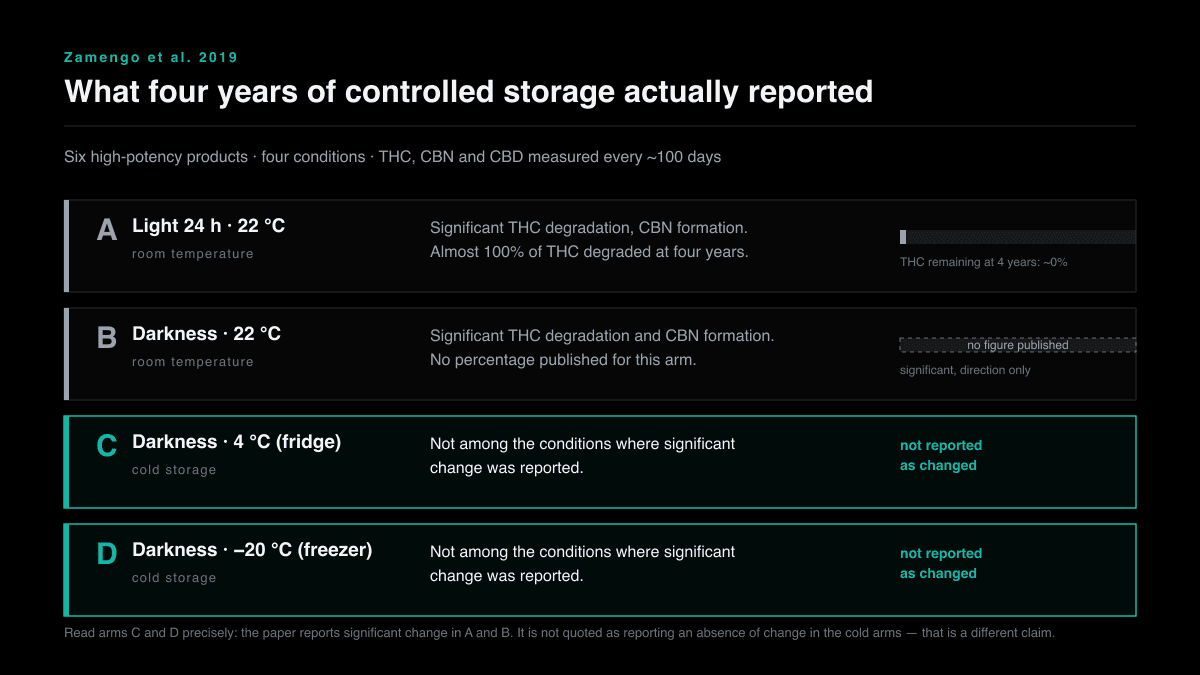
That the damage happens at room temperature. Zamengo and colleagues held six high-potency cannabis products — herbal and resin — under four controlled conditions for four years, measuring THC, CBN and CBD roughly every 100 days.[1]
Their reported result is blunt: “Significant changes in the THC (degradation) and CBN (formation) content were detected under storage conditions A and B, and almost 100% of THC was degraded after four years.”[1] A and B are the two room-temperature arms. C is a fridge and D is a freezer.
| Arm | Condition | What was reported |
|---|---|---|
| A | Light 24 h, 22 °C | Significant THC degradation and CBN formation; near-total THC loss at four years[1] |
| B | Darkness, 22 °C | Significant THC degradation and CBN formation[1] |
| C | Darkness, 4 °C (fridge) | Not among the conditions where significant change was reported |
| D | Darkness, −20 °C (freezer) | Not among the conditions where significant change was reported |
Read the C and D rows precisely. The paper reports significant change in A and B; it is not quoted here as reporting an absence of change in C and D, because that is a different claim.
The study’s other finding is the one worth carrying around: “the storage temperature and light exposure had two different effects on the conversion of THC to CBN: temperature changed only the speed, light changed both the speed and the stoichiometry of this conversion.”[1] Cold slows the reaction. Darkness changes what the reaction produces. They are not interchangeable, and one of them is free.
Is the cold doing the work, or the dark?
Mostly the dark, and the seal. The oldest careful storage study on record found the effect of temperature up to 20 °C “insignificant,” while “exposure to light (not direct sunlight) was shown to be the greatest single factor in loss of cannabinoids.”[2]
Fairbairn, Liebmann and Rowan stored nine herbal samples, two resin samples and solutions of pure cannabinoids for up to two years. Their conclusion is a useful baseline for anyone deciding whether to buy freezer equipment: carefully prepared cannabis or extracts are “reasonably stable for 1 to 2 years if stored in the dark at room temperature.”[2]
They also found that air oxidation caused significant losses, and that those losses “could be reduced if care was taken to minimize damage to the glands which act as ‘well filled, well closed containers’.”[2] That sentence is fifty years old and it is still the most useful thing written about cannabis storage: the trichome is the package. Your jar is the second package.
Does freezing weed damage trichomes?
Cold makes resin brittle — that part of the folklore is real and peer-reviewed. What follows from it is a handling rule, not a chemistry warning. Frozen trichome heads snap off more readily when the flower is moved, ground or knocked.
The clearest published statement comes from work on ice-water extraction: “Ice water causes the resins to become brittle, while the remaining plant material remains more flexible.”[4] That differential is not a side effect — it is the entire operating principle of solventless hash. The industry chills material precisely so the glands break away from the plant — that process has its own page in our guide to bubble hash, and our guide to concentrates covers what the glands become afterwards.
So the honest version is this: freezing does not degrade the chemistry inside an intact gland. It makes the gland easier to knock off the plant. Those glands are where the aroma and the cannabinoids live,[2] so losing them to the bottom of a jar is a real loss — one caused by handling frozen flower, not by the freezer itself.
| Action while frozen | Risk | Do this instead |
|---|---|---|
| Grinding straight from the freezer | High — brittle glands shear off[4] | Let the sealed jar reach room temperature first |
| Shaking or tipping the jar | Moderate — same mechanism, less force | Move the jar, not the flower inside it |
| Breaking buds apart by hand | Moderate | Wait; warm flower is flexible again |
| Leaving it sealed and still | None identified in any located study | This is the whole method |
Does cured cannabis actually freeze?
Barely. A properly cured flower holds so little free water that a domestic freezer is nowhere near cold enough to freeze most of it — which is why the ice-crystal damage people worry about is largely a problem borrowed from wet food.
Two published numbers meet here. In frozen systems, “the water activity of the frozen system is solely determined by temperature,” and “freezing at −20 °C corresponds to aw of 0.82.”[3] Meanwhile the ASTM specification for dry cannabis flower is a water activity of 0.55 to 0.65.[6] Cured flower is drier than the point at which ice forms at freezer temperatures.
| Water activity | Approximate temperature at which that water freezes | What sits here |
|---|---|---|
| 0.99 | −1 °C | Fresh-cut plant material; most food |
| 0.90 | −10 °C | Under-dried, still-damp flower |
| 0.82 | −19 °C | The published pairing[3]; a domestic freezer |
| 0.70 | −33 °C | Flower at the moisture level of a slow dry[7] |
| 0.65 | −38 °C | Top of the ASTM range for dry flower[6] |
| 0.55 | −50 °C | Bottom of the ASTM range[6] |
This table is a calculation, not a measurement. The temperatures are the first-order freezing-point relation in reference [3] run backwards across the ASTM range in reference [6]; the relation reproduces that paper’s own −20 °C / 0.82 pairing to within a degree. It was derived for solutions, and much of the water left in a dried flower is sorbed into the matrix rather than dissolved in it. Read it as an order-of-magnitude statement about how little freezable water remains — not as a measured freezing point for cannabis, which nobody has published.

The practical consequence is that the fresh-versus-cured distinction is the one that matters. Wet flower at the top of that table freezes near 0 °C and has plenty of water to form crystals with. That is a real risk, and it is one reason the drying and curing process exists before storage does — and it starts earlier still, with when the plant was cut.
Can weed get freezer burn?
Not in the way meat does. Freezer burn is ice sublimating out of a frozen matrix and leaving it desiccated. Cured cannabis has very little ice in it to begin with, so the term is borrowed rather than accurate.
What can happen instead is slower and duller: moisture migrating out of an imperfectly sealed container into the dry air of a freezer, leaving flower that crumbles and smokes harshly. Ice crystals in any frozen system also “grow through recrystallization during long-term preservation,”[3] which is why a container that is genuinely airtight matters more in a freezer than in a cupboard, not less.
The other failure is condensation, and it happens on the way out rather than on the way in. A jar at −18 °C brought into a warm kitchen is far below the dew point of the room; open it and water condenses onto the flower. Repeat that nightly and the humidity in the jar drifts upward toward the range where mould becomes possible.[7]
Should you use the freezer, the fridge or a cupboard?
Decide by how often you will open the container, not by how long you plan to keep it. This is the one question that separates the three answers, and it is the question nobody asks.
The access-frequency test. Freezing buys you exactly one thing — a slower reaction rate — and charges you in three: mechanical fragility while cold, a condensation event on every opening, and moisture migration over time. All three costs are paid per opening. The single benefit accrues per month. So the arithmetic is settled entirely by the ratio between those two, and you can work it out before you buy anything.
| How often you will open it | Best location | Why |
|---|---|---|
| Daily or weekly | Cool dark cupboard | Dark plus airtight is most of the benefit;[2] no condensation, no brittle glands |
| Monthly | Cupboard, or a fridge if the room runs warm | Temperature only changes the speed of the reaction[1] — at this frequency the handling costs dominate |
| Once, in months | Freezer, sealed and opaque | The one case where the per-month benefit clearly outweighs a single opening |
| Splitting a batch: some now, most later | Both — small jar out, large jar frozen | Separates the two access patterns instead of compromising between them |
Bulk-scale storage is a different physics problem with different equipment and is out of scope here. This page is about a jar, not a case.

How do you freeze cannabis properly?
Dry and cured first, opaque and airtight second, full third, and left alone fourth. The procedure is short because most of the ways people get this wrong happen at the moment they take it back out.
| Step | What to do | Why it matters |
|---|---|---|
| 1. Check it is dry | Only well-cured flower goes in | Damp flower has water that will actually freeze |
| 2. Use rigid, opaque, airtight | Amber or opaque glass with a gasket; a vacuum-sealed pouch is a workable second | Darkness changes what the degradation reaction produces, not just how fast[1] |
| 3. Fill it | Minimise headspace; several small jars beat one large one | Volatiles outgas into whatever headspace exists[8] |
| 4. Portion before freezing | Freeze what you will use in one go per container | Every reopening is a separate condensation event |
| 5. Label and forget it | Back of the freezer, away from the door | Door shelves swing in temperature every time the freezer opens |
| 6. Thaw sealed | Half an hour on the counter, unopened, before you defrost the seal | Warming the jar before opening keeps water off the flower |
Two things not to bother with. A humidity pack inside a frozen jar does nothing useful, because two-way packs regulate toward a relative humidity at room temperature and the jar is not at room temperature. And an inert-gas top-off is not the upgrade it is sold as — argon displacement on its own did not prevent terpene loss in a controlled comparison, because a large share of the loss is outgassing from the material itself.[8]
Does freezing kill mould or stop it?
It suspends growth; it does not sterilise anything. Contamination that went into the freezer comes back out of it, and freezing is not a remediation step in any published protocol.
This matters because the fungal load on cannabis is a documented health question rather than a cosmetic one — over a hundred fungal species have been associated with cannabis and hemp, and the remediation methods that actually work are industrial, not domestic.[11] Cold storage is a way of not making the problem worse.
The prevention worth doing is upstream. Microbial counts on dried flower track how it was dried and handled, with a water activity of roughly 0.65 to 0.70 pairing with 12–14% moisture content in one large multi-year dataset.[7] Get the drying right and the freezer is storing clean material; get it wrong and the freezer is storing the problem.
Does freezing protect potency, or smell?
Both, but they are on different clocks. Cannabinoid loss is a years-long oxidation problem. Aroma loss is a weeks-to-months volatility problem, and it is the one that no container has been shown to solve at room temperature.
On the aroma side, the relevant experiment stored dried inflorescences in the dark at 18 °C and 60% relative humidity for six months across three container types, and reported that “the volatilome of cannabis inflorescences after drying (TD) is not maintained upon any of the storage conditions applied.”[5] Glass did better than plastic or open trays — but nothing held the profile. Our guide to cannabis smell and storage covers which compounds leave first, and how fast.
The sharpest notes go faster still. The volatile sulfur compounds behind the skunk character peak at the end of the curing process and had measurably declined ten days after jarring.[9] No storage method recovers those. A freezer only protects what is still there on the day the jar is sealed — which is an argument for freezing early, not for freezing what has already gone quiet. Craft-tier flower is loudest in its first weeks, and that is the window worth sealing away.
The aroma you are protecting is also not predicted by the name on the label, which is a separate argument made at length in our piece on sativa, indica and hybrid labels. For extracts rather than flower, the storage rules diverge enough to need their own page, which is in progress.
Freeze it loud, not quiet
The one thing the evidence does say clearly is that a freezer protects what is still in the jar on the day you seal it, and the sharpest notes are gone within weeks of curing. If you are going to buy a batch and put most of it away, the case for buying at the top of the shelf is stronger than usual — you are preserving the difference, not creating it. These four are craft-tier and in stock today.


Prices shown at time of writing. Free shipping over $150. Interac e-Transfer or crypto.
What do Canadian rules say about how you store it?
Nothing about freezers specifically. The rules govern the container cannabis is sold in, not where you put it afterwards — but the requirements are a decent specification for a home jar anyway.
Section 108 of the Cannabis Regulations requires the immediate container of a cannabis product to be opaque or translucent, to prevent contamination, to keep dried cannabis dry, and to meet the child-resistant standard referenced in the Food and Drug Regulations.[10] Opaque, sealed, dry, child-resistant. That is the freezer procedure above, written by a regulator for a different reason.
The one practical note: a freezer is a good place to keep cannabis away from children and pets, but only if the container is still the child-resistant one or an equivalent. A freezer door is not a lock, and the regulation is about the container rather than the room it is in.

Frequently Asked Questions
Can you freeze weed without ruining it?
Yes, if it is well cured and dry, the container is opaque and airtight, and you leave it alone. The damage people attribute to freezers is caused by handling cold flower and by opening cold jars in warm rooms. Sealed and undisturbed, no located study reports a problem.
Does freezing weed make it lose potency?
The opposite, over long periods. A four-year controlled study found significant THC degradation and CBN formation in its room-temperature arms, with near-total THC loss by year four; the refrigerated and frozen arms were not among the conditions where significant change was reported. Cold slows the reaction rather than causing it.
Does freezing weed break the trichomes off?
Cold makes resin brittle while plant material stays flexible — that is the published mechanism behind ice-water hash making. So frozen glands do snap off more readily, but only when the flower is moved, shaken or ground. Let the sealed jar warm to room temperature first and the problem disappears.
How long can you keep weed in the freezer?
Longer than in a cupboard, though no study has put a consumer number on it. The useful framing is that aroma fades on a scale of months and cannabinoid loss on a scale of years, and cold slows both. What actually ends a frozen jar’s life is usually repeated opening, not elapsed time.
Should you thaw frozen weed before opening the jar?
Always. A jar at freezer temperature is far below the dew point of a warm room, so opening it immediately condenses water onto the flower. Half an hour on the counter with the lid still closed is enough. The same wait also lets brittle trichome heads become flexible again.
Is the fridge better than the freezer for weed?
For most people, yes, because fridges get opened less carelessly than cupboards and warm up faster than freezers. But neither beats a cool dark cupboard if you are opening the container weekly. Choose by access frequency: freezer for months untouched, cupboard for daily use, fridge in between.
Can weed get freezer burn?
Not really. Freezer burn is ice sublimating out of frozen food, and properly cured cannabis holds very little freezable water. What can happen is moisture escaping an imperfect seal into dry freezer air, leaving crumbly, harsh-smoking flower. The fix is a genuinely airtight rigid container rather than a bag.
Do you need a humidity pack in a frozen jar?
No. Two-way humidity packs regulate toward a target relative humidity at room temperature, and a frozen jar is not at room temperature, so the pack is not doing the job it was designed for. Put the pack in when the jar comes out of the freezer and goes into regular use.
Does freezing kill mould on cannabis?
No. Freezing suspends microbial growth without sterilising anything, so contamination that goes into a freezer comes back out of it. The methods shown to reduce fungal load are industrial rather than domestic. Prevention happens during drying and curing, and a frozen jar only preserves whatever state the flower was already in.
Is freezing weed better than vacuum sealing it?
They solve different problems and work well together. Vacuum sealing removes headspace oxygen; freezing slows the reactions. Neither stops volatiles outgassing from the plant material itself, which one controlled comparison showed argon displacement could not prevent either. Vacuum plus cold plus opacity is the full long-term protocol.
References
- Zamengo, L., Bettin, C., Badocco, D., Di Marco, V., Miolo, G., & Frison, G. The role of time and storage conditions on the composition of hashish and marijuana samples: A four-year study. Forensic Science International, 2019, 298, 131–137. DOI: 10.1016/j.forsciint.2019.02.058 (Six high-potency herbal and resin products held four years under four conditions — A: light 24 h at 22 °C; B: darkness at 22 °C; C: darkness at 4 °C; D: darkness at −20 °C — with THC, CBN and CBD by GC-FID roughly every 100 days. Verbatim: “Significant changes in the THC (degradation) and CBN (formation) content were detected under storage conditions A and B, and almost 100% of THC was degraded after four years,” and “temperature changed only the speed, light changed both the speed and the stoichiometry of this conversion.” Abstract read directly, 2026-09-19.)
- Fairbairn, J. W., Liebmann, J. A., & Rowan, M. G. The stability of cannabis and its preparations on storage. Journal of Pharmacy and Pharmacology, 1976, 28(1), 1–7. DOI: 10.1111/j.2042-7158.1976.tb04014.x (Nine herbal samples, two resin samples and pure cannabinoid solutions stored up to two years. Verbatim: “Exposure to light (not direct sunlight) was shown to be the greatest single factor in loss of cannabinoids”; “The effect of temperature, up to 20°, was insignificant but air oxidation did lead to significant losses. These could be reduced if care was taken to minimize damage to the glands which act as ‘well filled, well closed containers'”; and the conclusion that material is “reasonably stable for 1 to 2 years if stored in the dark at room temperature.” Abstract read directly, 2026-09-19.)
- Miyawaki, O. Water and Freezing in Food. Food Science and Technology Research, 2018, 24(1), 1–21. DOI: 10.3136/fstr.24.1 (Review of water behaviour in frozen food systems. Verbatim: “The water activity of the frozen system is solely determined by temperature,” with “freezing at −20°C corresponds to aw of 0.82,” and “Ice crystals are known to grow through recrystallization during long-term preservation.” The freezing-point relation in this paper is what the water-activity table on this page runs backwards; the extrapolation is this article’s arithmetic, not the paper’s result, and is labelled as such on the page. Read directly, 2026-09-19.)
- MacGowan, C., & Martynenko, A. Electrostatic separator of cannabis trichomes: an innovative approach to extraction. Journal of Cannabis Research, 2025, 7, 23. DOI: 10.1186/s42238-025-00281-z (Describes the mechanism of wet fractionation: “Ice water causes the resins to become brittle, while the remaining plant material remains more flexible.” Also notes that trichome surface charge “was temperature-dependent, decreasing to 0 at temperatures below zero (−18 °C)” — an electrostatic finding, not a structural one, and not used on this page for anything else. Read directly, 2026-09-19.)
- Spadafora, N. D., Felletti, S., Chenet, T., Sirangelo, T. M., Cescon, M., Catani, M., De Luca, C., Stevanin, C., Cavazzini, A., & Pasti, L. The influence of drying and storage conditions on the volatilome and cannabinoid content of Cannabis sativa L. inflorescences. Analytical and Bioanalytical Chemistry, 2024, 416(16), 3797–3809. DOI: 10.1007/s00216-024-05321-w (Tray drying versus freeze drying, then six months “stored in a dark chamber with controlled temperature and humidity (18 °C and 60%, respectively)” across three container types — HDPE boxes, open-air trays and brown glass bottles. Verbatim: “the volatilome of cannabis inflorescences after drying (TD) is not maintained upon any of the storage conditions applied.” The only located peer-reviewed comparison of storage container types for cannabis. Read directly, 2026-09-19.)
- ASTM International. ASTM D8197 — Standard Specification for Maintaining Acceptable Water Activity (aw) Range (0.55 to 0.65) for Dry Cannabis Flower Intended for Human/Animal Use. ASTM International, current edition. store.astm.org (The 0.55–0.65 water-activity specification for dry cannabis flower. Cited here from this programme’s verified source library, where it was recorded for article #10; the standard itself is paywalled and was not re-read this run.)
- Punja, Z. K., Ni, L., Lung, S., & Buirs, L. Total yeast and mold levels in high THC-containing cannabis (Cannabis sativa L.) inflorescences are influenced by genotype, environment, and pre- and post-harvest handling practices. Frontiers in Microbiology, 2023, 14, 1192035. DOI: 10.3389/fmicb.2023.1192035 (Over 2,000 samples across three years; pairs 12–14% moisture content with a water activity of 0.65–0.70, the closest published aw-to-moisture pairing for cannabis flower, and shows microbial counts tracking drying and handling practice. Cited from this programme’s verified source library, recorded during the article #11 run.)
- Bueno, J., Leuer, E., Kearney, M., Jr., Green, E. H., & Greenbaum, E. A. The preservation and augmentation of volatile terpenes in cannabis inflorescence. Journal of Cannabis Research, 2020, 2, 27. DOI: 10.1186/s42238-020-00035-z (Terpene loss in storage across packaging conditions; argon displacement alone did not prevent terpene loss over six weeks, because a large share of the loss is outgassing from the plant material itself. Cited from this programme’s verified source library, recorded during the article #10 run.)
- Oswald, I. W. H., Ojeda, M. A., Pobanz, R. J., Koby, K. A., Buchanan, A. J., Del Rosso, J., Guzman, M. A., & Martin, T. J. Identification of a New Family of Prenylated Volatile Sulfur Compounds in Cannabis Revealed by Comprehensive Two-Dimensional Gas Chromatography. ACS Omega, 2021, 6(47), 31667–31676. DOI: 10.1021/acsomega.1c04196 (Plants were hung to cure and dry for 11 days, volatile sulfur compounds reached a maximum at the end of that process, and a final measurement ten days after jarring showed a substantial decrease in all VSC concentrations. Cited from this programme’s verified source library, with the ten-day figure as corrected on article #10 in September 2026.)
- Cannabis Regulations (SOR/2018-144), s. 108. Immediate container. Justice Laws Website. laws-lois.justice.gc.ca (The immediate container of a cannabis product must be opaque or translucent, prevent contamination, keep dried cannabis dry, have a security feature and meet the child-resistant standard in subsections C.01.001(2) to (4) of the Food and Drug Regulations. Cited from this programme’s verified source library; the container-capacity provision is deliberately not restated on this page.)
- Gwinn, K. D., Leung, M. C. K., Stephens, A. B., & Punja, Z. K. Fungal and mycotoxin contaminants in cannabis and hemp flowers: implications for consumer health and directions for further research. Frontiers in Microbiology, 2023, 14, 1278189. DOI: 10.3389/fmicb.2023.1278189 (Over 100 fungal species associated with cannabis and hemp; the remediation methods with documented log reductions — gamma irradiation, cold plasma, e-beam — are industrial processes, not domestic ones. Cited from this programme’s verified source library, recorded during the article #11 run.)
This article is for informational purposes only and is not medical advice. Do not drive after using cannabis. Keep all cannabis products locked away from children and pets. Follow the cannabis laws applicable in your jurisdiction.