
Hash goes in a bowl, a joint, a pipe, a bong, on a knife or into a vaporizer, and the method matters less than the temperature. Almost every argument about how to smoke hash is really an argument about heat — how much of it, for how long, and how much of your material survives the trip.
This is the deep version of the consumption material in our guide to cannabis concentrates, which keeps the format comparison tables and the dab-temperature section. Here we work through each method, what it costs you, and the surprisingly thin evidence underneath most of the advice you will read elsewhere.

Key Takeaways
- Fire converts your hash and then destroys most of it. Decarboxylation is “essentially complete during the smoking process,” yet recovery of THC in smoking simulations was “only about 30%.”[1]
- The cannabinoid boiling-point chart is a units error. The famous 155–157 °C figure for THC is a high-vacuum number; at atmospheric pressure THC boils above 400 °C.[4]
- Vaporizers evaporate, they do not boil — and evaporation is a rate, not a switch. At 180 °C “only 10% and 20%” of THC leaves in 20 and 40 seconds.[4]
- Two peer-reviewed papers disagree about 230 °C — one measured the best by-product ratio there,[6] the other puts combustion there.[7]
- The “bongs filter more THC than tar” claim was never peer-reviewed, and the newsletter it comes from actually found waterpipes performed worse than a joint.[13]
- Nobody has measured hash smoke. Every smoking-machine study we could locate used herbal flower. Figures quoted for hash are extrapolations.
- Tobacco is a regional convention, not a requirement. Tobacco routes were used by 77.2–90.9% of European respondents against 4.4–16.0% in the Americas.[12]
How Do You Smoke Hash?
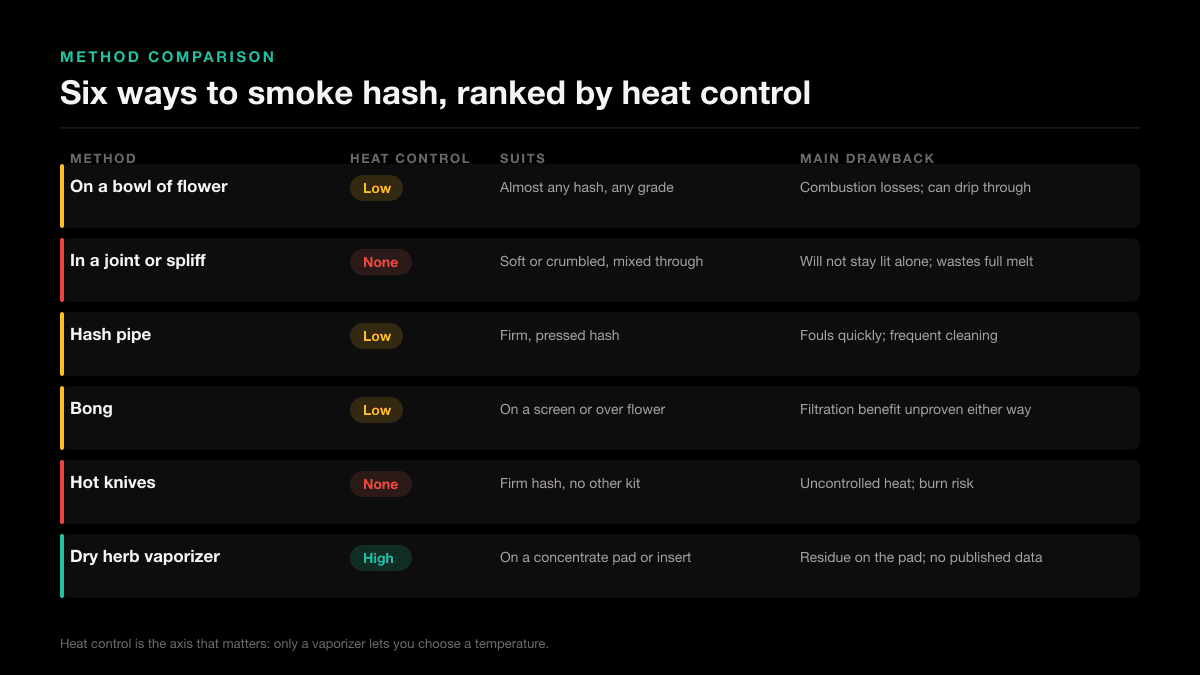
Six methods cover essentially all of it: on top of a bowl, rolled into a joint, in a dedicated hash pipe, through a bong, on hot knives, or vaporized. They differ in how much control you have over the heat, and that is the axis that matters.
| Method | Heat control | Suits | Main drawback |
|---|---|---|---|
| On a bowl of flower | Low | Almost any hash, any grade | Combustion losses; hash can drip through |
| In a joint or spliff | None | Soft or crumbled hash, mixed through | Will not stay lit on its own; wastes full melt |
| Hash pipe | Low | Firm, pressed hash | Fouls quickly; needs frequent cleaning |
| Bong | Low | Hash on a screen or over flower | Filtration benefit is unproven either way |
| Hot knives | None | Firm hash, no other kit available | Uncontrolled heat; burn risk; no evidence base |
| Dry herb vaporizer | High | Hash on a concentrate pad or insert | Residue on the pad; no published data on hash |
If you take one thing from this page, take the ranking in that middle column. Everything downstream — flavour, efficiency, how rough it feels — follows from whether you can decide what temperature your material reaches, or whether a flame decides for you.
How Do You Prepare Hash Before Smoking It?
Warm it slightly, then break it up. Hard pressed hash is a dense solid with very little exposed surface, which is exactly the wrong shape for what you are about to do to it. Crumbling turns one lump into many small ones.
There is a physical reason this helps, and it is the same reason a vaporizer setting is not a switch. Vaporization below the boiling point is evaporation, a process governed by surface area and time rather than by crossing a threshold.[4] A pea of hash heats from the outside in; the middle may never get there at all.
| Hash type | Texture | Preparation |
|---|---|---|
| Soft, hand-pressed | Pliable at room temperature | Roll into a thin worm or flatten between parchment |
| Hard, pressed slab | Brittle, snaps cold | Warm gently in the hand, then crumble |
| Dry sift / kief-pressed | Crumbly already | Break by hand; no warming needed |
| Bubble hash, low grade | Sandy or granular | Use as is over flower |
| Full melt bubble hash | Melts and bubbles with heat | Do not crumble into a joint — see below |
One caution on warming: a lighter flame held under hash is already at combustion temperature and will start the reaction you were trying to control. Hand warmth or a few seconds near a warm mug is the whole technique. Our bubble hash guide covers why the grades behave so differently.
How Do You Smoke Hash in a Pipe or Bowl?
Put flower underneath it. A bed of ground cannabis gives the hash something to sit on, keeps it off the screen, and supplies the sustained ember that a lump of resin will not produce by itself.
- Pack loosely — a tight bowl pulls harder and hotter, and heat is the thing you are trying to spend carefully.
- Crumble the hash across the top rather than dropping one piece in the middle, so it heats evenly instead of melting into a single blob.
- Use a screen if the hash is soft. Softer material liquefies and runs, and what runs through the hole is gone.
- Corner the bowl — light the edge, not the centre, so you are not combusting the whole load on the first pull.
- Grind consistency matters for the flower underneath; our grinder guide covers why.
A dedicated hash pipe does the same job with a smaller bowl and often a longer stem. It works, and it fouls fast — resin that is already concentrated leaves more behind than flower does. Plan on cleaning it far more often than you would a flower piece.
Can You Put Hash in a Joint?
Yes, but it has to be mixed through ground flower, not added as a lump. Hash on its own will smoulder and go out. It has no structure to hold an ember and no airflow through it.
The usual approaches are to roll the hash into a thin worm and lay it along the length of the joint, or to crumble it and mix it evenly into the flower before rolling. Warming it slightly makes both far easier. Our rolling guide covers the mechanics of the roll itself.
One thing not to do: put full melt bubble hash in a joint. Material that has been washed and dried specifically to be clean enough to vaporize on a heated surface is being fed to an open flame instead, and you will taste none of what you paid for. Our hub says the same thing rather more bluntly.
Do You Need Tobacco to Smoke Hash?
No. It is a regional habit, and the numbers on that are unusually clear. A global survey of 33,687 people reporting past-year cannabis use found tobacco-based routes “most common in Europe (77.2–90.9%)” and far less common elsewhere.[12]

| Finding | Figure |
|---|---|
| Respondents using a tobacco-based route, all countries | 65.6%[12] |
| Tobacco-based routes, Europe | 77.2–90.9%[12] |
| Tobacco-based routes, the Americas | 4.4–16.0%[12] |
| Tobacco-based routes, Australasia | 20.7–51.6%[12] |
| Vaporizer use, highest country | Canada, 13.2%[12] |
| Non-tobacco routes and wanting to use less tobacco | “a 10.7% increase in odds”[12] |
Hash acquired its association with tobacco in markets where hash was what was available and tobacco was the carrier people already had. That is a supply history, not a technical requirement — and we could find no study testing whether hash needs a carrier to sustain combustion at all.
Two caveats, stated because they matter. This is a self-selected online survey, cross-sectional, and it cannot establish cause. And its association is specifically with intentions about tobacco: the authors note that “associations between route of administration and intentions to use less cannabis were inconsistent.”[12]
Is a Bong Better for Hash?
Smoother, almost certainly. Cleaner, nobody has shown. This is the single most confidently repeated claim in cannabis folklore and the one with the weakest evidence behind it in either direction.
Health Canada’s position is that with water pipes, the water “can lower the temperature of the smoke and help filter some of the harmful substances in the smoke,” while adding that this “doesn’t make pipe smoking safe” — and noting that water pipes “can produce greater levels of second-hand smoke than tobacco cigarettes.”[14]
The popular version runs the other way and is usually stated as “bongs filter out more THC than tar.” That claim traces to a 1996 article in a newsletter, not a journal. It was never peer-reviewed, and what it actually reported was that “waterpipes performed uniformly worse than the unfiltered joint,” with the bong producing “30% more tar per cannabinoids.”[13]
Its author added his own caveat: it is “premature to judge that waterpipes are actually unhealthful,” since gas-phase toxins were not analysed.[13] So the honest summary is that the regulator says water helps a little, the one measurement anybody made says it hurts a little, and neither is a peer-reviewed result.
What About Hot Knives?
It works, and there is no research on it whatsoever. We searched specifically for peer-reviewed toxicology, prevalence data or burn-injury case reports on hot knives as a consumption method and found nothing at all, in either direction.
The mechanism is worth understanding even so. Two blades heated on an element are uncontrolled and are typically far hotter than any temperature at which cannabinoids and terpenes survive intact — the whole dose arrives at once, in a single unmeasured hit, and a large share of it is destroyed on contact.
The practical hazards are also the obvious ones rather than exotic ones: red-hot metal, an open element, and glassware balanced over both. Our hub lists hot knives among the traditional uses for hash and we are not contradicting it. We are saying that any confident safety claim about the method — for or against — is currently unsourced.
Can You Vaporize Hash?
Yes, on a concentrate pad or insert rather than loose in the chamber. A dry-herb vaporizer is the only common method that lets you choose the temperature, which is why it is the most efficient one on the list.

The delivery numbers for flower are good and device-dependent. Across four electrically driven vaporizers all set to 210 °C, recovery of total THC in the vapour ranged from 54.6% to 82.7%, with decarboxylation efficiency “excellent for THC (≥ 97.3%).”[5] The spread between the best and worst device at the same setting was roughly one and a half times.
That study also observed something useful: the one gas-powered device in the group could not have its temperature controlled or monitored, and “combustion of cannabis was observed” with it.[5] Uncontrolled heat means combustion, whatever the device is called.
An honest gap: we could locate no peer-reviewed measurement of vaporizing hash, bubble hash or dry sift on a pad. Every figure above is from flower. Hash is denser and holds far less air, so treat those recoveries as an upper bound rather than a prediction. Our vapes and carts guide covers cartridge hardware separately.
What Temperature Should You Use?
Lower than a flame and higher than the charts say. The cannabinoid boiling-point tables circulating on every forum are wrong, and they are wrong in a specific, documented way that is worth understanding before you set a dial.

A 2023 paper in Cannabis and Cannabinoid Research notes that “dozens of documents and websites report that the boiling point of THC is 155–157 °C.” That figure is a high-vacuum measurement. At ordinary atmospheric pressure THC boils above 400 °C and CBD at approximately 463.9 °C.[4]
| Compound | Commonly charted | Actual atmospheric boiling point[4] |
|---|---|---|
| THC | 155–157 °C | Above 400 °C |
| CBD | 160–180 °C | ≈463.9 °C |
| β-caryophyllene | 119 °C or 130 °C | ≈263 °C |
| α-pinene | — | 155 °C |
| β-myrcene | — | 168 °C |
| Limonene | — | 176 °C |
So how does a vaporizer running at 180–220 °C work at all? Because it is not boiling anything. “Vaporization below the boiling point is termed evaporation,”[4] and evaporation is a rate. At 180 °C “only 10% and 20%” of the THC evaporates within 20 and 40 seconds; at 220 °C it is “34% and 50%.”[4]
That kills the popular idea of dialling in a temperature to release one terpene and not the next. It also means the two knobs you actually have are heat and time, and that surface area — how finely you broke that hash up — is doing more work than the number on the screen.
Which setting, then?
The published range is 170–230 °C, and the two studies that measured it disagree at the top of it. Rather than pick a number, here is what each one actually found.
| Setting | THC yield[6] | By-products per THC[6] | Read |
|---|---|---|---|
| 170 °C | 4.43 mg/g | 3.5 : 1.0 | Worst ratio measured — too cool to be efficient |
| 200 °C | 19.79 mg/g | 0.7 : 1.0 | Good ratio, moderate yield |
| 210 °C | — | — | 54.6–82.7% THC recovery by device[5] |
| 230 °C | 67.10 mg/g | 0.3 : 1.0 | Best ratio measured — but see the conflict below |
| Combusted joint (control) | — | 1.6 : 1.0 | Worse than either usable vape setting |
For scale, and because it is the whole reason a flame and a dial behave so differently: measured burning-cone temperatures inside a cigarette are “usually in the range 800–900° C during a puff.”[9] That is tobacco, not cannabis — no peer-reviewed measurement of a burning cannabis joint was located this run — but it is roughly four times the top of the vaporizer range above.
The conflict, printed rather than smoothed over: the paper above reports the best by-product ratio at 230 °C, while a separate peer-reviewed vaporizer study describes 230 °C as “the point of combustion where noxious pyrolytic byproducts are formed” and reports optimal sample temperatures nearer 185 °C.[7] Both are real measurements. Neither used hash.
The Delivery Stack: Where Your Hash Actually Goes
Four things stand between a piece of hash and you, and only the first one is nearly free. We use this stack whenever somebody asks whether a bong beats a joint, because it shows which step the argument is actually about — and it is rarely the big one.

| # | Step | What it costs you |
|---|---|---|
| 1 | Conversion — THCA becomes THC | Almost nothing. “Essentially complete during the smoking process”[1]; ≥97.3% at 210 °C in a vaporizer[5] |
| 2 | Destruction — the heat consumes what it converted | The big one. Recovery in smoking simulations “only about 30%”[1] |
| 3 | Exposure — how much material reaches working temperature | Set by surface area and time[4] — this is why crumbling matters |
| 4 | Capture — vapour reaching your lungs, not the room | Sidestream smoke, the roach, the bong water, the exhale |
The scale of step 2 is the part nobody mentions. One smoking-machine study of twelve cannabis samples reported delivery efficiency with “a mean and median of 12.6% and 10.8%.”[2] Pharmacokinetic review puts the systemic availability of smoked THC at “ca. 8–24%,” within a raw range of 2–56% driven largely by how the person smokes.[3]
Three consequences follow, and they are the useful ones:
- Every method argument is a step-2 argument. Bong versus joint mostly moves step 4, which is the smallest of the four. Flame versus controlled heat moves step 2, which is the largest.
- Step 3 is the one you control for free. Breaking hash up costs nothing and changes how much of it ever participates.
- Step 1 is never the bottleneck. Worrying about whether your hash is “activated” before you smoke it is worrying about the one step that takes care of itself.
This is the consumption-side sibling of the no-purification principle in our rosin guide and the texture stack in the shatter, wax and crumble comparison. Same habit: find the step that sets the outcome, then stop arguing about the others.

Should You Dab Hash Instead?
Only if it is clean enough to melt. Five- and six-star full melt behaves like a solvent extract on a heated surface. Lower grades carry enough plant material that they leave residue and foul a banger, which is why the hub says they must be smoked.
If you do dab it, temperature is a safety variable and not only a flavour one. Our concentrates guide keeps the full dab-temperature section, including the measured degradation-product figures, and the rule it lands on is to use the lowest temperature that fully vaporizes your material without leaving residue.
Two further data points worth knowing. Consumers commonly aerosolize between 340 °C and 482 °C, and detectable ketene equivalents have been reported from aerosolization at 250 °C.[8] Transfer is imperfect too: “up to 40% of the theoretically available THC could be captured in the vapor stream of a dab.”[16]
What Should You Not Do?
Most hash mistakes are heat mistakes, and the rest are container mistakes. None of the following is exotic; they are simply the failures that come up most often, and each has a reason behind it.
| Don’t | Why |
|---|---|
| Hold a lighter flame directly on hash | A flame is at combustion temperature; you burn what you meant to vaporize |
| Drop a whole lump into a bowl | It heats from the outside in, melts, and runs through the hole |
| Roll full melt into a joint | The grade exists to be vaporized cleanly; an open flame wastes it |
| Dab low-grade hash | Plant material does not melt; it chars and fouls the banger |
| Heat hash in a plastic pipe | Health Canada advises glass or ceramic, because other materials “can have harmful chemicals that can be inhaled when heated”[14] |
| Hold the smoke in | Published guidance is to “avoid deep or other risky inhalation practices”[15] |
| Eat it straight off the block | Raw hash is largely acidic cannabinoid; heat is what converts it[1] |
| Judge a batch by colour | Colour is not a quality proxy — our hub covers why |
On that last practical point, smoke is smoke. Cannabis smoke has been measured to carry ammonia at levels “up to 20-fold greater than that found in tobacco,” with hydrogen cyanide, nitrogen oxides and some aromatic amines at “concentrations 3-5 times those found in tobacco smoke.”[10]
One independent measurement found a cannabis joint produced “roughly 3.4 (±0.6) times more TPM than a tobacco cigarette.”[11] Health Canada’s own guidance calls smoking “the most common method of consuming cannabis and the most harmful one,” and says vaping, while carrying its own risks, “is less harmful for your lungs than smoking cannabis.”[14]

What to put on the bowl
Everything above is about spending heat carefully on a piece of hash. These are what that piece looks like when you buy it rather than press it.


Prices shown at time of writing. More in hash.
Where Canadian Law Sits on Smoking Hash
The federal Act says nothing about how you consume cannabis, and almost nothing about where. Both are provincial, and they vary more than any other cannabis rule in Canada — enough that the same act is legal in an Ontario park and prohibited on a Quebec sidewalk.
| Rule | What it says |
|---|---|
| Pipes, bongs and vaporizers | Named in the definition of a cannabis accessory — “rolling papers or wraps, holders, pipes, water pipes, bongs and vaporizers”[17] |
| Method of consumption | No federal rule. Provinces hold the power of “restricting where cannabis may be consumed”[17] |
| Public possession | 30 g dried equivalent, determined under Schedule 3 rather than by raw weight[17] |
| Ontario | Permitted in private residences and “many outdoor public places (for example, sidewalks and parks)”[17] |
| British Columbia | Generally allowed where tobacco smoking is allowed, but not in parks by default[17] |
| Manitoba | Smoking and vaping cannabis prohibited in public places[17] |
| Quebec | The most restrictive: outdoor smoking prohibited including on public roads; minimum age 21; 150 g cap in a residence[17] |
| Vehicles | Consumption prohibited in a motor vehicle in the provinces surveyed here |
Quebec adds one that surprises people: its legislation expressly permits a landlord to add a cannabis-smoking prohibition to a lease.[17] If you rent there, the rule that binds you may be in your lease rather than in a statute.
The same two caveats as everywhere else on this site. Cannabis law in Canada is federal and provincial at once, and this is general information rather than legal advice. Check your own province and municipality — several of the rules above are set by bylaw below the provincial level.
Frequently Asked Questions
How do you smoke hash?
Warm it slightly, crumble it, and put it on a bed of ground flower in a bowl, mix it through a joint, load a hash pipe, or set it on a concentrate pad in a dry herb vaporizer. The vaporizer is the only one of those that lets you choose the temperature, which is why it wastes the least.
Do you need tobacco to smoke hash?
No. Mixing hash with tobacco is a regional convention rather than a technical requirement. In one global survey, tobacco-based routes were used by 77.2 to 90.9 percent of European respondents but only 4.4 to 16.0 percent in the Americas. Ground cannabis flower does the same carrier job without the nicotine.
Can you vaporize hash in a dry herb vaporizer?
Yes, on a concentrate pad or insert rather than loose in the chamber, where it will melt into the screen. Published delivery figures are for flower, not hash: four devices at 210 degrees Celsius recovered between 54.6 and 82.7 percent of total THC into the vapour, with decarboxylation above 97 percent.
What temperature should you vaporize hash at?
The published range is roughly 170 to 230 degrees Celsius, and the two studies that measured it disagree at the top end. One reports the best by-product ratio at 230; another describes 230 as the point where pyrolytic by-products form and puts the optimum nearer 185. Neither study used hash.
Why does hash go out in a joint?
Because it has no structure to hold an ember and no airflow through it. A lump of resin smoulders and self-extinguishes. Mixing crumbled hash evenly through ground flower, or rolling it into a thin worm laid along the length, gives the joint something that burns continuously underneath it.
Can you eat hash without heating it?
You can, but very little will happen. Raw cannabis resin is largely acidic cannabinoid, and heat is what converts it into the active form. That conversion is essentially complete when you smoke or vaporize, which is why hash intended for cooking needs a separate decarboxylation step first.
Is a bong better than a joint for hash?
Smoother, probably. Cleaner, nobody has demonstrated. Health Canada says water can lower smoke temperature and filter some harmful substances without making it safe. The widely repeated claim that bongs filter more THC than tar comes from a 1996 newsletter that was never peer-reviewed and actually found the opposite.
Are hot knives a bad way to smoke hash?
There is no research on the method at all, in either direction. What can be said is that two blades heated on an element are uncontrolled and far hotter than the range in which cannabinoids survive, so the whole dose arrives at once and much of it is destroyed. The hazards are burns and hot metal.
How much hash should you start with?
Much less than you would use of flower, because concentrated resin delivers considerably more in a single pull. Start with a piece smaller than a grain of rice on top of a normal bowl and wait several minutes before adding more. Overshooting is the most common first-time mistake with any concentrate.
Where can you legally smoke hash in Canada?
That depends entirely on your province, because the federal Act does not regulate where you consume. Ontario permits many outdoor public places including sidewalks and parks. British Columbia broadly follows its tobacco rules but excludes parks. Manitoba prohibits public places, and Quebec prohibits outdoor public smoking including roads.
References
- Filer, C. N. Acidic Cannabinoid Decarboxylation. Cannabis and Cannabinoid Research, 2022, 7(3), 262–273. DOI: 10.1089/can.2021.0072 Read this run. Source of the verbatim statement that in simulated smoking experiments “the decarboxylation of THCA-A to THC was essentially complete during the smoking process. However, the recovery of THC in each study was only about 30%,” with the authors reasoning that the missing mass balance “could likely be attributed to its combustion during the simulation.” A review summarising two prior smoking-simulation studies, not a primary measurement — labelled as such wherever it is used here.
- Sheehan, T. J., Hamnett, H. J., Beasley, R., & Fitzmaurice, P. S. Chemical and physical variations of cannabis smoke from a variety of cannabis samples in New Zealand. Forensic Sciences Research, 2019, 4(2), 168–178. DOI: 10.1080/20961790.2018.1445937 ⚠️ Abstract only — Taylor & Francis, Oxford Academic and PubMed were all unreachable this run; the abstract was read via the authors’ own institutional record. Twelve cannabis samples run on a smoking machine; Δ9-THC delivery efficiency reported with “a mean and median of 12.6% and 10.8%.” Herbal flower, not hash.
- Huestis, M. A. Human Cannabinoid Pharmacokinetics. Chemistry & Biodiversity, 2007, 4(8), 1770–1797. Read in full via a publicly hosted PDF of the published paper; the copy was truncated before the bibliography, so the primary sources behind its figures are not confirmed and no DOI is stated. Source of “the systemic availability of smoked THC is ca. 8–24%,” of the wider reported range of “2–56%,” and of the statements that “Pyrolysis of THC during smoking destroys additional drug” and that THC carboxylic acids decarboxylate “with nearly complete conversion upon heating.”
- Eyal, A. M., Berneman Zeitouni, D., Tal, D., Schlesinger, D., Davidson, E. M., & Raz, N. Vapor pressure, vaping, and corrections to misconceptions related to medical cannabis’ active pharmaceutical ingredients’ physical properties and compositions. Cannabis and Cannabinoid Research, 2023, 8(3), 414–425. DOI: 10.1089/can.2021.0173 Full text read this run. Source of the boiling-point corrections (THC above 400 °C and CBD ≈463.9 °C at atmospheric pressure against the widely charted 155–157 °C; β-caryophyllene ≈263 °C against a charted 119–130 °C), of the definition that “vaporization below the boiling point is termed evaporation,” and of the evaporation-rate figures at 180 °C and 220 °C. Declared conflict of interest: five of the six authors state they are employees of a medical cannabis manufacturer. The underlying vapour-pressure physics is checkable against standard references, which is why it is used here, but the affiliation is disclosed.
- Lanz, C., Mattsson, J., Soydaner, U., & Brenneisen, R. Medicinal Cannabis: In Vitro Validation of Vaporizers for the Smoke-Free Inhalation of Cannabis. PLOS ONE, 2016, 11(1), e0147286. DOI: 10.1371/journal.pone.0147286 Full text read this run. Four electrically driven vaporizers plus one gas-powered device, 50 mg of plant material in triplicate per variety. “The temperature was set at 210°C for all electrically-driven vaporizers.” Total THC recovered in the vapour 58.4%, 66.8%, 82.7% and 54.6% by device; decarboxylation “excellent for THC (≥ 97.3%) and CBD (≥ 94.6%).” The gas-powered device could not be temperature-controlled and “combustion of cannabis was observed.” A small in-vitro study on flower — not a human study, and not a study of hash.
- Pomahacova, B., Van der Kooy, F., & Verpoorte, R. Cannabis smoke condensate III: The cannabinoid content of vaporised Cannabis sativa. Inhalation Toxicology, 2009, 21(13), 1108–1112. DOI: 10.3109/08958370902748559 Full text of the published paper read this run via a publicly hosted PDF; Taylor & Francis is unreachable from this run, and the volume, issue and page numbers were confirmed independently through Crossref. Three vaporizer temperatures against a combusted cannabis cigarette control, in triplicate. THC yields 4.43, 19.79 and 67.10 mg/g at 170, 200 and 230 °C. By-product-to-THC ratios “0.3:1.0, 0.7:1.0, 1.6:1.0, and 3.5:1.0 for the Volcano at 230°C and 200°C and the cannabis cigarette and 170°C, respectively.” The authors caution that it is “not claimed or suggested that the by-products produced by smoking cannabis are similar to those formed during vaporization” — the ratio is a mass measure, not a toxicity equivalence.
- Gieringer, D., St. Laurent, J., & Goodrich, S. Cannabis Vaporizer Combines Efficient Delivery of THC with Effective Suppression of Pyrolytic Compounds. Journal of Cannabis Therapeutics, 2004, 4(1), 7–27. DOI: 10.1300/J175v04n01_02 Full text of the published paper read this run via a publicly hosted PDF. Three 200 mg samples vaporized at 155–218 °C, delivering “36%-61% of the THC in the sample.” Source of the statement that combustion and noxious pyrolytic by-products occur “near 230°C” and that “sample temperatures around 185°C were optimal for vaporization, with toxins beginning to appear above 200°C” — note that the second phrase is the paper’s characterisation of earlier work rather than its own measurement. The authors state the study did not measure low-molecular-weight gases such as carbon monoxide, ammonia or hydrogen cyanide. This paper and reference [6] disagree about 230 °C, and that disagreement is printed in the body rather than resolved.
- Munger, K. R., Anreise, K. M., & Strongin, R. M. Cannabis concentrate vaping chemistry. Frontiers in Toxicology, 2025, 7, 1568207. DOI: 10.3389/ftox.2025.1568207 Re-read this run. Source of the consumer aerosolization range “between 340°C and 482°C” and of the report of “readily detectable levels of ketene equivalents” at 250 °C. Its methacrolein-by-temperature series (185 ppb at 526 °C down to undetectable at 322 °C) is the same underlying measurement as Meehan-Atrash, Luo & Strongin, ACS Omega 2017, from the same laboratory, and is deliberately left in our hub’s dab-temperature section rather than repeated here. Checked this run for any definition of hash consumption method: none appears.
- Baker, R. R. Temperature distribution inside a burning cigarette. Nature, 1974, 247(5440), 405–406. DOI: 10.1038/247405a0 ⚠️ Preview only; full text paywalled. Reports burning-cone temperatures “usually in the range 800–900° C during a puff” and “700–800° C during the natural smoulder between puffs,” with the paper’s point being that different measurement methods disagree about where in the coal the maximum sits. This is TOBACCO, not cannabis. No peer-reviewed measurement of the burning-cone temperature of a cannabis joint was located in this run, so no cannabis-specific combustion temperature is stated anywhere on this page.
- Moir, D., Rickert, W. S., Levasseur, G., Larose, Y., Maertens, R., White, P., & Desjardins, S. A comparison of mainstream and sidestream marijuana and tobacco cigarette smoke produced under two machine smoking conditions. Chemical Research in Toxicology, 2008, 21(2), 494–502. DOI: 10.1021/tx700275p ⚠️ Abstract only — pubs.acs.org returned 403 on every attempt and no open copy exists. Health Canada authors. Source of the verbatim findings that “ammonia was found in mainstream marijuana smoke at levels up to 20-fold greater than that found in tobacco” and that “Hydrogen cyanide, NO, NO x , and some aromatic amines were found in marijuana smoke at concentrations 3-5 times those found in tobacco smoke.” Because the data tables could not be reached, the absolute tar, carbon monoxide and ammonia yields from this study are deliberately not stated anywhere on this page.
- Graves, B. M., Johnson, T. J., Nishida, R. T., et al. Comprehensive characterization of mainstream marijuana and tobacco smoke. Scientific Reports, 2020, 10, 7160. DOI: 10.1038/s41598-020-63120-6 Open access, read this run. Source of the finding that “smoking a marijuana joint produces roughly 3.4 (±0.6) times more TPM than a tobacco cigarette,” measured against 3R4F reference cigarettes under a 55 mL, 2-second, 30-second puffing regime. The full author list beyond the first three names was not transcribed and is given as “et al.” rather than guessed.
- Hindocha, C., Freeman, T. P., Ferris, J. A., Lynskey, M. T., & Winstock, A. R. No Smoke without Tobacco: A Global Overview of Cannabis and Tobacco Routes of Administration and Their Association with Intention to Quit. Frontiers in Psychiatry, 2016, 7, 104. DOI: 10.3389/fpsyt.2016.00104 Publisher PDF read this run. Global Drugs Survey 2014; 33,687 respondents reporting past-12-month cannabis use. “Tobacco based routes of administration were used by 65.6% of respondents” and were “most common in Europe (77.2-90.9%)”; the Americas 4.4–16.0% and Australasia 20.7–51.6%. “Vaporizer use was most common in Canada (13.2%) and the United States (11.2%).” Non-tobacco routes were associated with “a 10.7% increase in odds for ‘desire to use less’ tobacco,” while “associations between route of administration and intentions to use less cannabis were inconsistent.” ⚠️ A cross-sectional, self-selected online convenience sample skewing young and male — it cannot establish cause. The paper’s total country count could not be reconciled from a single sentence and is deliberately not stated.
- Gieringer, D. Marijuana Water Pipe and Vaporizer Study. MAPS Newsletter, 1996, 6(3); revised February 2000. ⚠️ NOT PEER-REVIEWED. This is a newsletter article published by the Multidisciplinary Association for Psychedelic Studies. It was never published in a peer-reviewed journal and no journal version exists. It is cited here solely because it is the documented origin of the widely repeated waterpipe-filtration claim, and because what it reports is the opposite of the folklore: “waterpipes performed uniformly worse than the unfiltered joint. The least bad waterpipe, the bong, produced 30% more tar per cannabinoids than the unfiltered joint.” Seven devices, NIDA-supplied material at 2.3% THC. The author’s own caveat is quoted in the body: it is “premature to judge that waterpipes are actually unhealthful,” because gas-phase toxins were not analysed. No peer-reviewed experimental study of cannabis waterpipe filtration was located in any venue this run. A 2025 preprint was researched and dropped: it is not peer-reviewed, ran one sample per condition, and its own authors state no conclusions can be drawn from it.
- Health Canada. Cannabis accessories for inhalation: Minimizing your risk when smoking, vaping and dabbing. Government of Canada, modified 20 September 2024. canada.ca Read in full this run. Source of the verbatim statements that smoking is “the most common method of consuming cannabis and the most harmful one”; that with water pipes the water “can lower the temperature of the smoke and help filter some of the harmful substances in the smoke” but this “doesn’t make pipe smoking safe”; that “water pipes can produce greater levels of second-hand smoke than tobacco cigarettes”; that vaping cannabis “is less harmful for your lungs than smoking cannabis” while its aerosol “has been shown to contain harmful substances”; and the advice to use glass or ceramic because other materials “can have harmful chemicals that can be inhaled when heated.” This page carries no guidance on mixing cannabis with tobacco, and neither does Health Canada’s health-effects page — a genuine gap in Canadian consumer guidance.
- Fischer, B., Russell, C., Sabioni, P., van den Brink, W., Le Foll, B., Hall, W., Rehm, J., & Room, R. Lower-Risk Cannabis Use Guidelines: A Comprehensive Update of Evidence and Recommendations. American Journal of Public Health, 2017, 107(8), e1–e12. DOI: 10.2105/AJPH.2017.303818 ⚠️ Recommendation text only — the AJPH full text returned 403 this run, and the citation was confirmed against a national drug-library catalogue record. Canadian-led. Source of the recommendations to “avoid combusted cannabis inhalation and give preference to nonsmoking use methods” and to “avoid deep or other risky inhalation practices.”
- Raber, J. C., Elzinga, S., & Kaplan, C. Understanding dabs: contamination concerns of cannabis concentrates and cannabinoid transfer during the act of dabbing. The Journal of Toxicological Sciences, 2015, 40(6), 797–803. DOI: 10.2131/jts.40.797 Source of the finding that “up to 40% of the theoretically available THC could be captured in the vapor stream of a dab” during inhalation experiments. The same paper reports that “over 80% of the concentrate samples were contaminated in some form” across 57 samples from the 2015 California medical market, which predates that state’s mandatory testing regime. Provenance note: jstage.jst.go.jp was not reached this run, so this entry is cited from our own verified source library, where it was recorded from the publisher full text on 22 August 2026.
- Cannabis Act (S.C. 2018, c. 16), ss. 2(1), 8(1)(a) and 17–18; Health Canada, Federal, Provincial and Territorial Roles and Responsibilities; Smoke-Free Ontario Act, 2017 as summarised on ontario.ca; Government of British Columbia, Where you can consume cannabis; Government of Manitoba, Where you can’t use cannabis; Cannabis Regulation Act (Quebec), CQLR c. C-5.3, ss. 12, 16 and 107. All read this run — laws-lois.justice.gc.ca was reachable on every attempt. Section 2(1) defines a cannabis accessory to include “rolling papers or wraps, holders, pipes, water pipes, bongs and vaporizers.” Section 8(1)(a) sets the public-possession limit at an amount “as determined in accordance with Schedule 3” equivalent to 30 g of dried cannabis; the Schedule 3 conversion factors are not restated here. Health Canada’s roles document lists “Restricting where cannabis may be consumed” among provincial and territorial powers. Ontario permits “many outdoor public places (for example, sidewalks and parks)”; British Columbia states adults “can generally smoke or vape cannabis in a public place where smoking and vaping tobacco is allowed” but prohibits provincial, regional and municipal parks except in designated areas; Manitoba states “Smoking and vaping cannabis will be illegal in public places”; Quebec s. 16 prohibits cannabis smoking “on public roads” and in outdoor places open to the public, and s. 107 expressly permits a landlord to add a cannabis-smoking prohibition to a lease. ⚠️ Alberta’s provincial consumption rules could not be verified from an official source this run and are deliberately not stated. Sections 17–18 govern the promotion of cannabis accessories, which is why this page describes methods rather than recommending specific hardware.
This article is for informational and harm-reduction purposes only and is not medical advice. Cannabis affects individuals differently. Hash and other concentrates are considerably stronger than flower — begin with a very small amount. Smoking anything carries risk. Follow the cannabis laws applicable in your province and municipality.