
Skin is not one barrier. It is a greasy layer on top of a watery one, and cannabidiol is very comfortable in the first and very unhappy in the second. That single fact explains most of what the research on topical CBD does and does not show.
This is the absorption page. What CBD is, how it differs from THC and what the evidence supports at any dose are all in our CBD guide; whether CBD does anything for skin conditions is a separate question we answer, at length and in the negative, in our cannabis and acne article. What follows is narrower: what has actually been measured about CBD crossing skin, and whether the number on the jar is real.

Key Takeaways
- CBD does cross skin — the question is how much. In the one human transdermal trial located, CBD and both of its metabolites were detected in every urine sample collected.[4]
- CBD sits outside the window for passive transdermal delivery. That window is a molecule under 500 daltons with a log P of 1 to 3; cannabinoid log P runs 6 to 7.[1]
- The rate-limiting step is not the one everyone names. It is not the outer barrier — it is the watery layer underneath, which a strongly oil-loving molecule struggles to enter.[1]
- Every transdermal CBD study that worked used a permeation enhancer or a purpose-built carrier.[2][3][4] A jar of balm is neither.
- A bigger number on the jar is not a published improvement. The highest dose in the rat study broke linear pharmacokinetics and did no better than a dose ten times smaller.[3]
- Of 105 topical products tested, 24% were accurately labelled for CBD.[5]
- The only human trial is open-label. Its authors say so themselves, in the abstract.[4]
Does CBD Absorb Through Skin?
Yes, and poorly. In the only human transdermal CBD trial we could locate, cannabidiol and both of its major metabolites were detected in every participant’s urine — at low concentrations, from a gel built with a permeation enhancer.[4]
That is a more useful answer than either of the two you usually get. “CBD is absorbed through the skin barrier” is true and tells you nothing about quantity. “CBD cannot penetrate skin” is contradicted by the measurement above.
The honest version has three parts: some CBD gets through, the amount depends almost entirely on the formulation rather than the milligram figure, and nobody has published what an ordinary retail balm delivers into a human.
What Has to Happen Before CBD Reaches Anything?
Four gates sit between the jar and the tissue under it, and they multiply rather than add. This is our framework rather than a published finding, and it is why two products with identical milligram figures are not comparable.
| Gate | What has to happen | What you can find out |
|---|---|---|
| 1. The vehicle | CBD has to leave the cream, gel or balm it is dissolved in | Almost nothing — base composition is rarely disclosed |
| 2. The outer barrier | It has to cross the stratum corneum, the greasy outermost layer | This is the easy gate for CBD[1] |
| 3. The watery layer | It has to diffuse through the aqueous tissue beneath that barrier | The published rate-limiting step[1] |
| 4. The label | The jar has to contain what it says it contains | Tested: 24% accurate in one sample of 105[5] |
If each gate passes only a fraction, the fractions compound. A product that loses two thirds at every gate delivers roughly one part in eighty-one of the figure on the front, and no consumer-facing document tells you any of the four fractions.
Where this could be overread: the ledger is an argument about uncertainty, not an argument that topicals deliver nothing. Gate 3 is a bottleneck, not a wall — the human data shows material getting through it.[4]
Why Is CBD a Hard Molecule to Get Through Skin?
Because it is far too oil-loving. The window for passive transdermal delivery is a molecule under 500 daltons carrying a log P between 1 and 3; cannabinoids run a log P of 6 to 7.[1] CBD clears the size gate and misses the polarity one badly.
Log P is a measure of how strongly a compound prefers oil over water, and a high figure is what “lipophilic” means. A molecule has to be greasy enough to enter the outer barrier and watery enough to leave it again — and that second half is where cannabidiol runs out of road.
| Property | Passive transdermal window[1] | Where cannabidiol sits |
|---|---|---|
| Molecular weight | Under 500 Da | 314.46 Da — comfortably inside |
| Log P (oil-water preference) | 1 to 3 | 6 to 7 for cannabinoids[1] — far outside |
| Water solubility | Needs some | Slight: roughly 2–5 µg/mL[1] |
| Practical consequence | Crosses unaided | Needs help, or very little arrives |
The 2022 review puts the mechanism plainly: “The aqueous layers of the skin’s tissue beneath the stratum corneum present a rate-limiting step for hydrophobic cannabinoid diffusion.”[1]
That is the correction worth carrying away. Most CBD topical copy describes the skin barrier as the obstacle and the product as the thing that gets past it. The published obstacle is on the other side of the barrier, and getting past it is a formulation problem rather than a marketing one.
What Is a Permeation Enhancer, and Why Does It Matter?
It is an ingredient added to a formulation specifically to loosen the skin barrier so a difficult molecule can cross it. Every transdermal CBD study with a positive result that we could locate used one, a purpose-built carrier, or both.
This is the single most under-reported variable in the category. The milligram figure is on the front of the jar in large type. The thing that determines whether those milligrams go anywhere is not printed at all.
| Study | What the formulation contained | Effect reported |
|---|---|---|
| Paudel 2010, guinea pigs[2] | Transcutol HP at 6% v/v in the gel | Plasma CBD increased 3.7-fold[2] |
| Hammell 2016, rats[3] | Ethanol at 72.5% w/w with isopropyl myristate | Measurable plasma CBD at every dose[3] |
| Bawa 2024, humans[4] | 4% w/w gel with a tocopheryl phosphate mixture | CBD detected in all urine samples[4] |
| A retail balm | Not disclosed | Never published |
None of that makes enhancers suspicious. They are ordinary formulation science and they are the reason those studies had something to measure. The point is narrower: a result obtained with an enhancer is a result about that formulation, and it does not transfer to a jar whose base you cannot see.
Is a CBD Topical the Same Thing as a Transdermal CBD Product?
No, and the difference is the whole article. A topical is designed to stay where you put it. A transdermal is designed to cross into the bloodstream. Every study quoted on this page is a transdermal study, and most retail products are not transdermals.
The words are used interchangeably in shop copy and they describe opposite design goals. A CBD balm or a CBD lotion sold for a sore shoulder is a topical: the intention is local. A patch or an enhancer-built gel is a transdermal: the intention is systemic.
| Topical | Transdermal | |
|---|---|---|
| Design intent | Stay in or on the skin | Cross into the bloodstream |
| Typical format | Balm, cream, CBD lotion, salve | Patch, enhancer-built gel |
| Built with an enhancer? | Usually not, and rarely stated | By definition, or it does not work |
| What the studies here tested | Not this | This[2][3][4] |
| Canadian product class | Both are “cannabis topicals” under the Cannabis Act and its regulations[8] | |
This matters for reading a claim. CBD absorption data from a transdermal gel is being used, all over this category, to sell a balm that was never built to cross anything. The figures are real; the product they are attached to is a different object.
What Did the Animal Studies Actually Measure?
Blood concentrations and joint swelling in rodents, not skin outcomes in people. Both of the transdermal CBD studies with usable pharmacokinetics used animals whose skin is not human skin, and both say so.
Paudel and colleagues applied a CBD gel to hairless guinea pigs and reported a steady-state plasma concentration of 6.3 ± 2.1 ng/mL, reached at 15.5 ± 11.7 hours.[2] The wide error on that timing is worth noticing — it is most of the number.
Hammell and colleagues applied CBD gels to rats with induced arthritis in one knee, for four consecutive days, at four dose levels.[3] That study is the origin of most of the transdermal CBD figures in circulation, and it is a rat study about a joint, not a study about skin.
| Evidence tier | Example here | What it can establish | What it cannot |
|---|---|---|---|
| Cells in a dish | The 2014 sebocyte work[6] | That a mechanism exists | That it happens in a person |
| Animal, controlled | Paudel 2010, Hammell 2016[2][3] | Dose-response in that species | Human skin behaviour |
| Open-label in humans | Bawa 2024[4] | Feasibility, absorption, tolerability | Efficacy — no control arm |
| Randomised, controlled | None located for transdermal CBD | Efficacy | — |
That ladder is the whole argument. A claim built on the top row and sold as though it came from the bottom row is the standard failure in this category, and our acne article traces one example through four hops from a dish to a product claim.

Has Transdermal CBD Been Tested in People?
Once, that we could locate, and it was an open-label feasibility trial rather than a controlled one. Fifteen people with hand osteoarthritis completed four weeks of a 4% w/w transdermal CBD gel applied three times daily.[4]
Pain ratings fell by about 1.9 points on a 0–10 scale and grip strength in the treated hand rose.[4] Self-reported hand functionality did not improve, which is an interesting asymmetry the authors report rather than smooth over.
The authors’ own conclusion is the sentence to carry away, and we quote it rather than paraphrase it: “Proof of efficacy, however, requires further confirmation in a placebo-controlled randomised trial.”[4]
What the trial does establish is absorption. CBD and both metabolites turned up in every urine sample, and no THC or THC metabolites were found.[4] The measured reductions also drifted back toward baseline during washout, which is at least consistent with the gel doing something.
Why an open-label trial cannot settle efficacy: in the topical setting specifically, the inactive base alone can produce a large response — our acne article reports a 45.9% vehicle response rate from a controlled trial. Without a control arm there is nothing to subtract.
Does a Stronger CBD Topical Get More In?
Up to a point, and then measurably not. In the rat study, plasma CBD tracked dose almost perfectly across the three lower gels and then stopped behaving when the dose was raised tenfold.[3]
| Gel dose[3] | Plasma CBD after four days[3] | What happened |
|---|---|---|
| 0.6 mg/day | 3.8 ± 1.4 ng/mL | On the line |
| 3.1 mg/day | 17.5 ± 4.4 ng/mL | On the line |
| 6.2 mg/day | 33.3 ± 9.7 ng/mL | On the line, and the optimal arm |
| 62.3 mg/day | 1629.9 ± 379.0 ng/mL | Off the line entirely |
Rats, four days, one induced arthritic knee. The three lower doses fitted a linear model with a slope of 1.0 and an R² of 0.999; the top dose did not follow that profile at all.[3]

The authors are direct about what that bought: the 6.2 mg/day dose optimally reduced swelling, and raising the dose to 62.3 mg/day “did not yield additional improvement.”[3]
Carry that across to a shelf with care, because it is a rat and a joint. But it is the only published dose-response curve in transdermal CBD, and it runs in the opposite direction to the marketing, where a bigger milligram figure is the entire pitch.
Do CBD Topical Labels Match What Is in the Jar?
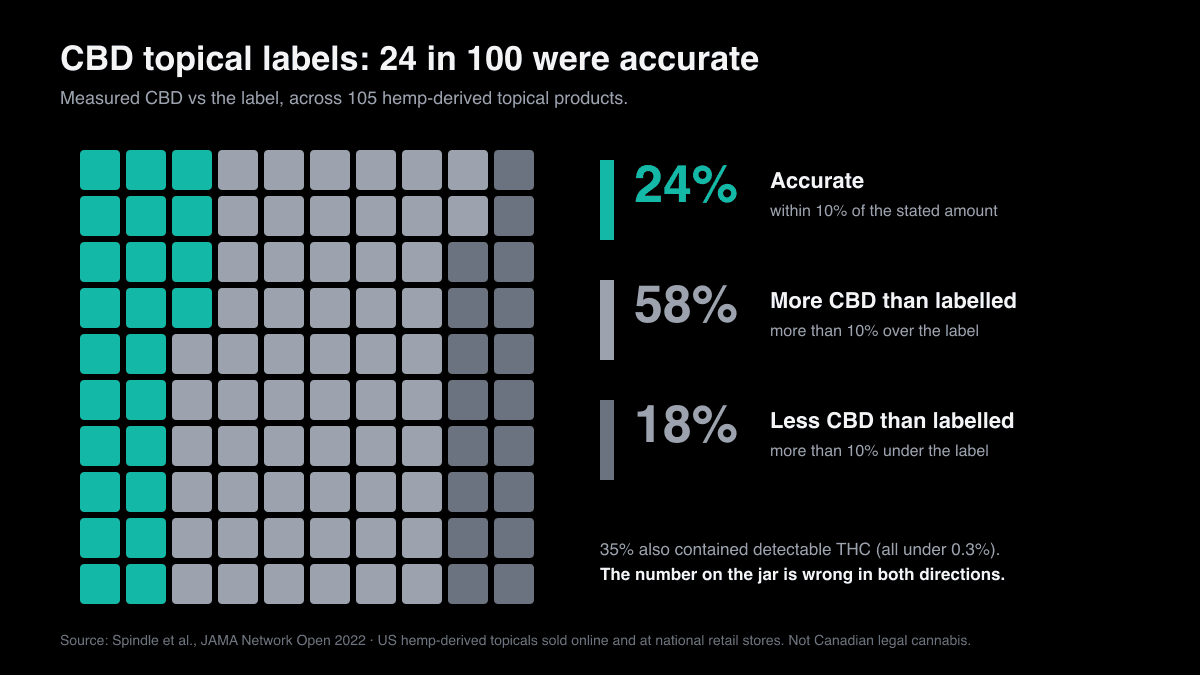
Usually not. When researchers tested 105 hemp-derived topical products bought online and from national retail chains, 24% were accurately labelled for CBD.[5]
| Result across 105 topical products[5] | Share |
|---|---|
| Accurately labelled for CBD (within 10% of the stated amount) | 24% |
| Over-labelled — more than 10% less CBD than advertised | 18% |
| Under-labelled — more than 10% more CBD than advertised | 58% |
| Contained detectable THC (all below the 0.3% hemp limit) | 35% |
Scope: US hemp-derived topicals sold online and at national retail stores, sampled for a 2022 study.[5] Not Canadian legal cannabis topicals, which are a different regime.
Notice which way the errors ran. Most mislabelled products held more CBD than claimed, not less — which is a labelling failure rather than a value judgement, and it means the number you are reasoning from is wrong in both directions across the category.
The comparison case is oral: an earlier study of 84 CBD extracts sold online found roughly 30% within 10% of their labelled content.[9] Different product class, different market, different year — so read the two figures side by side and never average them.
No topicals in stock right now — here is what is
Every CBD topical we list is currently sold out, so we are not going to put one in front of you. What we do have is oral CBD. It is a different route from everything on this page — swallowed, not applied — and none of the skin studies above apply to it. What carries over is the habit: read the milligram figure, and ask what it is a claim about.


Prices shown at time of writing.
What Can a Canadian CBD Topical Legally Contain and Claim?
A cannabis topical is capped at 1,000 mg of total THC per immediate container, and no limit is set on CBD at all.[8] What it may say is a separate and much tighter question.
Section 132.28 of the Cannabis Regulations prohibits representations that could create the impression that health or cosmetic benefits may be derived from a cannabis product.[7] Cosmetic benefits are named explicitly. Our acne article quotes the provision in full; we are not going to reproduce it here.
The practical consequence is worth stating for anyone comparing a Canadian product against an American one: the silence on a compliant Canadian label is regulatory, not modesty. The absence of a claim tells you nothing about the product, and the presence of one tells you the seller is somewhere they should not be.
How Should You Read a CBD Topical Claim?
Ask what was applied, to whom, and against what comparison. Three questions handle nearly every CBD skin claim in circulation, and our acne article has a four-question version that costs about thirty seconds.
| What the claim says | What to check | Why it matters |
|---|---|---|
| “Clinically studied” | Whether there was a control arm | Open-label results cannot separate the base from the CBD[4] |
| “1000 mg extra strength” | Whether the dose-response supports it | The one published curve plateaued[3] |
| “Deeply absorbing” | Whether any enhancer is disclosed | The enhancer is what moved the numbers[2] |
| “Third-party testing” | Whether you can read the actual document | Three quarters of tested labels missed[5] |
| “Proven to work” | Whether a randomised trial exists | None located for transdermal CBD |
If a certificate of analysis is offered, it is worth actually opening. Find the cannabinoid section and compare its CBD figure against the milligram number on the front — that one comparison is the check the 105-product study ran.
Frequently Asked Questions
Does CBD absorb through skin?
Some does. In the one human transdermal trial we could locate, cannabidiol and both of its major metabolites were detected in every participant’s urine sample, from a gel formulated with a permeation enhancer. How much crosses depends far more on what the CBD is dissolved in than on the milligram figure printed on the container.
Why is CBD a hard molecule to get through skin?
Because it strongly prefers oil to water. Passive transdermal delivery suits molecules under 500 daltons with a log P of 1 to 3, and cannabinoid log P runs 6 to 7. CBD is small enough but far too greasy, so it enters the outer layer of skin easily and then struggles to leave it.
Does a stronger CBD topical put more CBD into your skin?
Not indefinitely. In the only published transdermal dose-response study, blood levels in rats tracked dose closely across three lower gels and then broke that pattern entirely at a dose ten times higher, which produced no additional reduction in swelling. A larger number on a jar is not a published improvement.
What is a permeation enhancer?
An ingredient added to loosen the skin barrier so a difficult molecule can cross it. One study used Transcutol HP at 6% and saw blood CBD rise 3.7-fold; another used ethanol with isopropyl myristate; the human trial used a tocopheryl phosphate mixture. Retail products rarely disclose what base they use.
Has transdermal CBD been tested in people?
Once, in an open-label feasibility trial of fifteen people with hand osteoarthritis who applied a 4% gel for four weeks. Pain scores fell and grip strength rose, but self-reported function did not. The authors state plainly that proof of efficacy requires a placebo-controlled randomised trial, which has not been published.
Do CBD topical labels match what is in the jar?
Often not. When 105 hemp-derived topicals bought online and at national retail chains were tested, 24% were accurate for CBD within 10% of the stated amount. Fifty-eight percent contained more than advertised and 18% contained less. That sample was the US hemp market, not Canadian legal cannabis.
Does CBD from a topical reach your bloodstream?
In the studies that measured it, yes, at low concentrations. Guinea pigs reached a steady-state plasma level of about 6 ng/mL from a gel, and human participants had detectable CBD and metabolites in urine after four weeks. Those are purpose-built formulations, so do not read the figures onto a retail balm.
Why are most CBD skin studies done on animals?
Because they allow controlled dosing and tissue sampling that human trials cannot. The trade-off is that rodent and guinea pig skin is not human skin, so permeation figures do not carry across directly. It is a reason to read animal pharmacokinetics as an indication of direction rather than of quantity.
How much CBD can a Canadian cannabis topical contain?
There is no limit set on CBD in a cannabis topical. The cap that exists is on THC: 1,000 milligrams of total THC per immediate container. That is a composition rule rather than a safety endorsement of any particular amount, and it says nothing about how much of it crosses skin.
How should you read a CBD topical label?
Read the milligram figure as the amount in the container, not the amount delivered. Look for a certificate of analysis you can actually open, check whether any study cited had a control arm, and note that a compliant Canadian label makes no benefit claim because regulation prohibits it, not because the seller is being coy.
References
- Mahmoudinoodezh, H., Telukutla, S. R., Bhangu, S. K., Bachari, A., Cavalieri, F., & Mantri, N. The Transdermal Delivery of Therapeutic Cannabinoids. Pharmaceutics, 2022, 14(2), 438. DOI: 10.3390/pharmaceutics14020438 (Source of the log P 6–7 figure, the 2–5 µg/mL water solubility figure, the <500 Da / log P 1–3 passive-transdermal window, and the verbatim rate-limiting-step sentence quoted in the body.)
- Paudel, K. S., Hammell, D. C., Agu, R. U., Valiveti, S., & Stinchcomb, A. L. Cannabidiol bioavailability after nasal and transdermal application: effect of permeation enhancers. Drug Development and Industrial Pharmacy, 2010, 36(9), 1088–1097. DOI: 10.3109/03639041003657295 (Hairless guinea pigs, transdermal gel. Steady-state plasma CBD 6.3 ± 2.1 ng/mL at 15.5 ± 11.7 h; 3.7-fold increase with Transcutol HP at 6% v/v. The full-text PDF carries a different title form; the publisher record’s title is used here.)
- Hammell, D. C., Zhang, L. P., Ma, F., Abshire, S. M., McIlwrath, S. L., Stinchcomb, A. L., & Westlund, K. N. Transdermal cannabidiol reduces inflammation and pain-related behaviours in a rat model of arthritis. European Journal of Pain, 2016, 20(6), 936–948. DOI: 10.1002/ejp.818 (Rats, complete Freund’s adjuvant monoarthritic knee model, four consecutive days. Gels at 0.6, 3.1, 6.2 and 62.3 mg/day; plasma CBD 3.8 ± 1.4, 17.5 ± 4.4, 33.3 ± 9.7 and 1629.9 ± 379.0 ng/mL; linear across the three lower doses, slope 1.0, R² = 0.999. Vehicle: 72.5% w/w ethanol with isopropyl myristate.)
- Bawa, Z., Lewis, D., Gavin, P. D., Libinaki, R., Joubran, L., El-Tamimy, M., Taylor, G., Meltzer, R., Bedoya-Pérez, M., Kevin, R. C., & McGregor, I. S. An open-label feasibility trial of transdermal cannabidiol for hand osteoarthritis. Scientific Reports, 2024, 14, 11792. DOI: 10.1038/s41598-024-62428-x (Open-label, uncontrolled. 18 consented, 15 completed; 4% w/w transdermal gel with a tocopheryl phosphate mixture, three times daily for four weeks. CBD and metabolites detected in all urine samples; no THC detected.)
- Spindle, T. R., Sholler, D. J., Cone, E. J., Murphy, T. P., ElSohly, M., Winecker, R. E., Flegel, R. R., Bonn-Miller, M. O., & Vandrey, R. Cannabinoid Content and Label Accuracy of Hemp-Derived Topical Products Available Online and at National Retail Stores. JAMA Network Open, 2022, 5(7), e2223019. DOI: 10.1001/jamanetworkopen.2022.23019 (105 topical products; 24% accurately labelled for CBD within 10%; 18% over-labelled, 58% under-labelled; THC detected in 35%, all below 0.3%. US hemp-derived market, 2022 sampling.)
- Oláh, A., Tóth, B. I., Borbíró, I., et al. Cannabidiol exerts sebostatic and antiinflammatory effects on human sebocytes. Journal of Clinical Investigation, 2014, 124(9), 3713–3724. DOI: 10.1172/JCI64628 (Cultured human sebocytes and donated skin in organ culture; no human trial. Cited here only as the tier example — the study is covered in full in our cannabis and acne article, which owns it.)
- Government of Canada. Cannabis Regulations (SOR/2018-144), s. 132.28 — prohibition on representations that could create the impression that health or cosmetic benefits may be derived from a cannabis product. (Quoted verbatim in our cannabis and acne article; deliberately not reproduced here.)
- Government of Canada. Guide on composition requirements for cannabis products — 1,000 mg total THC per immediate container for cannabis topicals; no limit set on CBD or other cannabinoids. canada.ca
- Bonn-Miller, M. O., Loflin, M. J. E., Thomas, B. F., Marcu, J. P., Hyke, T., & Vandrey, R. Labeling Accuracy of Cannabidiol Extracts Sold Online. JAMA, 2017, 318(17), 1708–1709. DOI: 10.1001/jama.2017.11909 (84 products from 31 companies; approximately 30% within 10% of labelled CBD content. Oral extracts sold online in the 2017 US market — a different product class from the topicals in reference [5]. Do not average the two.)
This article is general information about the state of published research. It is not medical advice, and it does not describe any product sold on this website as suitable for any condition. Follow the cannabis laws applicable in your jurisdiction.