
Weed and Acne: What the Evidence Shows (and Doesn’t)
Published · Updated · Katie S.
Search does weed cause acne, does weed make you break out, weed breakouts or marijuana and acne and you get two confident answers, both wrong. One says smoking weed causes breakouts. The other says CBD clears them. Neither has the evidence behind it that the confident tone implies.
This page is about weed and skin as a question of evidence, not a pitch. Here is what has actually been measured, what has not, and how to tell the difference the next time a CBD skincare brand cites a study at you.
Key takeaways
- No published human study establishes that cannabis use causes acne. The question has barely been asked, let alone answered.
- The smoking-and-acne research is genuinely contradictory. A 2020 systematic review found “inconsistent evidence on whether smoking is a protective or risk factor” — and that is tobacco, not cannabis.[3]
- The famous CBD-and-sebum finding is real, well conducted, and was done on cells in a dish and donated skin in culture. There was no human trial in it.[1]
- Topical CBD has been tested on human acne once at scale: 368 patients, and it missed its primary endpoint. The company’s own disclosure explains why.[4]
- A 2025 meta-analysis of 17 studies and 3,359 participants found one statistically significant dermatology outcome for cannabinoids — a modest reduction in itch. Acne was not among the pooled outcomes.[2]
- In Canada it is illegal to put a cosmetic-benefit claim on a cannabis product. Cannabis Regulations s. 132.28, verbatim, below.[7]
- We sell CBD. We are not going to tell you it will fix your face.
Table of contents
- What actually causes acne?
- Does smoking weed cause acne?
- What does the research on smoking and acne show?
- Is cannabis smoke different from tobacco smoke?
- Do the munchies cause breakouts?
- Does weed raise testosterone enough to cause acne?
- Does CBD reduce sebum? What the 2014 study found
- Has CBD for acne been tested on real human acne?
- Why do skincare products seem to work when they don’t?
- How one lab study became “CBD clears acne”
- Four questions to ask about any cannabis skin claim
- Which claims about weed and skin hold up?
- Does it matter how you consume?
- Can a Canadian seller legally say CBD helps your skin?
- If you think weed is breaking you out, what can you check?
- Frequently asked questions
- References
What actually causes acne?
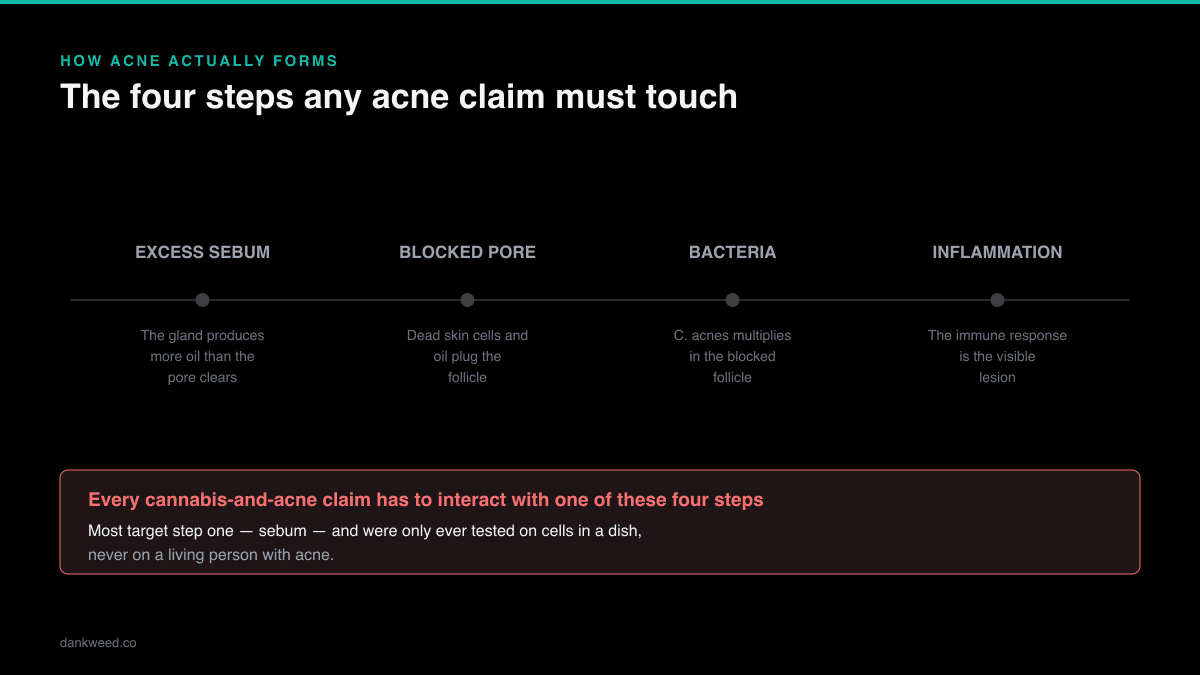
Acne is a disease of the hair follicle and the sebaceous gland attached to it. Four things happen together: the gland makes more sebum, the pore lining sheds cells that block the opening, bacteria colonise the trapped material, and the follicle wall inflames.
Every one of those four steps is under hormonal and genetic control before it is under anyone’s lifestyle control. The largest systematic review of acne epidemiology found a pooled odds ratio of 2.91 (95% CI 2.58–3.28) for having a parent with acne — one of the strongest and most consistent associations in the entire literature.[3]
That matters for this whole topic. Acne is common enough that almost any habit will look like a cause. The same review reports adolescent prevalence “ranging from 35% to close to 100%” depending on the population studied.[3] If most people get it and most people who use cannabis are young, the overlap is guaranteed whether or not there is any causal link.

Does smoking weed cause acne?
There is no published human study establishing that cannabis use causes acne. Not a positive one, and not a negative one either. The question has been asked in blog posts far more often than it has been asked in research.
That is an uncomfortable answer to give on a store’s website, because the honest version of “does weed cause breakouts” is a shrug with reasons attached. But inventing a verdict in either direction is how this topic got so unreliable in the first place.
What exists instead is a set of indirect arguments — smoke, appetite, hormones, sleep — each of which is a chain of two or three steps, and each of which gets thinner at every link. The rest of this page walks those chains and says where each one breaks.
| Argument | The proposed chain | Where it breaks |
|---|---|---|
| Smoke | Smoke irritates skin → inflammation → acne | The smoking-acne literature is contradictory even for tobacco, which is studied a hundred times more[3] |
| Appetite | Munchies → high-sugar food → acne | The appetite mechanism is well described in mice; the diet-to-acne link is itself unsettled[10][3] |
| Hormones | Cannabis alters androgens → sebum → acne | Three links, no human study connecting the last one |
| Sleep and stress | Disrupted sleep → cortisol → acne | Plausible for anyone’s sleep; nothing cannabis-specific has been measured for acne |
What does the research on smoking and acne show?
It genuinely disagrees with itself. The 2020 systematic review of acne epidemiology found “inconsistent evidence on whether smoking is a protective or risk factor,” with studies reporting results in opposite directions.[3]
This surprises people, because “smoking is bad for your skin” is treated as settled. For skin ageing and wound healing it is far better supported. For acne specifically, some cross-sectional studies find more acne in smokers, some find less, and the ones finding less are not obviously worse studies.
Two things follow. First, anyone telling you confidently that smoking causes acne is ahead of the evidence. Second — and this is the part the cannabis pages skip — all of that literature is about tobacco cigarettes. Extending a contradictory tobacco finding to cannabis adds a second layer of uncertainty on top of a first.
Is cannabis smoke different from tobacco smoke?
Chemically, yes, in measured ways. Health Canada researchers compared the two directly and found ammonia up to 20 times higher in mainstream cannabis smoke than tobacco, with hydrogen cyanide, nitric oxide and some aromatic amines three to five times higher.[9]
Mainstream polycyclic aromatic hydrocarbons were lower than tobacco in that comparison, while sidestream PAHs were higher.[9] So it is not a simple “worse” or “better” — the profile is different in both directions.
Here is the honest limit of that finding: it is a chemistry paper. It measured what is in the smoke. It did not measure anything about skin, and no one has run the follow-up. Reaching from “ammonia is elevated” to “your face breaks out” is exactly the kind of leap this article is about.
Do the munchies cause breakouts?
This is the strongest of the indirect arguments and it still has a broken link. The appetite effect is real and has a named mechanism. What it connects to — diet causing acne — is less settled than most people assume.
The mechanism first. In a mouse model, CB1 activation paradoxically increased the activity of hypothalamic POMC neurons and selectively drove release of β-endorphin rather than α-MSH, producing feeding; naloxone blocked it.[10] That is a real, specific, published pathway — in mice. Nobody needs convincing that appetite changes after cannabis, so the mechanism is not the weak point.
The weak point is the next link. The same systematic review that examined smoking found “inconsistent results between studies” on dietary factors, and said the association between diet and acne presentation or severity “was less clear” than family history.[3] High glycemic load has the best-supported case of any dietary factor, and even that is not a closed question.
So the honest version: if diet drives your acne, and if cannabis reliably changes what you eat, then there is an indirect route. Both conditionals are doing real work. This is the one argument worth taking seriously, and it is still not a finding about cannabis and skin — it is a finding about food.
Does weed raise testosterone enough to cause acne?
The chain is three links long and the last one is missing entirely. Acne is androgen-driven, cannabis has documented endocrine effects, and no study has connected those two facts to acne outcomes in people.
The endocrine research on cannabis is mixed on direction and size, and it is measured in blood hormone levels, not in lesion counts. A hormone shifting within its normal range is not the same event as a sebaceous gland changing its output, which is not the same event as a pore blocking.
We could write a paragraph here that sounds authoritative. It would be invented. The state of the evidence is that nobody has looked, and pretending otherwise is how the rest of the internet handles this cluster.
Does CBD reduce sebum? What the 2014 study found
Yes — in cultured human sebocytes and in donated human skin kept alive in culture. That study is real and it is good. It contained no human trial, and CBD was not acting through the cannabinoid receptors at all.[1]
Oláh and colleagues, publishing in the Journal of Clinical Investigation, showed that CBD at 1–10 µM suppressed lipid production induced by arachidonic acid and by a linoleic acid plus testosterone combination, and reduced sebocyte proliferation over 72 hours without killing the cells. The effect ran through TRPV4 ion channels, not CB1 or CB2, and a TRPV4 antagonist abolished it.[1]
Two details from that paper get left out of every summary of it. First, the same work shows that the skin’s own endocannabinoid, anandamide, increases sebaceous lipid production — CBD’s job in the experiment was to block that. Cannabinoid signalling in skin does not point one way.
Second, the authors’ own limitations are candid: no adequate animal model for acne exists, the pharmacokinetics of CBD in human skin are uncertain, and CBD’s effect on the acne-associated bacterium was not tested.[1] That last gap on human skin has not closed since, though the surrounding picture has filled in — what has and has not been measured about cannabidiol crossing skin is set out in our page on whether CBD absorbs through skin. Their conclusion was that CBD “has potential as a promising” agent. Potential is a word doing a specific job in that sentence.
| Claim you will see | What the study supports | Gap |
|---|---|---|
| “Clinically proven to reduce oil” | Lipid production fell in cultured sebocytes and skin organ culture[1] | No living participant was treated |
| “Works with your skin’s cannabinoid receptors” | The effect required TRPV4, and was unaffected by blocking CB1/CB2[1] | The receptor named in the marketing is the wrong one |
| “Cannabis is anti-acne because skin has an endocannabinoid system” | Skin has one, and anandamide pushes sebum up[1] | The direction of the argument is backwards |
| “Smoking CBD flower will help” | Nothing. The study applied CBD directly to the tissue | No route-of-administration data at all |
Has CBD for acne been tested on real human acne?
Once, at scale — and it did not work. A Phase 2 trial of a 5% topical CBD gel enrolled 368 patients with moderate to severe facial acne and missed its primary endpoint of change in inflammatory lesion count at week 12.[4]
The design was sound: three active arms of 92 patients each, plus 92 patients across two vehicle arms. The sponsor’s own disclosure states that the best-performing dose “was the best performing active dose, but statistical significance was not reached for this primary endpoint, due to the very high vehicle response from the USA sites.”[4]
The vehicle numbers are the interesting part. In Australia the placebo gel produced a 26.4% reduction in inflammatory lesions. At the US sites it produced 45.9%.[4] Same inert gel, wildly different result — which tells you something important about skincare evidence generally, covered in the next section.
The other human data is thin. A single-blind split-face study of a 3% cannabis seed extract cream in 11 participants reported reduced sebum and redness on the treated side.[11] A 2024 review in the American Journal of Clinical Dermatology lists the CBD acne human data as 23 participants of unpublished preliminary results, and notes that marketed CBD products “make unsubstantiated claims about their benefit to the skin.”[6] Whether the jar contains what the label says is a separate failure from what the label claims, and we handle that one on our CBD absorption and label-accuracy page.
Zoom out and the picture is consistent. A 2025 systematic review and meta-analysis pooled 17 studies and 3,359 participants across dermatology. Exactly one outcome reached statistical significance — a modest reduction in itch (SMD −0.29, 95% CI −0.52 to −0.06). Acne was not among the pooled outcomes, and the authors state that “most included studies were of low quality” and that cannabinoids “should not yet be recommended as standalone treatments for dermatologic conditions.”[2]
| Study | Participants | Design | Result |
|---|---|---|---|
| Phase 2 topical CBD gel[4] | 368 | Vehicle-controlled, 12 weeks, 5 arms | Missed primary endpoint |
| 3% cannabis seed extract cream[11] | 11 | Single-blind, split-face, 12 weeks | Sebum and redness reduced on treated side |
| CBD acne data in a 2024 review[6] | 23 | Preliminary, unpublished | Reported as favourable; not peer-reviewed |
| Dermatology meta-analysis[2] | 3,359 across 17 studies | Systematic review with pooling | Itch only; acne not pooled |
| Sebocyte and skin organ culture[1] | 0 living participants | In vitro and ex vivo | Sebum production fell |

Why do skincare products seem to work when they don’t?
Because acne improves on its own, in cycles, and because applying anything to your face twice daily for twelve weeks changes your behaviour as well as your skin. The trial above measured that effect directly: an inert gel cut inflammatory lesions by up to 45.9%.[4]
That is the single most useful number in this article. It is not a curiosity — it is the reason personal testimony about skincare, including yours and including ours, carries so little information. Nearly half the improvement people attribute to an active ingredient can appear with no active ingredient at all.
It also explains a pattern you will notice once you look for it. Small, uncontrolled skincare studies almost always report success. Large vehicle-controlled ones frequently do not. That is not because the big trials are badly run. It is because they include the comparison the small ones leave out.
How one lab study became “CBD clears acne”
Here is the decay chain, and you can watch it happen in real time on this topic. A finding loses one qualifier at each hop, and after four hops a cell-culture result has become a product claim.
Stage one is the paper: CBD suppressed lipogenesis in cultured sebocytes and skin organ culture via TRPV4, and the authors called it potential.[1] Stage two is a review article, which restates the finding accurately but compresses the model into a clause. Stage three is a brand’s science page, which drops the model entirely. Stage four is a product label.
We can demonstrate the hop rather than just assert it. A peer-reviewed 2024 review reports the Phase 2 trial as “40% reduction in acne lesions after 12 weeks” with “all doses safe with no adverse effects.”[5] Every word of that is defensible. The sponsor’s own filing for the same trial says the primary endpoint was not met because the vehicle arm improved almost as much.[4] One sentence is accurate and leaves you optimistic; the other is accurate and leaves you correctly informed.
The same chain runs for THC and acne, except there is no stage-one paper to decay from. Nobody has to be lying for this to happen. Each hop is a small, defensible compression, made by someone with less space than the person before them. That is why the fix is not “trust better sources” — it is knowing which qualifier goes missing first.
| Hop | What is dropped | What the claim looks like after |
|---|---|---|
| Paper → review | The experimental model | “CBD reduces sebum production” |
| Review → brand science page | The dose and the delivery route | “CBD is sebostatic” |
| Science page → marketing copy | The failed and null results | “Clinically studied for oily skin” |
| Marketing → your feed | That it is a claim at all | “CBD is good for acne” |
Four questions to ask about any cannabis skin claim
This is our framework, and it costs about thirty seconds. Run any “cannabis does X to your body” claim through it and most of them fall over at question one or question three.
- Was it people, or was it cells? “Human sebocytes” means human cells in a dish, not humans. This one distinction accounts for most of the overclaiming in cannabis skincare.
- Was there a control arm? If nothing inert was applied to a comparison group, the study cannot separate the ingredient from the routine. Given a 45.9% vehicle response, this is not a technicality.[4]
- Was the exposure anything like yours? A study applying purified CBD directly to tissue says nothing about smoking, vaping or eating cannabis. Route matters more here than dose, and what is known about the topical route specifically is on our CBD absorption page.
- Does the mechanism point the way the claim does? “Skin has cannabinoid receptors” is used to argue that cannabis helps skin. The same body of work shows the skin’s own endocannabinoid raising sebum.[1]
Question four is the one that catches the sophisticated claims. Mechanism talk sounds like evidence and is usually the part of a claim with the least evidence attached, because a receptor existing somewhere tells you nothing about which direction it moves.
Which claims about weed and skin hold up?
Almost none of them cleanly. Here is every popular claim in this cluster with a verdict and, where one exists, a source. Where nothing exists we say so rather than filling the row.
| Claim | Verdict | Basis |
|---|---|---|
| Smoking weed causes acne | Unestablished | No human study; the tobacco literature it borrows from is contradictory[3] |
| Weed detoxes your skin | No basis | Nothing measured; “detox” is not a defined outcome |
| CBD is clinically proven for acne | False | The one large vehicle-controlled trial missed its primary endpoint[4] |
| CBD reduces sebum production | True in cell and skin culture | Oláh et al., no human trial[1] |
| Cannabinoids help itchy skin | Weak but statistically significant | Pooled SMD −0.29 across controlled studies[2] |
| The munchies make you break out | Possible, indirect, unproven | Appetite mechanism in mice; diet-acne link unsettled[10][3] |
| Weed makes your face red | Vasodilation is real; the acne link is not studied | No acne outcome measured |
| Quitting weed cleared my skin | Uninformative on its own | Acne cycles; a 45.9% improvement occurred on inert gel[4] |
| Indica is better for skin than sativa | No basis | Those labels do not predict chemistry — see our pillar on it |
Does it matter how you consume?
For skin specifically, nobody has compared routes. What can be said is which arguments even apply to which format — the smoke argument cannot apply to an edible, and the sebum research applies to none of them, because it was applied directly to tissue.
| Format | Smoke argument | Appetite argument | Direct-to-skin research applies? |
|---|---|---|---|
| Smoked flower | Applies in principle[9] | Yes | No |
| Vapes and carts | Not combustion; different exposure, unstudied for skin | Yes | No |
| Edibles | Does not apply | Yes | No |
| Topicals | Does not apply | No | Closest, and still only the failed trial[4] — for what is known about getting cannabidiol across skin at all, see whether CBD absorbs through skin |
If you want the detail on what each of those formats actually is, we have written it up properly: vapes, carts and pens, edibles dosing, concentrates, and what CBD is. None of those pages makes a skin claim either, for the same reason this one does not.
One thing worth saying plainly, and it is not a skin claim: the Canadian lower-risk cannabis use guidelines advise against deep inhalation and breath-holding, on straightforward respiratory grounds.[12] That recommendation stands regardless of what your face is doing.
Can a Canadian seller legally say CBD helps your skin?
No. Cannabis Regulations s. 132.28 prohibits any representation that could create the impression that health or cosmetic benefits may be derived from a cannabis product. Cosmetic benefits are named explicitly.[7]
The text, verbatim: it is prohibited to make an express or implied representation, including by way of a brand element, on a cannabis product or its package, insert, leaflet, label or panel, “if there are reasonable grounds to believe that the representation could create the impression that health or cosmetic benefits may be derived from the use of the cannabis product.”[7]
There is a second layer. Under the Cannabis Act, all phytocannabinoids including CBD fall under the Act regardless of source, and Health Canada states plainly that “there is no legal pathway to market a natural health product containing CBD.”[8] That is why you cannot buy a CBD face cream off a Canadian pharmacy shelf the way you can in some other markets.
So when a page selling you cannabis tells you it will fix your skin, one of two things is true: it is offshore, or it is out of compliance. We are neither, which is a commercial constraint we would rather name than work around.

If you think weed is breaking you out, what can you check?
You cannot run a controlled trial on yourself, but you can avoid the two errors that make personal experiments useless: changing several things at once, and judging over too short a window.
Acne lesions turn over on a scale of weeks, and the vehicle data above shows how much apparent improvement can arrive from nothing in particular over twelve.[4] A two-week self-test tells you about the cycle you were already in.
| Common error | Why it misleads | Better version |
|---|---|---|
| Judging after a week or two | Shorter than the lesion cycle | Give any change 8–12 weeks before reading it |
| Changing several things at once | Nothing is attributable afterwards | Change one variable and hold the rest |
| Comparing to memory | Memory tracks mood, not lesion counts | Same-light photographs on the same day each week |
| Testing the wrong variable | Format, sleep and diet all moved together | Separate the smoke argument from the appetite one |
| Self-managing moderate or severe acne | Scarring risk rises with delay | See a physician or dermatologist — this is a medical condition with real treatments |
That last row is the important one and it is where a cannabis store’s usefulness ends. Acne that is painful, cystic or scarring is a clinical problem, and nothing sold on this website is an alternative to having it looked at.
Frequently asked questions
Does weed cause acne?
No published human study establishes that it does. The arguments people make are indirect — smoke, appetite, hormones — and each one has a missing link. The tobacco smoking literature that the smoke argument borrows from is itself contradictory, with a 2020 systematic review finding evidence pointing in both directions.
Does CBD oil for acne actually work?
It has not been shown to. The largest test was a Phase 2 trial of a 5% topical CBD gel in 368 patients, and it missed its primary endpoint at twelve weeks. The lab research showing CBD reduces sebum was done on cultured cells and donated skin, not on living participants.
Why do so many sites say CBD is proven for acne?
Because a single well-conducted 2014 laboratory study is quoted without its model. Each retelling drops one qualifier: first the cell culture, then the dose and route, then the failed human trial. After four hops a cell-dish result reads as a product claim without anyone stating a falsehood.
Do the munchies make you break out?
Possibly, indirectly, and it is unproven. The appetite effect has a documented mechanism, though the key study is in mice. The next link is weaker than people assume: reviews of acne epidemiology report inconsistent results for dietary factors, with high glycemic load the best supported and still not settled.
Is smoking weed worse for skin than vaping it?
Nobody has compared them for skin. Cannabis smoke has a measured chemical profile that differs from tobacco in both directions, but no study has followed that through to a skin outcome. Anyone ranking formats for your complexion is guessing with confidence.
Can a Canadian store sell CBD cream for acne?
Not with that claim on it. Cannabis Regulations s. 132.28 prohibits representations that could create the impression of health or cosmetic benefits from a cannabis product. Health Canada also states there is currently no legal pathway to market a natural health product containing CBD in Canada.
My skin cleared after I quit weed. Doesn’t that prove it?
Not on its own, unfortunately. Acne runs in cycles, and in the Phase 2 trial an inert gel with no active ingredient reduced inflammatory lesions by up to 45.9% at the American sites. That is the size of improvement that can appear from nothing in particular over twelve weeks.
Does THC affect skin differently from CBD?
The sebum research used CBD, and it worked through TRPV4 ion channels rather than the cannabinoid receptors THC acts on. So the findings do not transfer across. There is no comparable body of work on THC and sebaceous glands, and no human acne trial of either compound that succeeded.
What does the strongest evidence on cannabinoids and skin actually show?
A 2025 meta-analysis pooled 17 studies and 3,359 participants across dermatology. One outcome reached significance: a modest reduction in itch. Dryness, redness, quality of life and eczema severity did not. The authors described most included studies as low quality and advised against standalone use.
Should I stop using cannabis to fix my acne?
That is a decision no evidence currently supports either way, so it is yours. If your acne is painful, cystic or leaving marks, the higher-value move is seeing a physician or dermatologist, because effective prescription treatments exist and delay increases scarring risk. A store cannot help you with that part.
References
- Oláh A, Tóth BI, Borbíró I, et al. Cannabidiol exerts sebostatic and antiinflammatory effects on human sebocytes. Journal of Clinical Investigation. 2014;124(9):3713–3724. DOI 10.1172/JCI64628. Cultured human SZ95 sebocytes and full-thickness human skin organ culture. No human trial.
- Sermsaksasithorn P, et al. Cannabis and cannabinoids in dermatology: a systematic review and meta-analysis of quantitative outcomes. Frontiers in Pharmacology. 2025;16:1609667. DOI 10.3389/fphar.2025.1609667. 17 studies, 3,359 participants; pruritus SMD −0.29 (95% CI −0.52 to −0.06); no other pooled outcome significant.
- Heng AHS, Chew FT. Systematic review of the epidemiology of acne vulgaris. Scientific Reports. 2020;10:5754. DOI 10.1038/s41598-020-62715-3. Family history pooled OR 2.91 (95% CI 2.58–3.28); inconsistent evidence on smoking as risk or protective factor; dietary findings inconsistent.
- Botanix Pharmaceuticals Ltd. BTX 1503 acne Phase 2 study results. ASX/Media release, 23 October 2019. Sponsor disclosure, not peer-reviewed: 368 subjects; 5% BID, 5% QD, 2.5% QD and two vehicle arms; primary endpoint absolute change in inflammatory lesion count at week 12 not met; vehicle reduction 26.4% (Australia) versus 45.9% (USA).
- Ferreira I, Lopes CM, Amaral MH. Treatment advances for acne vulgaris: the scientific role of cannabinoids. Cosmetics. 2024;11(1):22. DOI 10.3390/cosmetics11010022. Cited here as the example of a peer-reviewed review reporting the Phase 2 lesion reduction without the vehicle comparison.
- Yoshizaki A, et al. The potential role of cannabidiol in cosmetic dermatology: a literature review. American Journal of Clinical Dermatology. 2024;25:951–966. DOI 10.1007/s40257-024-00891-y.
- Cannabis Regulations (SOR/2018-144), s. 132.28 — prohibited representation, health and cosmetic benefits. Justice Laws Website.
- Health Canada. Towards a pathway for health products containing cannabidiol: natural health products containing cannabidiol. All phytocannabinoids including CBD fall under the Cannabis Act; no legal pathway currently exists to market a natural health product containing CBD.
- Moir D, Rickert WS, Levasseur G, et al. A comparison of mainstream and sidestream marijuana and tobacco cigarette smoke produced under two machine smoking conditions. Chemical Research in Toxicology. 2008;21(2):494–502. DOI 10.1021/tx700275p. Health Canada authors.
- Koch M, Varela L, Kim JG, et al. Hypothalamic POMC neurons promote cannabinoid-induced feeding. Nature. 2015;519:45–50. DOI 10.1038/nature14260. Mouse model.
- Ali A, Akhtar N. Single-blind split-face study of a 3% cannabis seed extract cream on cheek skin sebum and erythema, 2015. n=11, 12 weeks. Cited via reference [5]. The primary text could not be retrieved from this run, so volume and page numbers are deliberately not stated rather than guessed. Verify before print use.
- Fischer B, Russell C, Sabioni P, et al. Lower-risk cannabis use guidelines: a comprehensive update of evidence and recommendations. American Journal of Public Health. 2017;107(8):e1–e12. DOI 10.2105/AJPH.2017.303818.
This article is general information about the state of published research. It is not medical advice, and it does not describe any product sold on this website as a treatment for anything.