
THC Tolerance and Dosing: What a Tolerance Break Resets
Published · Updated · Katie S.
Everyone who has used cannabis for a while has had the same conversation about tolerance, and almost every claim in it traces back to two brain-imaging studies that disagree with each other. Here is what has been measured, what has not, and why the part of tolerance people notice is not the part that matters.
Key Takeaways
- Tolerance to cannabis is real and visible in the brain. Imaging of chronic daily smokers found downregulation of CB1 receptors that was selective to cortical regions and correlated with years of smoking.[1]
- Nobody has measured how long a tolerance break should be. The two human imaging studies disagree by roughly a factor of fourteen: about four weeks in one,[1] two days in the other.[2]
- Neither study measured whether the high came back. They measured receptors. That is a different question from the one you are asking.
- Tolerance blunts the high but not the impairment. Across 122 users from infrequent to near-daily, acute neurocognitive effects were similar irrespective of use history.[3]
- Stopping is not free. Pooled across 47 studies and 23,518 people, 47% of those with regular or dependent use showed withdrawal symptoms.[4]
- No study has tested whether tolerance carries between smoking and edibles. The claim that switching format resets anything is untested, in both directions.
- Canadian law has no concept of tolerance at all. It caps what a package may contain;[9] the only official guidance on frequency is to use less often.[6]
What Is Cannabis Tolerance?
Tolerance is the same dose producing a smaller effect after repeated exposure. In cannabis it is clearly measurable at the receptor, weakly measurable in how high people feel, and — this is the part almost nobody knows — not measurable at all in how impaired they are.
That split is the whole subject. Treating weed tolerance as one thing that goes up and comes down is what makes the standard advice so confident and so frequently wrong. Four different phenomena share the word, and they are measured by four different instruments on four different timescales.

What Causes THC Tolerance?
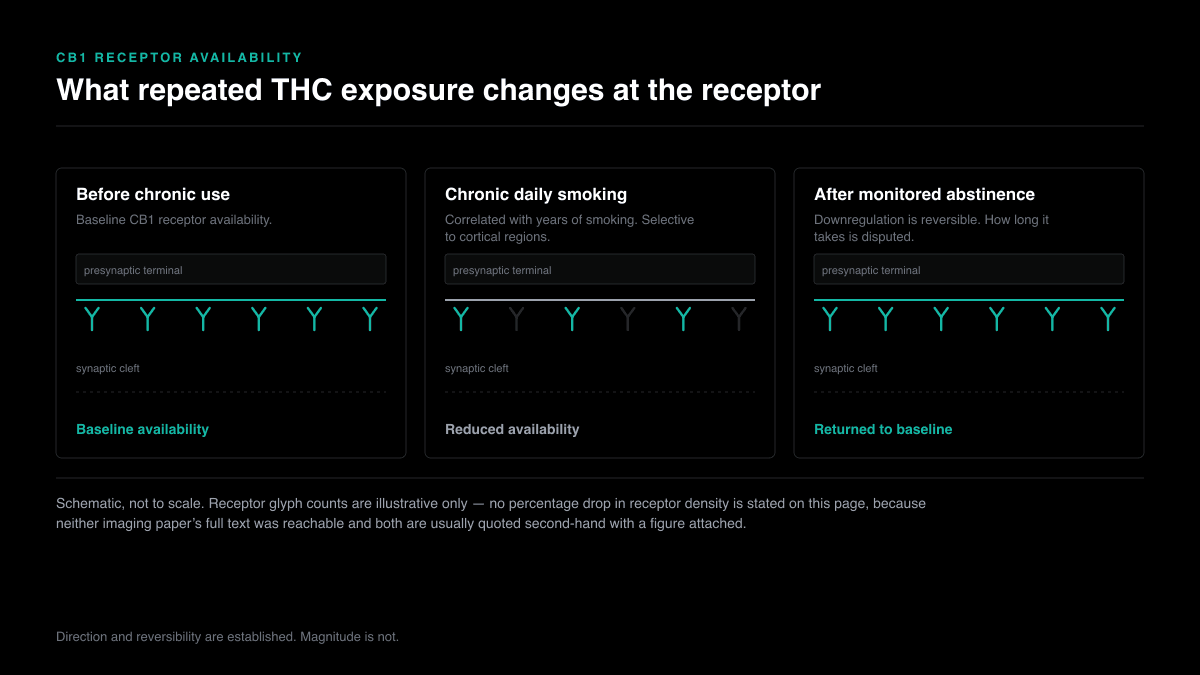
Repeated THC exposure reduces the availability of CB1 receptors in the brain. Positron emission tomography of chronic daily cannabis smokers found downregulation that was regionally selective to cortical areas and correlated with years of smoking.[1]
The 2012 study that established this in humans is worth quoting rather than paraphrasing, because it is the source almost every tolerance article is unknowingly citing. Its own summary reports reversible and regionally selective downregulation of brain cannabinoid CB1 receptors in human subjects who chronically smoke cannabis,
and adds that downregulation correlated with years of cannabis smoking and was selective to cortical brain regions.
[1]
A number we are deliberately not printing: the percentage drop in receptor density. Neither imaging paper’s full text was reachable from this research pass, and both are usually quoted second-hand with a figure attached. Direction and reversibility are established. Magnitude is not something we can state responsibly here.
| What changes | Direction | Evidence status |
|---|---|---|
| CB1 receptor availability | Falls with chronic use | Measured by PET imaging in humans[1][2] |
| Subjective intoxication | Tends to fall with use frequency | A non-significant trend in the largest study[3] |
| Neurocognitive impairment | Does not appear to fall | Measured: similar across use histories[3] |
| The dose you reach for | Rises | Not measured in any study we located |
| Potency of what you bought | Varies between lots | Legal dried flower declared 143–261 mg/g[11] |
The last row is not tolerance and is often mistaken for it. A weaker experience can be a weaker batch, and a declared potency figure is not a guarantee of what is in the jar.
How Long Does a Tolerance Break Take?
Nobody has measured it. The two human imaging studies that looked at recovery disagree by roughly a factor of fourteen — about four weeks in one, two days in the other — and neither of them measured whether the high came back.
This is the single most repeated number in cannabis writing and it has no measured basis. The 2012 study reports that after ∼4 weeks of continuously monitored abstinence from cannabis on a secure research unit, CB1 receptor density returned to normal levels.
[1] That sentence is where the popular month-long tolerance break comes from.
A 2016 study using a different tracer found something much faster. In eleven cannabis-dependent men and nineteen healthy controls, the dependent group had lower CB1 receptor availability at baseline, and those group differences in CB1R availability were no longer evident after just 2 days of monitored abstinence from cannabis.
[2]
| Hirvonen et al. 2012[1] | D’Souza et al. 2016[2] | |
|---|---|---|
| Population | Chronic daily cannabis smokers | Cannabis-dependent males, and controls |
| Recovery reported at | About four weeks | Two days |
| Abstinence conditions | Continuously monitored, secure research unit | Monitored abstinence |
| What was measured | Receptor density | Receptor availability |
| Subjective high measured? | Not reported as an outcome | Not reported as an outcome |
| Imaging ligand | Not stated here — full text not accessed | [11C]OMAR |
Different tracers, different populations, different definitions of the outcome. The two are not straightforwardly comparable, which is precisely why averaging them into “two to four weeks” is not a summary of anything.
A 2023 scope review of the tolerance literature reaches the same place from a different direction, concluding that the heterogeneity of measurements results in poor standardization and a lack of rigor in what is understood as cannabis tolerance.
[5] The review reports one study in which tolerance persisted about 7.5 days after 6.5 days of sustained THC administration and was gone by 11.5 days[5] — a third timeline, from a third method.
What would settle it: a trial randomising people to different abstinence durations and then measuring their response to a fixed dose. We could not locate one. Until it exists, every specific tolerance-break length in circulation is an extrapolation from receptor imaging, and receptor imaging did not ask the question.
Does Tolerance Protect You From Being Impaired?
No, and this is the most consequential finding on the page. Across 122 users whose histories ranged from infrequent to near-daily, acute effects on neurocognitive performance were similar regardless of how much cannabis they used.[3]
The study gave participants vaporised cannabis at 300 µg/kg of THC, with cocaine and placebo as comparison conditions.[3] Executive function, impulse control, attention, psychomotor function and subjective intoxication were all significantly worse after cannabis than after placebo.[3]
Its conclusion is quoted here verbatim because the wording matters: Acute effects of cannabis and cocaine on neurocognitive performance were similar across cannabis users irrespective of their cannabis use history. Absence of tolerance implies that that frequent cannabis use and intoxication can be expected to interfere with neurocognitive performance in many daily environments such as school, work or traffic.
[3]
The other half, stated so this is not overcorrected: in the same study subjective intoxication tended to decrease as use frequency rose, but only as a statistical trend rather than a significant result.[3] So the feeling of tolerance is real, weakly evidenced, and separate from the impairment it does not cover.
Canada’s lower-risk guidelines already say impairment can persist beyond the subjective high and recommend not driving for at least six hours after use.[7] Read alongside the tolerance data, that recommendation applies with more force to a daily user than to a first-timer, not less.
Do All Cannabis Effects Build Tolerance Equally?
No, and the differences are large enough that using one word for all of them is misleading. A 2023 scope review found tolerance reported inconsistently across physiological, cognitive, behavioural and subjective measures, with no standard definition holding across them.[5]
The review’s own framing is that cannabis tolerance show a disparity between the effects produced after a first administration compared to its chronic use,
across heterogeneous cannabinoids, doses and routes.[5] That heterogeneity is the finding, not a limitation of the finding.
| Domain | Does tolerance develop? | Evidence status |
|---|---|---|
| Receptor availability | Yes, and it reverses | Measured directly in humans, twice, with conflicting timelines[1][2] |
| Subjective high | Probably, weakly | A non-significant trend in the largest controlled sample[3] |
| Neurocognitive impairment | Apparently not | Measured: similar across use histories[3] |
| Physiological effects | Reported, inconsistently | Heterogeneous across the reviewed literature[5] |
| Behavioural and contextual | Barely studied | The review names contextual cues as a gap in cannabis research[5] |
The practical reading of that table is uncomfortable. The rung of the ladder you can feel — the high — is the one with the weakest evidence behind it. The rung you cannot feel at all is the one that has actually been measured, and it did not move.
Does Smoking Tolerance Carry Over to Edibles?
No study we could locate has measured it. Every page telling you that edibles bypass your tolerance, or that switching format resets it, is asserting something the published literature has not tested in either direction.
The mechanism argument runs both ways, which is why the absence of data matters. Downregulated CB1 receptors are downregulated whatever route the THC arrived by, which argues for tolerance carrying across. Oral dosing produces a different concentration curve and a different metabolite load, which argues that the experience will differ regardless of tolerance.
Both arguments are reasonable and neither has been tested. What is well established is that the routes behave differently in the body — our edibles dosing guide covers the onset and duration figures, and our vapes and carts guide covers the inhaled side.
A sourcing note that applies to this whole topic: almost everything written about edible tolerance, tolerance-break length and “resetting” comes from retailers and content farms. We have found no peer-reviewed dose-response study of any of it. Treat any specific number in that genre as vendor material until someone produces the paper.

Is Reverse Tolerance Real?
There is almost no modern evidence in either direction. The idea that long-term users become more sensitive rather than less circulates constantly in cannabis writing, and it rests on a literature that is close to empty.
The claim is old — it was being debated as a pharmacological question versus a psychological one in the early 1970s — and it has not attracted much serious study since. We could locate no recent controlled human work establishing sensitisation to THC in experienced users.
There are duller explanations for the experience people describe. A long-time user knows what to expect and interprets the same signal differently. Set, setting and expectation shape a subjective report. And a batch is not a constant: declared THC in legal Canadian dried flower spans a wide range between products.[11] None of that requires reverse tolerance to explain.
What Happens When You Stop?
Roughly half of people with regular or dependent use experience withdrawal symptoms. A meta-analysis pooling 47 studies and 23,518 participants put the overall prevalence at 47%, with a confidence interval of 41% to 52%.[4]
That headline figure conceals a large spread by setting, and the spread is more useful than the average. The same analysis reported 17% in population-based samples, 54% in outpatient samples and 87% in inpatient samples,[4] with higher prevalence associated with daily use and with concurrent tobacco or other substance use disorders.[4]
| Sample type | Pooled prevalence | 95% confidence interval |
|---|---|---|
| All samples pooled | 47% | 41%–52%[4] |
| Population-based | 17% | 13%–21%[4] |
| Outpatient | 54% | 48%–59%[4] |
| Inpatient | 87% | 79%–94%[4] |
A general-population figure of 17% and a clinical figure of 87% are not the same claim. Someone taking a break after daily use is closer to the higher end of that range than to the lower one.
Two things follow, and they point in opposite directions. A tolerance break has a cost that the advice rarely mentions. And that cost is itself evidence that the exposure was doing something worth interrupting.
The Four Different Things People Call Tolerance
Four separate phenomena share the word, they are measured by four different instruments, and they recover on four different clocks. This is our framework rather than any single paper’s result, and it explains why tolerance-break advice contradicts itself so reliably.
Every confident claim about tolerance is really a claim about one of these four layers, applied as though it described all of them. Once they are separated, most of the disagreement in the topic dissolves into people answering different questions.
| Layer | What it is | How it is measured | What is known about recovery |
|---|---|---|---|
| 1. Receptor | CB1 availability in the brain | PET imaging | Reverses — but two studies say two days and about four weeks[1][2] |
| 2. Subjective | How high a given dose feels | Self-report scales in dosing studies | Weakly evidenced even as an effect; recovery never measured[3] |
| 3. Functional | How impaired you actually are | Neurocognitive test batteries | No tolerance found, so nothing to recover[3] |
| 4. Behavioural | The dose you habitually reach for | Not measured in any study we located | Unstudied; the layer most under your control |
Layer one is what the science measured. Layer two is what you are asking about. Layer three is what matters if you have to drive, work or make a decision. Layer four is the only one that changes the moment you decide it does, and it is the one no paper has ever examined.
The advice fails because it borrows layer one’s evidence to make a promise about layer two, then quietly implies layer three comes along for free. It does not. That is the finding.

What Does Tolerance Mean for How You Dose?
That the published starting numbers are written for someone with no tolerance, and that escalating your dose is the expensive answer to a problem abstinence addresses for nothing. Canadian guidance still starts everyone at 2.5 mg of THC or less.[8]
Those numbers are not calibrated to you, and there is no published table that is. Nothing in the literature converts a use history into a personal dose, which is why every dosing guide including ours starts from the same conservative figure and tells you to move slowly from there.
| The question | What tolerance changes | What it does not change |
|---|---|---|
| Where to start | Nothing published. The 2.5 mg figure is the same for everyone[8] | The need to wait before adding more |
| Whether the effect will feel weaker | Probably yes, weakly evidenced[3] | That a weaker feeling can also mean a weaker batch[11] |
| Whether you are safe to drive | Nothing. Impairment did not decline with use history[3] | The six-hour recommendation, which still applies[7] |
| Whether to escalate | Escalation is the reflex; the evidence does not endorse it | That the dose you reach for is a choice, not a symptom |
| Whether a break will work | Receptors recover. Whether the high does is unmeasured | That withdrawal is common at the daily-use end[4] |
General information about published research, not medical advice, and not a recommendation to consume any amount.
One practical suggestion that costs nothing and is not a claim about anything: write down what you took and what happened. Nobody has your data, and four layers of uncertainty are easier to separate on paper than in memory.
What Do Canadian Rules Say About Tolerance?
Nothing at all. Neither the Cannabis Act nor the Cannabis Regulations contains any concept of personal tolerance. What Canadian law regulates is the package, and the only official guidance on frequency is guidance to use less often.[6]
The regulatory architecture is built around composition limits rather than consumption. Edible cannabis is capped at 10 mg of total THC per immediate container, extracts intended for ingestion at 10 mg per discrete unit, and cannabis extracts at 1,000 mg of THC per immediate container.[9] None of those figures is adjusted for anybody.
There is a second constraint that explains the silence. Health Canada’s labelling rules prohibit representations suggesting a benefit may be derived from a cannabis product.[10] A licensed producer therefore may not tell you how to dose for your tolerance, even where it knows. The gap that leaves is filled by retailers, which is exactly the material this article has spent its length declining to cite.
| Item | Addressed in Canadian rules? | Detail |
|---|---|---|
| Personal tolerance | No | The concept does not appear in the Act or the Regulations |
| THC per edible container | Yes | 10 mg of total THC per immediate container[9] |
| THC per ingestible extract unit | Yes | 10 mg per discrete unit[9] |
| THC per extract container | Yes | 1,000 mg per immediate container[9] |
| How much a person may consume | No | Not a regulated quantity |
| Advice on frequency | Guidance only | Limit to occasional use, one day a week or less[6] |
| A producer advising on dose | Constrained | No representation that a benefit may be derived[10] |
Health Canada’s lower-risk guidelines are worth reading in their own words rather than ours. They recommend that people avoid frequent or intensive use, and limit consumption to occasional use, such as only one day a week or weekends, or less,
and separately recommend using products with low THC content and high CBD: THC ratios.
[6] That is a public-health recommendation, not a rule, and it is the closest thing Canada publishes to tolerance advice.
Two hedges, as always. Cannabis is regulated federally and provincially at once, and provinces add their own rules. And this is general information about published requirements, not legal advice.
Frequently Asked Questions
What is a THC tolerance break?
A period of abstinence taken in the hope of restoring a stronger response to the same dose. Brain imaging shows that CB1 receptor changes from chronic use do reverse during monitored abstinence. What no study has measured is how long a break must be before the subjective high returns, which is the question people are actually asking.
How long should a tolerance break be?
There is no measured answer. The two human imaging studies report recovery of CB1 receptor availability after about four weeks and after just two days respectively, using different tracers and different populations. Neither measured subjective response. Any specific number you read is an extrapolation from receptor imaging that did not ask that question.
Does cannabis tolerance mean you are less impaired?
No. In a controlled study of 122 users ranging from infrequent to near-daily, acute effects on executive function, impulse control, attention and psychomotor performance were similar irrespective of cannabis use history. The authors describe this as an absence of tolerance and note it implies interference with performance at school, work or in traffic.
What causes tolerance to THC?
Repeated exposure downregulates CB1 cannabinoid receptors. A positron emission tomography study of chronic daily cannabis smokers found the downregulation was reversible, selective to cortical brain regions, and correlated with years of smoking. That is the mechanism nearly every article on this topic is citing, usually without naming it.
Do edibles reset your tolerance?
No study we could locate has tested it. The receptor changes underlying tolerance are not route-specific, which argues that tolerance carries across formats. Oral dosing does produce a different concentration curve, which argues the experience will differ anyway. Both arguments are reasonable and neither has been measured.
Is reverse tolerance to cannabis real?
There is almost no modern evidence either way. The question was debated in the early 1970s and has attracted little controlled study since. Duller explanations cover most of what people describe: familiarity with the effect, expectation, setting, and genuine variation in potency between one product and the next.
What are the symptoms of stopping cannabis?
Withdrawal symptoms are common at the regular-use end. A meta-analysis of 47 studies and 23,518 participants put the pooled prevalence at 47%, ranging from 17% in population-based samples to 87% in inpatient samples. Higher rates were associated with daily use and with concurrent tobacco or other substance use.
Should you increase your dose as tolerance builds?
The evidence does not endorse it. Escalation is the reflex answer, but the effect it targets is the weakly evidenced one, and it does nothing for the impairment that did not decline with use history in the first place. Reducing frequency is the better supported lever and it costs nothing.
How much THC should a regular user take?
No published guidance answers that. Canadian public health advice starts everyone at 2.5 mg of THC or less regardless of history, and nothing in the literature converts a use pattern into a personal dose. That absence is real rather than an oversight, and it is why this page prints no personalised figure.
Do Canadian rules account for cannabis tolerance?
No. Neither the Cannabis Act nor the Cannabis Regulations contains any concept of personal tolerance. The rules cap what a package may contain rather than what a person may consume, and labelling rules prevent a producer from suggesting a benefit, so no legal seller may advise you on dosing for tolerance.
References
- Hirvonen, J., Goodwin, R. S., Li, C.-T., Terry, G. E., Zoghbi, S. S., Morse, C., Pike, V. W., Volkow, N. D., Huestis, M. A., & Innis, R. B. (2012). Reversible and regionally selective downregulation of brain cannabinoid CB1 receptors in chronic daily cannabis smokers. Molecular Psychiatry, 17(6), 642–649. DOI 10.1038/mp.2011.82. Source for reversible, regionally selective cortical CB1 downregulation, the correlation with years of cannabis smoking, and the return to normal receptor density after approximately four weeks of continuously monitored abstinence on a secure research unit. The publisher’s own abstract was read directly on nature.com on 30 August 2026; the full text was not accessible this run (PMC returned a reCAPTCHA and a hosted PDF returned 403), so no percentage figure, subject count or tracer is stated on this page.
- D’Souza, D. C., Cortes-Briones, J. A., Ranganathan, M., Thurnauer, H., Creatura, G., Surti, T., Planeta, B., Neumeister, A., Pittman, B., Normandin, M. D., Kapinos, M., Ropchan, J., Huang, Y., Carson, R. E., & Skosnik, P. D. (2016). Rapid changes in cannabinoid 1 receptor availability in cannabis-dependent male subjects after abstinence from cannabis. Biological Psychiatry: Cognitive Neuroscience and Neuroimaging, 1(1), 60–67. DOI 10.1016/j.bpsc.2015.09.008. Source for eleven cannabis-dependent males and nineteen healthy controls imaged with the reversible ligand [11C]OMAR, for lower baseline CB1 receptor availability in the dependent group, and for group differences being no longer evident after just two days of monitored abstinence. Bibliographic record and abstract read via a bibliographic index on 30 August 2026; publisher full text not accessed. The index record reports an approximate percentage for the baseline difference; it is deliberately not repeated here.
- Ramaekers, J. G., van Wel, J. H., Spronk, D. B., Toennes, S. W., Kuypers, K. P. C., Theunissen, E. L., & Verkes, R. J. (2016). Cannabis and tolerance: acute drug impairment as a function of cannabis use history. Scientific Reports, 6, 26843. DOI 10.1038/srep26843. Source for N = 122 drug users allocated across four cannabis use-history groups, an acute vaporised dose of 300 µg/kg THC with cocaine and placebo as comparison conditions, significantly worse executive function, impulse control, attention, psychomotor function and subjective intoxication after cannabis than placebo, acute neurocognitive effects being similar irrespective of use history, and the subjective intoxication decrease with frequency being a trend rather than a significant result. Full text read directly on nature.com on 30 August 2026. ⚠️ An erratum was published on 2 September 2016 (Scientific Reports 6:31939); it was not retrieved this run, so figures are quoted as they appear in the article as accessed.
- Bahji, A., Stephenson, C., Tyo, R., Hawken, E. R., & Seitz, D. P. (2020). Prevalence of cannabis withdrawal symptoms among people with regular or dependent use of cannabinoids: a systematic review and meta-analysis. JAMA Network Open, 3(4), e202370. DOI 10.1001/jamanetworkopen.2020.2370. Source for the pooled prevalence of cannabis withdrawal syndrome of 47% (6,469 of 23,518; 95% CI 41%–52%) across 47 studies, for the subgroup figures of 17% in population-based samples (95% CI 13%–21%), 54% in outpatient samples (95% CI 48%–59%) and 87% in inpatient samples (95% CI 79%–94%), and for the association with daily cannabis use and concurrent tobacco and other substance use disorders. The complete published paper was read as a PDF on a public host on 30 August 2026 and is cited by journal, volume, article number and DOI rather than by the host.
- Ibáñez-Jiménez, E., Miguez, G., Quezada-Scholz, V., Alfaro, F., Bertin, F., Aguilar, C., Ramírez, S., & Laborda Rojas, M. A. (2023). Cannabis tolerance: a scope review. Revista Interamericana de Psicología / Interamerican Journal of Psychology, 57(3), e1925. DOI 10.30849/ripijp.v57i3.1925. Source for the disparity in cannabis tolerance across physiological, cognitive, behavioural and subjective response levels, for the conclusion that heterogeneity of measurement results in poor standardization and a lack of rigor in what is understood as cannabis tolerance, for the absence of contextual-cue research, and for the reported timeline in which tolerance persisted about 7.5 days after 6.5 days of sustained THC administration and was absent at 11.5 days. Open access; read directly on the journal’s own site on 30 August 2026. ⚠️ A scope review rather than a systematic review, and the 7.5-day figure is a study reported inside it rather than this review’s own measurement — it is attributed that way in the body.
- Health Canada. Canada’s lower-risk cannabis use guidelines. Source for the verbatim recommendations to avoid frequent or intensive use and limit consumption to occasional use, such as only one day a week or weekends, or less, and to use products with low THC content and high CBD:THC ratios. Read directly on canada.ca on 30 August 2026.
- Fischer, B., Russell, C., Sabioni, P., van den Brink, W., Le Foll, B., Hall, W., Rehm, J., & Room, R. (2017). Lower-risk cannabis use guidelines: a comprehensive update of evidence and recommendations. American Journal of Public Health, 107(8), e1–e12. DOI 10.2105/AJPH.2017.303818. Source for the recommendation not to drive for at least six hours after use and for impairment persisting beyond the subjective high. Read in full during our 16 August 2026 research pass for article #6 and cited here from our source library with that provenance.
- Council of Chief Medical Officers of Health. CCMOH statement on cannabis extracts, edibles and topical products. Public Health Agency of Canada, January 2020. Source for the recommendation to start with 2.5 mg of THC or less. Read in full during our 16 August 2026 research pass for article #6 and cited here from our source library with that provenance. The onset and duration figures from the same statement belong to our edibles guide and are deliberately not repeated on this page.
- Health Canada. Guide on composition requirements for cannabis products. Source for the limit of 10 mg of total THC per immediate container for edible cannabis, 10 mg of THC per discrete unit for extracts intended for ingestion, and 1,000 mg of THC per immediate container for cannabis extracts. Read in full during our 16 and 19 August 2026 research passes for articles #6 and #9 and cited here from our source library with that provenance.
- Health Canada. Packaging and labelling guide for cannabis products. Source for the prohibition on any representation that a benefit may be derived from a cannabis product, and for the mandatory Total THC and Total CBD declarations. Read in full during our 28 August 2026 research pass for article #18 and cited here from our source library with that provenance.
- Health Canada. Cannabis Data Gathering Program, 21 February 2025. Source for declared total THC in legal dried flower ranging 143–261 mg/g and for 48% of legal samples measuring below 80% of their label claim. Read in full during our 10 August 2026 research pass and cited here from our source library with that provenance. Used on this page only to establish that batch potency varies, not as a statement about tolerance.
This article is general information about published research and published Canadian rules. It is not medical, legal or professional advice, it recommends no dose, and it makes no therapeutic or health claim about any cannabis product. If you are concerned about your cannabis use, speak to a physician or a pharmacist. Cannabis is regulated federally and provincially in Canada; check the rules where you live.