
Cross-faded is one of the few pieces of weed slang with controlled human data behind it. Alcohol measurably raises how much THC reaches your blood from the same cannabis dose. What it does to your judgement is a separate question, and a better-measured one than you would expect.
Most pages on this phrase give you a definition and a warning. This one covers the pharmacokinetics, the driving evidence, what the order of consumption does and does not change, the Canadian law that prices the combination separately, and the parts nobody has measured. Our weed slang guide covers the term itself alongside the rest of the vocabulary.

Key Takeaways
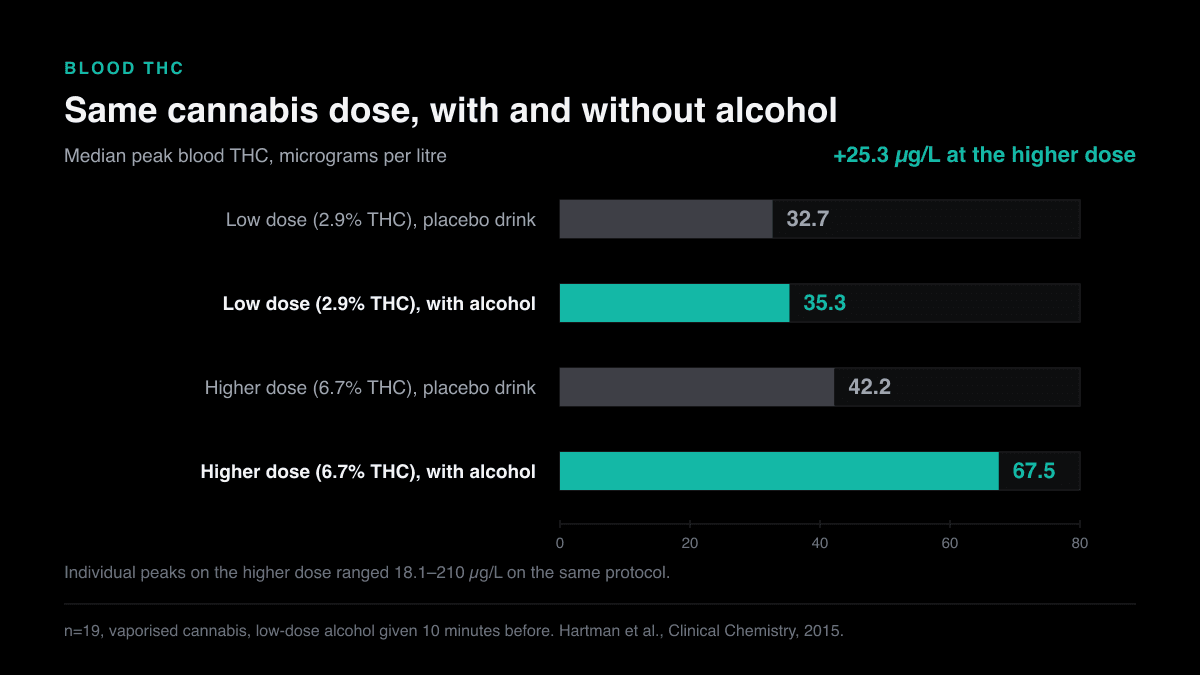
- Alcohol raises blood THC from the same cannabis dose. Median peak blood THC went from 42.2 to 67.5 µg/L when a low alcohol dose was given before higher-dose vaporised cannabis.[1]
- The driving impairment is additive, not synergistic. The authors state it plainly: “Cannabis-alcohol SDLP effects were additive rather than synergistic.”[2] Additive is still two impairments stacked.
- There is an equivalence worth knowing. 13.1 µg/L blood THC produced roughly the lane-keeping decay of 0.08 g/210 L breath alcohol, and 5 µg/L THC plus 0.05 g/210 L alcohol landed in the same place as 0.08 alcohol alone.[2]
- “Weed before beer” has no evidence behind it in either direction. Co-use studies “typically administer a fixed dose of alcohol before cannabis, and there is a lack of data on the acute effects of cannabis before alcohol.”[5]
- Canada writes the combination as its own offence. 2.5 ng of THC per mL of blood together with 50 mg of alcohol per 100 mL — below the 5 ng/mL THC-alone threshold.[3]
- µg/L and ng/mL are the same unit. The 67.5 µg/L peak above is 27 times the 2.5 ng/mL combined-offence threshold. Blood THC also falls fast, which is why the two numbers describe different moments.
- Nobody has studied concentrates with alcohol. “To our knowledge, no studies have explored concentrate and alcohol co-use.”[5]
- Alcohol is the substance most often combined with cannabis in Canada — 38% of past-year consumers, by Health Canada’s own survey.[7]
- The cross-fade ledger has four multipliers and only two of them have controlled human data attached.
What Does Being Cross-Faded Actually Do?
It puts more THC in your blood than the same cannabis would on its own, and it stacks two impairments instead of one. Those are the two claims with controlled human data behind them. Almost everything else attached to the word is folklore.
The slang meaning — drunk and high at once, usually with the implication of having overshot — is covered in our weed slang guide, which also handles the spelling (cross faded, crossfaded and cross-faded are the same word). This page is about what happens physiologically, what has been measured, and what has not.
The distinction that matters throughout: simultaneous use means both substances at the same time; concurrent use means both within some period but not together.[6] Cross-faded is simultaneous use, and simultaneous use is the pattern the research treats as its own category.
Does Alcohol Make You Higher?
It raises the amount of THC that reaches your blood. Whether that registers as “higher” is a different question and a less well-measured one. The blood concentration part has been measured directly, under controlled dosing, in a crossover design.
Thirty-two people were given placebo or a low alcohol dose ten minutes before inhaling vaporised cannabis at three THC concentrations — placebo, 2.9% and 6.7%. Nineteen completed every session. The alcohol dose targeted roughly 0.065% breath alcohol.[1]
| Condition | Median peak blood THC | Observed range |
|---|---|---|
| Low-dose cannabis (2.9% THC), placebo drink | 32.7 µg/L | 11.4–66.2 µg/L |
| Low-dose cannabis, with alcohol | 35.3 µg/L | 13.0–71.4 µg/L |
| Higher-dose cannabis (6.7% THC), placebo drink | 42.2 µg/L | 15.2–137 µg/L |
| Higher-dose cannabis, with alcohol | 67.5 µg/L | 18.1–210 µg/L |
n=19, vaporised cannabis, low-dose alcohol.[1] The medians are the figures our slang guide carries; the ranges are the part worth adding. Look at the high-dose row — one person peaked at 210 µg/L and another at 18.1 µg/L on the same protocol.
The effect was not limited to THC. Peak concentrations of 11-OH-THC and CBN were also significantly higher when alcohol was coadministered, and so was CBD when measured against baseline.[1] Whatever alcohol is doing, it is doing it to cannabinoid absorption broadly rather than to THC specifically.
Keep the hedge the authors kept. Their framing is that the higher THC concentrations may explain the increased performance impairment seen with cannabis-alcohol combinations.[1] A blood concentration is not a feeling, and this study measured the concentration.
Does Cannabis Change How Drunk You Get?
This is the direction with far less evidence, and the honest answer is that it has not been settled. The controlled literature is built almost entirely around giving alcohol first and cannabis second, which measures one direction and leaves the other open.
Researchers designing a co-administration study in 2022 described the state of the field in print: “evidence on acute effects of co-use is conflicting,” with some studies showing “additive effects of alcohol and cannabis” and “others demonstrating negligible effects of combining these substances.”[5]
There is a second gap in the same paragraph, and it is a large one for a Canadian market full of extracts. High-THC concentrates “are increasingly popular on the legal-market, but to our knowledge, no studies have explored concentrate and alcohol co-use.”[5] Our guides to concentrates and vapes and carts cover those formats; neither has been run alongside a drink in a laboratory.
| The question | Evidence status | What exists |
|---|---|---|
| Does alcohol raise blood THC? | Measured | Crossover study, n=19, significant increase in peak THC, 11-OH-THC and CBN[1] |
| Does the combination impair driving more than either alone? | Measured | Simulator study, n=18, additive lane-keeping effects[2] |
| Does cannabis change blood alcohol? | Unsettled | Acute co-use evidence described by researchers as “conflicting”[5] |
| Does order of use matter? | Understudied | “a lack of data on the acute effects of cannabis before alcohol”[5] |
| Do concentrates behave differently with alcohol? | Unstudied | “no studies have explored concentrate and alcohol co-use”[5] |
| What causes cross-fade nausea? | Unstudied | No controlled study of the phenomenon located |
Two rows in that table are the whole evidence base for a phrase with tens of thousands of monthly searches.
Does It Matter Whether You Drink or Smoke First?
Nobody knows, and the reason is specific rather than vague. “Beer before grass, you’re on your ass; grass before beer, you’re in the clear” is a rhyme, and the experiment that would test it has not been published.
The 2022 protocol paper puts it directly: order of use “may influence intoxication and other acute effects, but is also understudied,” and “Co-use studies typically administer a fixed dose of alcohol before cannabis, and there is a lack of data on the acute effects of cannabis before alcohol.”[5]
So the one condition that has been run repeatedly — alcohol first, cannabis second — is precisely the half of the rhyme that folklore calls the bad one. The comparison that would make the saying testable does not exist in the controlled literature.
What this does not mean. “Understudied” is not “disproven,” and it is not permission to treat the reverse order as safe. It means the confident version of the advice you have heard, in either direction, is not coming from research.
How Much Worse Is the Impairment?
Measurably worse, and additively rather than explosively. The same research group ran a driving simulator study on 18 people using the identical cannabis doses, with and without alcohol, and reported the interaction in units a reader can hold onto.

Lane-position variability rose by 0.26 cm per µg/L of blood THC, and by 0.42 cm per 0.01 g/210 L of breath alcohol.[2] Convert between them and 13.1 µg/L of blood THC produced about the same weaving as 0.08 g/210 L of breath alcohol.[2]
| What was measured | Result | Why it matters |
|---|---|---|
| THC effect on lane-position variability | +0.26 cm per µg/L blood THC[2] | A dose-response, not a threshold |
| Alcohol effect on the same measure | +0.42 cm per 0.01 g/210 L breath alcohol[2] | Lets the two be compared directly |
| Blood THC equivalent to 0.08 breath alcohol | 13.1 µg/L THC[2] | The single most portable number on this page |
| The combination | 5 µg/L THC + 0.05 g/210 L alcohol ≈ 0.08 g/210 L alcohol alone[2] | Two legal-ish inputs, one over-the-limit output |
| Nature of the interaction | “additive rather than synergistic”[2] | Rules out the popular “1 + 1 = 3” |
Breath alcohol (g/210 L) and blood alcohol (mg/100 mL) are different measures and are not interchangeable. These study figures are breath. Canada’s offences, in the next section, are written in blood.
Read the fourth row twice. Additive is not reassuring — it is the mechanism by which two amounts that each feel modest arrive at the impairment of one amount that is not. That is the finding, stated without inflation and without softening.
What Does Canadian Law Say About Driving Cross-Faded?
It treats the combination as its own offence, at a lower THC threshold than THC alone. The Blood Drug Concentration Regulations, made under the Criminal Code, set three numbers, and the third is the cross-fade one.
| Offence | Prescribed concentration | Measured in |
|---|---|---|
| Summary conviction offence | 2 ng of THC per mL of blood[3] | Blood |
| Hybrid offence, THC alone | 5 ng of THC per mL of blood[3] | Blood |
| Hybrid offence, combination | 2.5 ng/mL THC together with 50 mg of alcohol per 100 mL of blood[3] | Blood |
Provincial licence sanctions sit on top of the federal offences and vary. This is not legal advice.
One unit note, because two of our own pages would otherwise look inconsistent: µg/L and ng/mL are the same unit. The 67.5 µg/L median peak above is 27 times the 2.5 ng/mL combined threshold — but blood THC falls steeply after inhalation, so a peak and a roadside sample describe very different moments.
Worth stating plainly: the Regulatory Impact Analysis Statement published with the regulation records that the combination level “is set at ≥2.5 ng/ml and ≥50 mg/100 ml,” and gives no explanation of why the combined THC figure is set below the THC-alone one.[4] The rule is clear. The published reasoning for that particular number is not.
Why Does Being Cross-Faded Make People Sick?
No controlled study of it was located, so this section is shorter and more honest than the ones you will find elsewhere. Greening out — acute nausea, dizziness, sweating, sometimes vomiting — is well described by the people it happens to and poorly described by research.
What can be said without inventing a pathway: our slang guide notes that alcohol on board makes it more likely, and the blood data above gives one plausible contributor, since the same cannabis dose is delivering more THC.[1] That is a contributor, not a mechanism.
What we are not going to do is give you a physiological story with no study behind it. Every confident explanation of cross-fade nausea in circulation — blood pressure, the vestibular system, gastric emptying — is reasoning from adjacent findings rather than from anyone having measured this.
Where Does a Cross-Fade Actually Go Wrong?
Four multipliers sit between “a couple of drinks and a couple of hits” and where a person ends up. We call it the cross-fade ledger. Two of the four have controlled human data. The other two are where the folklore rushed in.
| Multiplier | What decides it | What has been measured |
|---|---|---|
| 1. Input | How much THC actually reaches the blood from a given dose | Measured. Alcohol raised median peak blood THC 42.2 → 67.5 µg/L at the higher dose, with an individual range of 18.1–210 µg/L[1] |
| 2. Order | Which substance goes first, and how far apart | Not measured. “a lack of data on the acute effects of cannabis before alcohol”[5] |
| 3. Combination | How the two impairments stack | Measured, for one outcome. Lane-keeping effects were “additive rather than synergistic”[2] — that is weaving, not every faculty |
| 4. Judgement | Whether you can tell, and what you do next | Measured for cannabis alone, not for the pair. Driving confidence fell sharply in the first two hours and tracked measured ability[8] |
Read down the right-hand column and the pattern is the same one that shows up across this whole subject. The multiplier with the cleanest evidence — input — is the one people argue about least. The two that decide most real outcomes on a Friday night, order and judgement, are the two with the thinnest data attached.
Tolerance belongs in this picture too, and it is the fifth thing nobody has measured. There is no controlled study of whether cannabis tolerance carries across to the combination; our guide to THC tolerance and dosing sets out how little is established about tolerance even on its own.
How Common Is Mixing Cannabis and Alcohol?

It is the most common combination there is. Health Canada’s own national survey reports that among people who consumed cannabis in the past 12 months, “alcohol (38%) was the substance most commonly consumed in combination with cannabis.”[7]
The same survey records that the frequency of combining alcohol with cannabis “sometimes”, “often” or “always” has decreased since 2018.[7] Common and declining, in other words — a fairly rare combination of findings in this field.
| Term | Definition | Why the distinction is used |
|---|---|---|
| Simultaneous use | “the use of more than one substance at the same time”[6] | This is cross-faded. It is the pattern with the pharmacokinetic interaction |
| Concurrent use | “the use of two or more substances separately within a given time period”[6] | Both in the same month, never in the same hour — a different exposure |
Public Health Ontario’s evidence brief reports 13% of Canadian students aged 12–18 engaging in simultaneous use in the past year, and up to 27% when asked without a time frame.[6] It describes simultaneous use as “associated with more harmful consequences than the use of either substance alone” and as increasing the odds of impaired driving, but publishes no odds ratio — so we do not print one.
What Lowers the Risk If You Are Going to Do Both?
Only one item on this list has a real evidence base, and it is the one about driving. Canadian lower-risk cannabis use guidelines advise against combining cannabis with alcohol before driving, because the impairment compounds.[9]
- Do not drive, at all, on the combination. This is the recommendation with published evidence behind it and a separate criminal offence attached.[9][3]
- Assume the same cannabis dose is not the same dose. The blood data says it is not.[1] Whatever you would normally take is the wrong reference point.
- Watch the routes with a delay. An edible taken while drinking is a decision made an hour before the effect arrives — our edibles dosing guide covers the timing.
- Do not reason from the rhyme. The order question is unstudied in the direction everyone asks about.[5]
- Do not reason from your tolerance. Cross-substance tolerance has not been measured.
We are a retailer, so take the framing rather than the reassurance. None of the above makes combining cannabis and alcohol safe, and none of it is advice about your health. It is what the published work does and does not support.
Cross-Faded Myths, Checked
Six claims that circulate constantly, each set against what was measured. Two are broadly right, two are wrong, and two are questions the research has simply never been asked.
| The claim | Status | What the evidence says |
|---|---|---|
| “Drinking makes the weed hit harder” | Supported, with a hedge | Alcohol significantly raised peak blood THC; the authors say that “may explain” greater impairment[1] |
| “Mixing them is exponentially worse” | Overstated | Lane-keeping effects were “additive rather than synergistic”[2] |
| “Grass before beer, you’re in the clear” | Not evidence | The cannabis-before-alcohol direction has not been run in controlled co-use studies[5] |
| “A bit of each is safer than a lot of one” | False in the one place it has been tested | 5 µg/L THC with 0.05 g/210 L alcohol matched 0.08 g/210 L alcohol alone on weaving[2] |
| “Cross-fading is just a vibe, not a real interaction” | False | A crossover study measured significantly higher peak THC, 11-OH-THC and CBN with alcohol[1] |
| “Dabs and carts are worse with alcohol” | Unknown | “no studies have explored concentrate and alcohol co-use”[5] |
Our hub keeps a wider slang and myth table covering 420, za, loud and couch lock. Product categories are a poor guide to what an experience will be in general — our article on what labels can and cannot predict makes the same argument about cultivar names.
Frequently Asked Questions
What happens when you mix weed and alcohol?
Alcohol raises the amount of THC that reaches your blood from the same cannabis dose. In a controlled crossover study, median peak blood THC rose from 42.2 to 67.5 micrograms per litre at the higher cannabis dose when a low alcohol dose came first. The impairments from the two then stack.
Is being cross-faded more dangerous than being drunk or high?
For driving, yes, and the researchers quantified it. Lane-keeping effects were additive rather than synergistic, but five micrograms per litre of blood THC combined with 0.05 breath alcohol produced about the same weaving as 0.08 breath alcohol on its own. Two modest inputs, one serious output.
Should you smoke before or after drinking?
There is no research answer, which is itself the answer. Controlled co-use studies almost always give alcohol first and cannabis second, and researchers state in print that there is a lack of data on cannabis before alcohol. The rhyme people quote has never been tested in either direction.
Does alcohol make weed stronger?
It makes more THC reach your blood, which is not quite the same claim. Peak concentrations of THC, 11-OH-THC and CBN were all significantly higher with alcohol coadministered. The study authors say the higher concentrations may explain the greater impairment observed, and they keep that hedge deliberately.
Can you be charged for driving after weed and one drink?
Canada writes the combination as a separate offence. The Blood Drug Concentration Regulations prescribe 2.5 nanograms of THC per millilitre of blood together with 50 milligrams of alcohol per 100 millilitres — a lower THC figure than the 5 nanogram threshold that applies to THC on its own.
Why does mixing weed and alcohol make you throw up?
No controlled study of this was located, so anyone giving you a confident mechanism is guessing. What is measured is that the same cannabis dose delivers more THC to the blood when alcohol is present. That is a plausible contributor to the experience, not an established explanation of it.
How long does being cross-faded last?
No study measured the duration of the combined state as its own outcome. Blood THC peaks within minutes of inhaling and falls steeply, while alcohol clears on its own slower schedule, so the two curves separate. Duration figures circulating online are not drawn from controlled research.
Are dabs or vape carts worse to combine with alcohol?
Unknown, and the gap is stated explicitly in the literature. Researchers designing a co-administration study wrote that no studies have explored concentrate and alcohol co-use, despite concentrates being widely sold. Extrapolating from vaporised flower data to a high-potency extract is not supported.
Does a high tolerance protect you when you mix?
There is no evidence either way. No controlled study has tested whether tolerance to cannabis carries across to the cannabis-and-alcohol combination, and the consumer tolerance literature generally has very little research behind it. Treating your usual amount as a safe reference point is not supported by anything published.
How common is combining cannabis and alcohol in Canada?
It is the most common combination. Health Canada’s national survey found alcohol at 38% was the substance most commonly consumed in combination with cannabis among past-year consumers, and also recorded that the frequency of combining the two has decreased since 2018.
References
- Hartman, R. L., Brown, T. L., Milavetz, G., Spurgin, A., Gorelick, D. A., Gaffney, G., & Huestis, M. A. Controlled Cannabis Vaporizer Administration: Blood and Plasma Cannabinoids with and without Alcohol. Clinical Chemistry, 2015, 61(6), 850–869. DOI: 10.1373/clinchem.2015.238287 (Thirty-two participants received placebo or low-dose alcohol ten minutes before inhaling vaporised cannabis at three THC concentrations — placebo, low 2.9% and high 6.7%; nineteen completed all sessions. Median peak blood THC, no alcohol: 32.7 µg/L (range 11.4–66.2) at the low dose and 42.2 µg/L (15.2–137) at the high dose. With alcohol: 35.3 µg/L (13.0–71.4) and 67.5 µg/L (18.1–210). Verbatim: “Blood Cmax, with and without accounting for baseline concentrations for THC, 11-OH-THC, and CBN, were significantly higher when alcohol was coadministered with cannabis.” The 0.065% breath alcohol target and the authors’ “may explain the increased performance impairment” phrasing are carried from this programme’s own full read of the paper during the article #05 run on 15 August 2026, where this is that article’s reference [5]; the figures match exactly. Abstract and full bibliographic record re-read on academic.oup.com on 18 September 2026. ALREADY IN THIS PROGRAMME’S SOURCE LIBRARY.)
- Hartman, R. L., Brown, T. L., Milavetz, G., Spurgin, A., Pierce, R. S., Gorelick, D. A., Gaffney, G., & Huestis, M. A. Cannabis effects on driving lateral control with and without alcohol. Drug and Alcohol Dependence, 2015, 154, 25–37. DOI: 10.1016/j.drugalcdep.2015.06.015 (Companion driving-simulator study to reference [1], same dosing protocol. Eighteen completers, thirteen men, aged 21–37, inhaling 500 mg of placebo, low 2.9%-THC or high 6.7%-THC vaporised cannabis. Verbatim figures: THC increased standard deviation of lateral position by “0.26 cm per μg/L THC” and alcohol by “0.42 cm per 0.01g/210L BrAC”; “13.1μg/L THC” produced lateral-control impairment comparable to 0.08 g/210 L breath alcohol; and “Cannabis-alcohol SDLP effects were additive rather than synergistic, with 5μg/L THC+0.05g/210L alcohol showing similar SDLP to 0.08g/210L alcohol alone.” Note the alcohol figures are BREATH alcohol, not the blood alcohol used in Canadian offences, and this article keeps the two apart in print. Abstract read via PubMed Central, PMCID PMC4536116, on 18 September 2026 after ScienceDirect and the PubMed record itself were unreachable. NEW TO THIS PROGRAMME’S SOURCE LIBRARY.)
- Blood Drug Concentration Regulations (SOR/2018-148), made under the Criminal Code. laws-lois.justice.gc.ca (Prescribes the blood drug concentrations for the conveyance offences: 2 ng of THC per mL of blood for the summary conviction offence, 5 ng/mL for the hybrid offence, and — for the combination offence — “the prescribed blood alcohol concentration is 50 mg of alcohol per 100 mL of blood and the prescribed blood drug concentration for tetrahydrocannabinol (THC) is 2.5 ng of THC per mL.” Read on laws-lois.justice.gc.ca on 18 September 2026; the host served the regulation on this attempt, as it did on 17 September 2026, after refusing this programme on 15 September 2026. ALREADY IN THIS PROGRAMME’S SOURCE LIBRARY, added by article #27.)
- Regulatory Impact Analysis Statement published with the Blood Drug Concentration Regulations, Canada Gazette, Part II, Volume 152, Number 14, 11 July 2018. gazette.gc.ca (Cited here for one thing and labelled as such: the RIAS records that “the BDC level for THC and alcohol in combination is set at ≥2.5 ng/ml and ≥50 mg/100 ml, respectively” and refers to the recommendations of the Drugs and Driving Committee, but publishes no rationale for why the combined THC figure sits below the THC-alone hybrid figure. The article states the absence rather than supplying a reason. This is a government primary record of what the rule requires, cited as the regulatory impact statement rather than as the regulation, under the rule added to this programme on 24 August 2026. Read on gazette.gc.ca on 18 September 2026 — note that this host returned PROVENANCE_REQUIRED to this programme on 25 August 2026. NEW TO THIS PROGRAMME’S SOURCE LIBRARY.)
- Karoly, H. C., Prince, M. A., Emery, N. N., Smith, E. E., Piercey, C. J., & Conner, B. T. Protocol for a mobile laboratory study of co-administration of cannabis concentrates with a standard alcohol dose in humans. PLOS ONE, 2022. DOI: 10.1371/journal.pone.0277123 (A study protocol, not a results paper, and cited here only for its account of the state of the evidence — which is what a protocol’s background section is for. Verbatim: “evidence on acute effects of co-use is conflicting,” with some studies showing “additive effects of alcohol and cannabis” and “others demonstrating negligible effects of combining these substances”; “high-THC-content cannabis concentrates are increasingly popular on the legal-market, but to our knowledge, no studies have explored concentrate and alcohol co-use”; “order of use may influence intoxication and other acute effects, but is also understudied”; and “Co-use studies typically administer a fixed dose of alcohol before cannabis, and there is a lack of data on the acute effects of cannabis before alcohol.” No finding or outcome is taken from this source, because it reports none. Read on journals.plos.org on 18 September 2026. NEW TO THIS PROGRAMME’S SOURCE LIBRARY.)
- Ontario Agency for Health Protection and Promotion (Public Health Ontario), Meyer, W., & Leece, P. Evidence brief: risk factors for simultaneous use of alcohol and cannabis. Toronto, ON: Queen’s Printer for Ontario; August 2018. publichealthontario.ca (Provincial public health agency evidence brief. Definitions used verbatim in this article: simultaneous polysubstance use is “the use of more than one substance at the same time” and concurrent use is “the use of two or more substances separately within a given time period.” Prevalence figure used: among Canadian students aged 12–18, “13% of students reported engaging in this pattern of use in the past year, and up to 27% when asked the same question without a time frame.” The brief states that simultaneous use is “associated with more harmful consequences than the use of either substance alone” and increases the odds of impaired driving but publishes NO odds ratio, so none is stated on this page. Read on publichealthontario.ca on 18 September 2026. NEW TO THIS PROGRAMME’S SOURCE LIBRARY.)
- Health Canada. Canadian Cannabis Survey 2024: Summary. canada.ca (National survey of cannabis use in Canada. Used for two statements, both verbatim: among people who consumed cannabis in the past 12 months, “alcohol (38%) was the substance most commonly consumed in combination with cannabis”; and “The frequency of combining alcohol or tobacco with cannabis ‘sometimes’, ‘often’ or ‘always’ decreased for both of these behaviours since 2018.” The survey publishes no figure for driving after combined use, and none is stated here. Read on canada.ca on 18 September 2026 — note that this host returned PROVENANCE_REQUIRED to this programme on 25 and 27 August 2026 and served the page today. NEW TO THIS PROGRAMME’S SOURCE LIBRARY.)
- Hartley, S., Simon, N., Cardozo, B., Larabi, I. A., & Alvarez, J. C. Can inhaled cannabis users accurately evaluate impaired driving ability? A randomized controlled trial. Frontiers in Public Health, 2023, 11, 1234765. DOI: 10.3389/fpubh.2023.1234765 (Thirty healthy male volunteers aged 18–34, fifteen chronic and fifteen occasional consumers, randomised controlled trial on a driving simulator. Verbatim: “Cannabis consumption (at 10 and 30 mg) led to a marked decrease in driving confidence over the first two hours which remained below baseline at 8 hours,” and “Driving confidence was shown to be related to driving ability and to reaction times in both chronic and occasional consumers.” SCOPE, stated in the body of this article: this trial tested CANNABIS ALONE. It is cited here only for multiplier 4 of the cross-fade ledger, to establish that self-assessment has been measured for cannabis on its own and NOT for the combination. No claim about self-assessment while cross-faded is drawn from it. Male-only sample. Read on frontiersin.org on 18 September 2026. NEW TO THIS PROGRAMME’S SOURCE LIBRARY.)
- Fischer, B., Russell, C., Sabioni, P., van den Brink, W., Le Foll, B., Hall, W., Rehm, J., & Room, R. Lower-Risk Cannabis Use Guidelines: A Comprehensive Update of Evidence and Recommendations. American Journal of Public Health, 2017, 107(8), e1–e12. DOI: 10.2105/AJPH.2017.303818 (Canadian-led evidence-based guidelines, and this programme’s default citation for any harm-reduction phrasing. Cited here for one recommendation only: that combining cannabis with alcohol before driving should be avoided because the impairment compounds. Provenance: read during the article #05 run on 15 August 2026 and recorded in this programme’s source library, where it is that article’s reference [6]; not re-read on 18 September 2026, as ajph.aphapublications.org is not reachable from a scheduled cloud run. Re-cited under the library rule formalised on 23 August 2026.)
This article is for informational purposes only and is not medical or legal advice. It describes what published studies measured and what published Canadian guidance and regulation say. Do not drive after using cannabis, and do not combine cannabis with alcohol before driving. Keep all cannabis away from children and pets, and follow the cannabis laws applicable in your jurisdiction.