
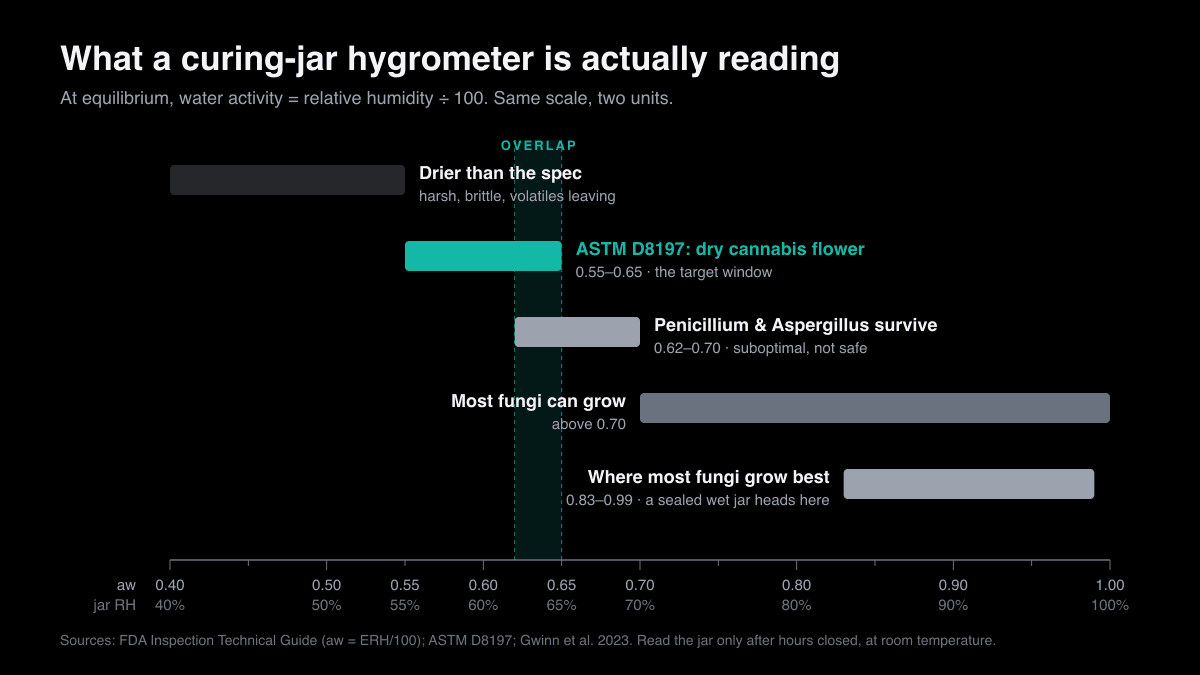
Every guide to curing gives you a humidity number and no source for it. The number is roughly right. What almost nobody explains is that a hygrometer sealed in a jar is measuring the same quantity a testing lab measures, under a different name — which is what makes the reading worth acting on.
This is the detail page for the jar phase — what people type as how to cure weed and get answered with a ritual. The step before it — deciding when to cut — is in our guide to when to harvest cannabis. What follows is the procedure, the one measurement that runs it, and what three weeks in a sealed container was actually measured to do.

Key Takeaways
- A sealed jar’s humidity reading is water activity in different units. Water activity is defined as equilibrium relative humidity divided by 100.[5] The published specification for dry cannabis flower is 0.55 to 0.65.[3]
- A reading taken straight after closing the jar is meaningless. Equilibrium in the headspace takes hours, and a 0.1 °C gap between flower and air shifts the result by about 0.005.[5]
- Moisture goes up in the jar, not down. A three-week cure raised moisture content by between 3.3 and 13.6 percentage points depending on how the material was dried.[1]
- The mould ceiling is closer than the spec suggests. Below 0.7 water activity most fungi cannot grow, but Penicillium and Aspergillus survive at 0.62 to 0.7.[6]
- Glass jars and Mylar bags performed the same. Neither moisture nor yeast and mould counts differed significantly between them over three weeks.[1]
- Nobody has published a cure-duration study. Every confident week count in circulation is a protocol someone happened to use, not an optimum.[1][9]
How do you cure cannabis?
Dry to the specification first, seal the flower in an opaque container in the dark, and open it briefly each day for the first week. The cure is finished when the humidity inside the jar stops climbing — not when a calendar says so.
That is the whole procedure for curing cannabis. Everything else on this page is either the evidence behind one of those steps or the reason a step goes wrong. The single decision that decides whether a cure works is made before the lid goes on: if the flower is too wet at that moment, no amount of burping rescues it.
| Decision | What it controls | How you check it |
|---|---|---|
| When to seal | Whether the cure is a cure or an incubation | Water activity 0.55–0.65 at the point of jarring[3] |
| What to seal it in | Less than the internet claims | Opaque, airtight, rigid enough not to crush[1] |
| How full | Whether interior moisture can reach the headspace | Loose, not packed — compressed flower traps water |
| When to open it | How fast moisture leaves the system | The equilibrium reading, not the clock |
| When to stop | Nothing measurable — no study defines an endpoint | Readings that settle and stay settled[1] |
Note what is missing from that list: a number of weeks. The literature does not supply one, and this page does not invent one. What it can supply is a measurement you can actually take.
What actually happens inside a curing jar?
Water moves outward from stems and flower interiors into the surrounding air, which is why moisture content rises in a sealed jar rather than falling. Total cannabinoid content stays put. Aroma peaks, colour shifts, and a small amount of further decarboxylation occurs.
The best single dataset on this comes from a study that dried two industrial hemp cultivars three different ways, then cured the dried material for three weeks in sealed glass jars or Mylar bags, in the dark, at room temperature.[1] It measured moisture, cannabinoids, colour and microbial load before and after.
| What was measured | What three weeks of curing did[1] |
|---|---|
| Moisture content | Rose by 3.3 to 13.6 percentage points, depending on drying method |
| Container humidity | Climbed over the three weeks — 17% to 22% in the freeze-dried set |
| Total cannabinoids | No significant change |
| Acid-to-neutral ratio | Fell significantly — further decarboxylation, generally under 2% |
| Greenness | Reduced |
| Yeast and mould | Fell in most sets, but not significantly. Curing did not raise the risk |
Read the scope before the numbers. Two CBD-type hemp cultivars, and one drying arm took the material below the moisture range smokable flower is held at. The directions transfer. The absolute moisture figures belong to that material, not yours. One widely-repeated version of this result — that moisture “rose from 3.3% to 13.6%” — is a misreading of the paper’s range of increases.
The mechanism behind the rising number is worth holding onto, because every other decision follows from it. A dried flower is not uniformly dry. Stems and the interior of a dense bud hold more water than the surface does, and sealing the container lets that water migrate outward until the whole system sits at one value. Burping vents the result. Curing is that negotiation, run slowly.
What humidity should a curing jar read?
Between 55 and 65 percent, once it has equilibrated — and that range is not folklore. Water activity is defined as equilibrium relative humidity divided by 100, and the published specification for dry cannabis flower is 0.55 to 0.65 water activity.
This is the part almost every curing guide leaves out. The United States Food and Drug Administration’s technical guide on the subject states the relationship as an equation: aw = ERH/100, where ERH is equilibrium relative humidity as a percentage.[5] A separate standard sets out how water activity in cannabis flower is determined, and notes it is a ratio and therefore carries no units.[4]
So a hygrometer sealed in a jar with flower, left long enough, is measuring the same physical quantity a testing laboratory reports — in percent rather than as a decimal. The 62% that circulates unsourced across the growing internet sits inside a published window. It is just never presented as the measurement it is.
| Water activity | Equilibrium jar reading | What it means |
|---|---|---|
| Below 0.55 | Under 55% | Drier than the specification. Harsh, brittle, volatiles already leaving[3] |
| 0.55–0.65 | 55–65% | The published range for dry cannabis flower[3] |
| 0.62–0.70 | 62–70% | Penicillium and Aspergillus survive here, suboptimally[6] |
| Above 0.70 | Above 70% | Sufficient drying is no longer achieved; most fungi can grow[6] |
| 0.83–0.99 | 83–99% | Where most fungi grow best. A sealed wet jar heads here[6] |
The two bolded rows overlap, and that overlap is the whole argument for aiming at the middle of the window rather than the top of it. The specification’s ceiling is not below the range those two genera tolerate — it is inside it.
The reading has two conditions attached. Equilibrium in a closed headspace takes several hours to establish, so a number read minutes after closing the lid is not a measurement.[5] And temperature matters more than people expect: a 0.1 °C difference between the flower and the air above it shifts the result by roughly 0.005 water activity.[5] Read a jar that has been closed and left alone, at room temperature, not one just carried in from somewhere colder.
Why do two growers get different results from the same jar?
Because one is running a schedule and the other is running a control loop. A cure has exactly one variable worth watching, and the burp is not a ritual performed on a timetable — it is the correction you apply after taking a reading.
The cure control loop. Close the jar. Wait long enough for the headspace to equilibrate.[5] Read it. Compare the reading to the window. Act on the difference. Close it again. The loop ends when two consecutive readings come back the same. It does not sort what you do in which week. It sorts what the number means.
| Equilibrium reading | What it is telling you | The correction |
|---|---|---|
| Above 70% | Too wet to be sealed at all[6] | Out of the jar and back to drying. Do not manage this one |
| 66–70% | Inside the range two fungal genera tolerate[6] | Longer, more frequent openings until it falls |
| 55–65%, still rising | Interior water is still migrating outward[1] | Keep the daily opening. The cure is working |
| 55–65%, stable | The system has equalised | Stretch the interval. This is the finish line |
| Below 55% | Over-dried past the specification[3] | Stop opening it. Moisture does not come back on its own |
| Changed since yesterday by a lot | Probably temperature, not moisture[5] | Re-read at a settled room temperature before acting |
The practical value of running it as a loop is that it tells you which week you are in without counting weeks. A jar that still climbs after every close has water left to give up. A jar that reads the same three days running is done, whether that took eleven days or a month.
How often should you burp curing jars?
Daily for the first week, then on a lengthening interval as the readings settle. No study has tested burping frequency against any outcome, so treat the cadence as a starting point and the hygrometer as the actual instruction.
What burping does is unambiguous even though the schedule is not. Opening the container exchanges the humid headspace for room air, which resets the gradient and lets more interior water migrate outward. Everything in the published curing data is consistent with that: moisture rose, container humidity climbed over three weeks, and the container type made no significant difference.[1] Most guides to curing weed hand you a schedule, and a schedule is a guess about someone else’s flower rather than a measurement of yours.
| Phase | Typical cadence | What the reading should be doing |
|---|---|---|
| Days 1–7 | Once daily, a few minutes | Climbing back after each close |
| Week 2 | Every second or third day | Climbing back less each time |
| Week 3 onward | Weekly, then leave it | Returning to the same number |
| Any phase, above 70% | Open it and stop curing | This is a drying problem, not a cure[6] |
An ammonia or damp smell at any point means the flower went in too wet and anaerobic activity has started. That is not a cure developing character. Open it, spread it out, and deal with the moisture.
How long should you cure cannabis?
There is no published answer. Nobody has run a study of cure duration against chemical or sensory quality, so the confident numbers in circulation are protocols that studies happened to use, not optima anyone measured.
That is worth stating plainly because most curing guides are unusually confident about it. What exists is a short list of durations chosen for other reasons, and they do not agree with each other by an order of magnitude.
| Published work | Cure duration used | Conditions |
|---|---|---|
| Baek and colleagues[1] | Three weeks | Sealed glass jars or Mylar bags, dark, room temperature |
| Oswald and colleagues[2] | Eleven days, hung | Roughly 22 °C, 45% relative humidity |
| Birenboim and colleagues[9] | One day, with desiccant | Following controlled-atmosphere drying |
None of the three was designed to find an optimum. Quoting any of them as “the right length of cure” reads a protocol as a recommendation. The honest instruction is procedural, and it is the loop above.
Does curing make cannabis smell stronger?
Yes, and the end of the cure is the loudest a flower will ever be. The compounds behind the skunk note were measured reaching their maximum at the end of an eleven-day cure, then dropping substantially over the following ten days of storage.
That work identified a family of prenylated volatile sulfur compounds and tracked them through processing. The verbatim finding is that the sulfur compounds “reached a maximum at the end of this process,” and that a final data point ten days after jarring “showed a substantial decrease in all VSC concentrations.”[2]
Terpenes are a separate and less flattering story. Over six months of storage, the volatile profile of dried inflorescences was not maintained under any condition tested, and monoterpenes degraded fastest because they are the most volatile.[8] The cure builds the smell; everything after it is a holding action, which is the subject of our storage guide and of whether the freezer helps.

Does curing break down chlorophyll?
Half of that claim now has a measurement behind it and half still does not. Colour change through drying and curing has been quantified, and the authors attribute the loss of greenness to chlorophyll degradation. Nobody has measured whether it changes how the smoke feels.
The colour side is straightforward. In the same hemp study, drying pushed a* values less negative, and the paper states the reduction in greenness “could be due to the degradation of the natural chlorophyll in the plant tissue.”[1] Its abstract attributes reduced greenness to both drying and curing. Hot air drying produced the most colour decay; freeze drying produced none that reached significance.
What is not being claimed. That curing “removes chlorophyll and that is why cured flower smokes smoother.” The study measured colour coordinates and proposed a mechanism in hedged language. It measured nothing about smoke, harshness or what anyone experienced. That second half of the folk claim remains unmeasured, and traces to vendor blogs rather than to research.
Can cannabis go mouldy in a curing jar?
Yes, if it went in above the specification — and the margin is narrower than the numbers suggest. Below 0.7 water activity most fungi cannot grow, but two of the genera most often found on cannabis survive between 0.62 and 0.7.
The review that sets this out is explicit: “If sufficient drying is achieved, the aw of cannabis tissues is reduced to <0.7, which prevents the growth of most fungi,” while Penicillium and Aspergillus “can survive at aw of 0.62–0.7,” a range it describes as suboptimal rather than safe.[6] Most fungi grow best between 0.83 and 0.99.[6]
Curing itself does not add risk. Yeast and mould counts fell in most cured sets in the hemp study, though not significantly, and the authors conclude curing “did not enhance the microbial safety risks.”[1] The risk is entirely front-loaded into the moisture content at the moment you seal it — which is also what a large survey of commercial samples found, with pre- and post-harvest handling driving microbial levels far more than anything later.[7]
Are glass jars better than Mylar bags?
Not measurably, over a three-week cure. Glass and Mylar produced no significant difference in final moisture content or in yeast and mould counts. Over months of storage the picture changes, and glass starts to cost you something.
In the cure itself, the container barely registered. Mylar bags ran slightly higher on yeast and mould than glass jars, but the difference was not significant, and the influence of curing method on moisture was not significant either.[1] The paper still recommends glass, on the strength of the whole package rather than a measured gap.
| Container | Over a three-week cure[1] | Over six months of storage[8] |
|---|---|---|
| Glass jar | No significant difference from Mylar | Best retention of the volatile profile — and the most decarboxylation |
| Mylar bag | Slightly higher yeast and mould, not significant | Not tested in that work |
| Rigid plastic | Not tested | Volatile pattern close to leaving it open to the air |
| Open to the air | Not a cure — there is no sealed headspace | Oxidation favoured; profile not retained |
The storage trade-off has a physical explanation the authors give directly: glass is inert and impermeable, so the sealed environment “cannot be in equilibrium with the external environment in terms of heat, moisture, and oxygen content,” which may itself drive decarboxylation. Plastics let water and oxygen through. Their conclusion is that no condition preserves both aroma and acid cannabinoids at once.[8]
What goes wrong during a cure?
Almost always one of four things: sealing too wet, reading the hygrometer too soon, packing the jar tight, or treating the calendar as the instrument. Only the first is difficult to undo.
| The mistake | Why it goes wrong | The fix |
|---|---|---|
| Jarring above the spec | Two common fungal genera still operate at 0.62–0.7[6] | Dry to 0.55–0.65 before the lid goes on[3] |
| Reading the jar immediately | Headspace equilibrium takes hours[5] | Read a jar that has been shut and left alone |
| Reading it cold | 0.1 °C shifts the result by about 0.005[5] | Let the jar settle at room temperature first |
| Packing it full | Compressed flower traps interior water where it cannot migrate | Fill loosely so there is a headspace to read |
| Curing to a date | No study supports any particular duration[1] | Cure to a stable reading instead |
| Expecting moisture back | Over-drying past the window is not reversible by burping[3] | Stop opening it once the reading sits at the low end |
| Waiting for a “stronger” cure | Total cannabinoid content did not change during curing[1] | Optimise aroma and moisture, which are the axes that moved |
One more that is not really a curing mistake at all: calling the harvest wrong in the first place. What you can and cannot see on the plant, and which signals have evidence behind them, is covered in our guide to when to harvest cannabis.

Already through the loop
Everything on this page is a way of managing one number until it stops moving. That is the slow part of growing, and it is the part you skip when you buy flower that has already been dried and cured. These four craft-tier cuts are in stock today.


Prices shown at time of writing.
Can you legally cure cannabis at home in Canada?
If you may legally grow and harvest the plants, curing what you harvested is part of the same activity. The federal cap is four plants per dwelling-house, and two provinces have taken their own line.
Section 12(4)(b) of the Cannabis Act makes it an offence to cultivate, propagate or harvest “more than four cannabis plants at any one time in their dwelling-house,” section 12(5) applies that cap to the dwelling rather than to each adult in it, and section 12(8) includes the yard or garden.[10]
The limit that catches people out is a different one. The federal cap is on plants, not on what comes off them — but public possession limits still apply to the cured product once it exists. Provincial rules diverge from the federal position, and some provinces are stricter than the federal cap — check your own province’s rules before you plant, not once the jars are full.
Once the readings settle, the job changes from curing to holding: sealed, opaque, cool and dark, which our storage guide covers end to end. If the aroma matters more to you than the flower does, the glands themselves are the shortest route to it — that is what concentrates are.
Frequently Asked Questions
How do you cure cannabis step by step?
Dry until the flower sits in the published window of 0.55 to 0.65 water activity, seal it loosely in an opaque airtight container in the dark, and open it briefly each day for the first week. Read the jar once it has equilibrated, and stop when the reading stops climbing.
What humidity should a curing jar be at?
Between 55 and 65 percent once the headspace has equilibrated. That is not an arbitrary number: water activity is defined as equilibrium relative humidity divided by 100, and the published specification for dry cannabis flower is 0.55 to 0.65 water activity. The jar reading and the lab figure are the same quantity.
How often should you burp curing jars?
Daily for the first week, every few days in the second, then weekly. No study has tested burping frequency against any measured outcome, so the cadence is a starting point. The hygrometer is the real instruction: keep opening while the reading climbs back, and stretch the interval once it stops.
Does weed get more potent as it cures?
No. In the study that measured it, three weeks of curing produced no significant change in total cannabinoid content. What did change was the ratio of acid to neutral cannabinoids, through a small amount of further decarboxylation, generally under two percent. Curing changes aroma and moisture, not how much is there.
Why does the humidity in my curing jar keep rising?
Because a dried flower is not uniformly dry. Stems and bud interiors hold more water than the surface, and sealing the container lets it migrate outward until everything sits at one value. Measured moisture content rose by between 3.3 and 13.6 percentage points over a three-week cure.
Can you cure weed in a Mylar bag instead of a glass jar?
Yes. Over a three-week cure, glass jars and Mylar bags showed no significant difference in final moisture content, and the slightly higher yeast and mould counts in Mylar were not statistically significant either. Glass is still the usual recommendation, but the measured gap during curing is not there.
How long does curing take?
Nobody has published a study of cure duration against quality, so there is no evidenced answer. Published work has used eleven days, three weeks and a single day with desiccant, none of them as an optimum. Cure to a stable equilibrium reading rather than to a number of weeks.
Does curing get rid of chlorophyll?
Colour change has been measured, and the researchers attribute the loss of greenness to chlorophyll degradation in hedged language. What has never been measured is the second half of the claim, that this is why cured flower smokes smoother. That part still traces to vendor blogs rather than research.
Can weed go mouldy while curing?
It can if it was sealed too wet. Below 0.7 water activity most fungi cannot grow, but Penicillium and Aspergillus survive between 0.62 and 0.7, which overlaps the top of the target window. Curing itself was found not to raise microbial risk; the moisture at sealing is what does.
Can you cure cannabis at home legally in Canada?
If you may legally grow the plants, yes. Section 12(4)(b) of the Cannabis Act caps cultivating, propagating or harvesting at four plants at any one time per dwelling-house, and the yard or garden counts. Two provinces departed from that position, and possession limits still apply to the finished product.
References
- Baek, Y., Grab, H., & Chen, C. Postharvest Drying and Curing Affect Cannabinoid Contents and Microbial Levels in Industrial Hemp (Cannabis sativa L.). Plants, 2025, 14(3), 414. DOI: 10.3390/plants14030414 (Two CBD-type cultivars, ‘Hempress’ and ‘Wild Bourbon’. Three drying methods — hot air at 75 °C, ambient air at 25 °C and 45% RH, and freeze drying — followed by three weeks of curing in sealed glass jars or Mylar bags in the dark at ambient temperature. Verbatim from the abstract: “Curing led to a 3.3% to 13.6% increase in hemp moisture, while the influence of curing method was not significant,” and “Both drying and curing did not significantly affect the total cannabinoid contents, but resulted in decarboxylation, and reduction in the greenness.” Results text: “the curing process increased from 3.3% to 13.6% on the wet basis”; “For HA dried samples, the moisture content increased from 5.8% to 12.1% and 15.8%”; “For FD samples, the RH increased from 17% to 22% over the 3-week curing process”; “the acid/neutral cannabinoids ratio reduced significantly, but the total cannabinoid content did not change”; curing decarboxylation “generally lower than 2%”; “Except for the HA dried samples, the curing process reduced the TYM levels in the hemp samples; however, the reductions were not statistically significant”; “samples cured in Mylar bags had slightly higher TYM levels than those cured in glass jars, though the differences were not significantly different”; “Curing did not enhance the microbial safety risks of hemp by yeast and molds”; on colour, “drying caused the a* values to increase (less negative), suggesting that the reduction in greenness, which could be due to the degradation of the natural chlorophyll in the plant tissue during drying process.” Article page read directly on mdpi.com, 2026-09-22. ⚠️ This reference CORRECTS our article #11, which reads the 3.3%–13.6% figures as a start and an end value rather than as the range of increases.)
- Oswald, I. W. H., Ojeda, M. A., Pobanz, R. J., Koby, K. A., Buchanan, A. J., Del Rosso, J., Guzman, M. A., & Martin, T. J. Identification of a New Family of Prenylated Volatile Sulfur Compounds in Cannabis Revealed by Comprehensive Two-Dimensional Gas Chromatography. ACS Omega, 2021, 6(47), 31667–31676. DOI: 10.1021/acsomega.1c04196 (Plants hung to cure and dry for 11 days at roughly 22 °C and 45% relative humidity; volatile sulfur compounds “reached a maximum at the end of this process.” A final data point ten days after jarring at room temperature “showed a substantial decrease in all VSC concentrations.” Cited from this programme’s verified source library, recorded during the article #10 and #11 runs.)
- ASTM International. ASTM D8197 — Standard Specification for Maintaining Acceptable Water Activity (aw) Range (0.55 to 0.65) for Dry Cannabis Flower Intended for Human/Animal Use. store.astm.org (The specification range is in the standard’s own title. Cited from this programme’s verified source library, recorded during the article #11 run. Paywalled — scope page only; no clause text has been read by this programme and none is quoted.)
- ASTM International. ASTM D8196-20 — Standard Practice for Determination of Water Activity (aw) in Cannabis Flower. store.astm.org (Scope: “This practice covers the recommended procedure for determining the water activity (aw) of a cannabis flower sample.” The scope page states that water activity is “a ratio, and thus is without unit designation.” New to this programme’s source library, added 2026-09-22 — it is the companion practice to D8197, which specifies the range but not the method. Paywalled — scope page read directly 2026-09-22; no clause text quoted.)
- U.S. Food and Drug Administration. Water Activity (aw) in Foods. Inspection Technical Guide, 16 April 1984. fda.gov (Defines water activity as “the ratio between the vapor pressure of the food itself, when in a completely undisturbed balance with the surrounding air media, and the vapor pressure of distilled water under identical conditions,” and states the relationship to equilibrium relative humidity as the equation aw = ERH/100. Also verbatim: “In determining the ERH (aw) several hours are required for the water vapor (relative humidity) to reach equilibrium in the headspace above the food in the closed container,” and “a 0.1 C difference between the solid or liquid sample and the supernatant air will result in an approximate 0.005 difference in water activity measurement.” New to this programme’s source library, added 2026-09-22. A general food-science guidance document, not cannabis-specific — used here only for the definition of water activity and the two measurement caveats, which are not product-specific. Read directly 2026-09-22. Its microbial thresholds are for foodborne bacteria and are deliberately NOT used on this page; the fungal figures come from reference 6.)
- Gwinn, K. D., Leung, M. C. K., Stephens, A. B., & Punja, Z. K. Fungal and mycotoxin contaminants in cannabis and hemp flowers: implications for consumer health and directions for further research. Frontiers in Microbiology, 2023, 14, 1278189. DOI: 10.3389/fmicb.2023.1278189 (Verbatim: “If sufficient drying is achieved, the aw (water activity) of cannabis tissues is reduced to <0.7, which prevents the growth of most fungi”; Penicillium and Aspergillus spp. “can survive at aw of 0.62–0.7, this range is suboptimal for fungal growth”; most fungi grow best at aw of 0.83–0.99, a figure the review attributes to Caplan et al. 2022. Also: “duration of drying and final moisture content (water activity) has a significant impact on the levels of fungi present.” Full text read directly on frontiersin.org, 2026-09-22; previously in this programme’s library from the article #11 run.)
- Punja, Z. K., Ni, L., Lung, S., & Buirs, L. Total yeast and mold levels in high THC-containing cannabis (Cannabis sativa L.) inflorescences are influenced by genotype, environment, and pre- and post-harvest handling practices. Frontiers in Microbiology, 2023, 14, 1192035. DOI: 10.3389/fmicb.2023.1192035 (Over 2,000 commercial samples across three years; microbial counts track genotype, environment and pre- and post-harvest handling. Used here only for the direction of that finding — that handling before and around drying dominates the outcome. Cited from this programme’s verified source library, recorded during the article #11 run.)
- Spadafora, N. D., Felletti, S., Chenet, T., Sirangelo, T. M., Cescon, M., Catani, M., De Luca, C., Stevanin, C., Cavazzini, A., & Pasti, L. The influence of drying and storage conditions on the volatilome and cannabinoid content of Cannabis sativa L. inflorescences. Analytical and Bioanalytical Chemistry, 2024, 416. DOI: 10.1007/s00216-024-05321-w (Tray drying at 18 °C and 55% RH for six days, versus freeze drying; then six months of storage at 18 °C and 60% RH in darkness in a brown glass bottle, an airtight HDPE box, or open on a tray. Verbatim: “the volatilome of cannabis inflorescences after drying (TD) is not maintained upon any of the storage conditions applied”; glass was “more beneficial for the retention of the initial VOC profile compared to open to air dry tray and closed high-density polyethylene box”; “monoterpenes undergo degradation more easily than larger terpenes, due to their higher volatility”; “storage in a glass bottle leads to a more marked increase in neutral cannabinoids and a decrease of acid cannabinoids if compared to the other two storage methods”; “Glass, being the most inert material, represents a barrier against gases preventing any permeability. In this case, the closed environment inside the glass bottle cannot be in equilibrium with the external environment in terms of heat, moisture, and oxygen content; this may lead to an increase of decarboxylation”; and “An optimal preservation condition for the retention of both VOCs and cannabinoid is still not available.” Full text PDF read directly from the University of Ferrara institutional repository, 2026-09-22. This is a STORAGE study, not a curing study — used on this page only for what happens after the cure ends.)
- Birenboim, M., Brikenstein, N., Duanis-Assaf, D., Maurer, D., Chalupowicz, D., Kenigsbuch, D., & Shimshoni, J. A. In Pursuit of Optimal Quality: Cultivar-Specific Drying Approaches for Medicinal Cannabis. Plants, 2024, 13(7), 1049. DOI: 10.3390/plants13071049 (Used here for one fact only: the protocol included a single day of curing with desiccant following controlled-atmosphere drying, which is the shortest cure duration in the published literature this programme has located. Cited from this programme’s verified source library, recorded during the article #11 run; the paper was not re-read this run and no other figure from it is used on this page.)
- Cannabis Act (S.C. 2018, c. 16), s. 12. Cultivation, propagation and harvesting. Justice Laws Website. laws-lois.justice.gc.ca (s. 12(4)(b) prohibits cultivating, propagating or harvesting “more than four cannabis plants at any one time in their dwelling-house”; s. 12(5) applies the cap per dwelling-house rather than per adult; s. 12(8) includes the yard or garden in “dwelling-house.” Cited from this programme’s verified source library; the provincial and territorial variations, and the public possession limit, are deliberately left to article #11.)
This article is for informational purposes only and is not medical advice. Growing cannabis at home is regulated differently in each province and territory — check the rules that apply where you live. Do not drive after using cannabis. Keep all cannabis products locked away from children and pets.