
Every guide to this gives the same four steps and cites nothing. The steps are mostly right. What none of them mention is that the middle one — the isopropyl soak — is a published laboratory extraction protocol, and that changes what you are holding at the end of it.
This is the detail page for grinder maintenance. What a grinder is, how to use one, which material to buy and what to reach for when you do not own one are all in our cannabis grinders guide. What follows is the cleaning routine, the evidence behind each step, and the three pieces of received wisdom that do not survive contact with a source.

Key Takeaways
- Freeze, tap, brush, dry. That sequence handles almost every grinder. The solvent step is a separate decision with separate costs, not step five.
- An isopropyl soak is an extraction, not a rinse. A published protocol extracted cannabis with food-grade isopropyl alcohol by shaking for 30 minutes at room temperature.[3]
- What you scrape out is aged resin. Light and warmth degrade cannabinoids at different rates, and light changes the chemistry as well as the speed.[4]
- Boiling water will not demagnetise the lid. The Curie temperature of the magnet material is 312 °C.[7] The finish and the trapped water are the real costs.
- Dry it completely before it goes back together. Below 0.7 water activity most fungi cannot grow, but two common genera survive between 0.62 and 0.7.[8]
- Nobody has published a study of grinder cleaning. Not the freeze, not the frequency, not the residue. Every confident number in circulation is someone’s habit.
How do you clean a weed grinder?
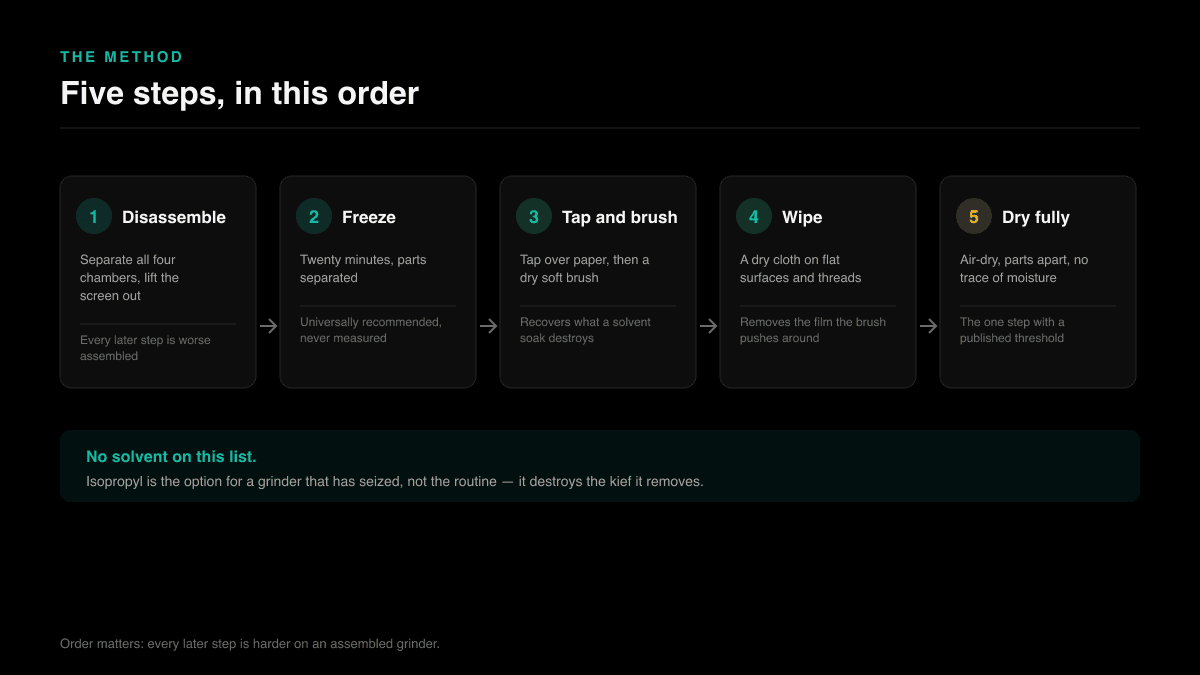
Take it apart, freeze the pieces for twenty minutes, tap the loose material out over a sheet of paper, brush every surface with a dry brush, and let it air-dry before reassembly. Solvent is a separate step you mostly do not need.
That is the whole routine for how to clean a grinder — a four-piece, a two-piece, or the same object sold as a herb grinder — and four of those five steps cost nothing but time. The step people skip is the last one, and it is the only one with a published reason attached.
| Step | What to do | Why it is in the list |
|---|---|---|
| 1. Disassemble | Separate all four chambers and lift the screen out if it is removable | Every later step is worse on an assembled grinder |
| 2. Freeze | Twenty minutes in the freezer, parts separated | Universally recommended and never measured — see below |
| 3. Tap and brush | Tap over paper, then a dry brush; soft bristles on the mesh | Recovers material a solvent soak destroys |
| 4. Wipe | A dry cloth on the flat surfaces and the threads | Removes the film the brush pushes around |
| 5. Dry fully | Air-dry, parts apart, until there is no trace of moisture | The one step with a published threshold behind it[8] |
Note what is not on the list: isopropyl alcohol. It belongs in the routine roughly as often as a grinder genuinely seizes, which for most people is once or twice a year.
What is the sticky stuff on grinder teeth?
It is trichome resin, sheared off the plant and pressed onto metal. The glands are physically small and sit on a stalk, which is exactly why they come off under mechanical stress and end up smeared where you cannot easily get at them.
Drug-type glandular trichomes have been measured at roughly 400 µm in total length, with a secretory cavity around 80 µm across where the cannabinoids accumulate.[1] Stalked glandular trichomes are the primary site of cannabinoid and terpene biosynthesis in the plant.[2] A grinder’s job is to break those heads off the stalk; the residue is the fraction that did not fall through the screen.
That geometry explains the whole maintenance problem. The material on the teeth is the same material a kief catcher collects on purpose, just stuck to the wrong surface, and it is the raw input for bubble hash and other concentrates. Cleaning a grinder is therefore always a recovery decision as well as a hygiene one.
Why do you freeze a grinder before cleaning it?
Because cold resin flakes and warm resin smears. That is the mechanism everybody gives, it is ordinary physics, and it has never been measured on a grinder in either direction. No study of the freeze step exists.
This is worth saying plainly rather than quietly dropping the step. Cannabis resin stiffens as it cools and softens as it warms — the temperature dependence itself is not in doubt, and heat measurably accelerates the chemical degradation of resin in the one kinetic study of the material.[6] What nobody has published is how much more material a twenty-minute freeze actually recovers from a grinder, or whether ten minutes would do.
So the honest instruction is: freeze it anyway. The step costs twenty minutes and no money, the mechanism is not exotic, and the risk of being wrong is zero. What it does not deserve is the precision people give it. Twenty minutes is a habit, not a finding, and a grinder that has been in the freezer overnight is not better prepared than one that went in after breakfast.
What does cleaning a grinder actually cost you?
Every method buys removal with something else. There are four currencies — the resin, the finish, the screen and the drying time — and the reason the standard advice looks contradictory is that each page optimises for a different one.
The cleaning ledger. Sort any method by what it takes away as well as what it removes, and the disagreements on this topic resolve. A dry brush is slow and recovers everything. A solvent soak is fast and converts your recoverable resin into a liquid you then have to do something with. Heat is fastest and spends the finish.
| Method | What it removes | What it costs |
|---|---|---|
| Tap and dry brush | Loose material and most of the film | Time. Nothing else — this is the free option |
| Freeze then brush | The same, plus the tacky layer[6] | Twenty minutes and a freezer shelf |
| Isopropyl soak | Essentially all of it | The resin as a solid, the finish on coated parts, and a drying wait[3] |
| Hot water | Most of the film | The finish, the gasket, and water in places that will not dry |
| Dishwasher | Everything, including the anodised colour | The finish outright, and any wood or acrylic part |
| Metal pick or blade | Whatever you can reach | The screen, permanently. A deformed mesh never sifts the same |
The screen is the part worth protecting. A woven mesh that has been prodded with a pin or scrubbed with a stiff brush stops grading particles by size, which is the only thing a four-piece grinder does that a two-piece does not. Our hub’s troubleshooting table covers the symptoms that follow.
Should you soak a grinder in isopropyl alcohol?
Only when brushing has stopped working — and understand what the soak is. Shaking cannabis in food-grade isopropyl alcohol for thirty minutes at room temperature is a published extraction protocol, not a washing-up step.
This is the detail the whole SERP leaves out. One peer-reviewed study put isopropyl alcohol, ethanol and supercritical carbon dioxide side by side on a single cultivar. Its alcohol arms used food-grade solvent with “shaking (via flask shaker) at 150 rpm for 30 min at room temperature” — which is, to within a wrist, what a grinder soak is.[3]
Its finding matters more than its method. The authors report that “Significant variation in the bioactive chemical profile was observed in the extracts resulting from the different protocols,” with 14 of 15 phytocannabinoids differing significantly between extraction methods, and bisabolol significantly enriched in the alcohol extracts relative to the carbon-dioxide fractions.[3] Rubbing alcohol does not lift resin off metal neutrally. It selects.
| Question people ask | What is actually established |
|---|---|
| Does isopropyl alcohol dissolve cannabis resin? | Yes — it is one of the alcohols used in published extraction work[3] |
| Is 99% better than 70%? | No comparison of concentrations on cannabis was located. The published protocol used food-grade solvent, not a stated purity[3] |
| Does the profile match what was in the grinder? | No. Extraction method significantly changed the chemical profile in the one study that tested it[3] |
| How much solvent stays behind? | Unmeasured on a grinder. Residual-solvent testing exists for commercial products, not for tools[10] |
| Will it strip the finish? | Our hub lists strong solvents as a risk to anodised aluminium colouring; no measurement of grinder coatings was located[10] |
Practical version: disassemble completely, soak metal parts only, never wood, acrylic or anything with a gasket, and air-dry until there is no smell of solvent at all. Our materials table covers which grinders tolerate this and which do not.
Is the kief you scrape out of a grinder still any good?
It is usable and it is old. Resin on grinder teeth has been sitting at room temperature, in air, often in daylight — which is close to the worst of the four storage conditions anyone has tested over four years.
The best-designed storage experiment located held cannabis products for four years under four controlled conditions: light at 22 °C, darkness at 22 °C, darkness at 4 °C and darkness at −20 °C. Significant THC degradation and CBN formation were detected under the two room-temperature arms, with “almost 100% of THC” degraded after four years.[4] The sentence that matters most is the mechanism: “temperature changed only the speed, light changed both the speed and the stoichiometry of this conversion.”[4]
A slower, gentler measurement gives the floor. Cannabis kept in closed barrels in the dark in an air-conditioned vault at 20–22 °C lost 16.6% ±7.4 of its original THC after one year.[5] That is the best case — dark, cool, sealed. Grinder residue is none of those things, and heat accelerates resin degradation further.[6]
| Where resin sits | Conditions | What has been measured |
|---|---|---|
| Sealed, dark, frozen | −20 °C, no light | Not among the conditions where significant change was reported[4] |
| Sealed, dark, room temperature | 20–22 °C, no light | 16.6% ±7.4 THC loss in one year[5] |
| Room temperature, in the dark | 22 °C, no light | Significant degradation over four years[4] |
| Room temperature, in the light | 22 °C, 24-hour light | Significant degradation, and altered stoichiometry[4] |
| On grinder teeth | Room temperature, air, intermittent light | Never measured. Closest to the bottom two rows |
The forensic literature uses the ratio of CBN to THC as an age clock — a ratio below 0.013 indicates material under six months old.[5] Nobody has run that clock on grinder reclaim, but the direction is not in question. Empty the kief catcher regularly rather than letting it mature, and store what you collect the way you would store anything else: cool, dark and sealed.

Or skip the scraping entirely
Everything above is about recovering kief a gram at a time from a screen. Pressed hash is the same material already collected and compressed, which is also why it keeps better: compression limits air contact in a way loose powder on grinder teeth never can.


Prices shown at time of writing. More in the hash category.
Does boiling water ruin a grinder’s magnets?
No. The neodymium magnets in a grinder lid have a Curie temperature of 312 °C — boiling water is 100 °C and nowhere close. The reasons not to boil a grinder are real, but they are about the finish and the water, not the magnetism.
The figure comes from work on recycling and remagnetising these materials, which states that the Curie temperature “is 312 °C for the pure Nd-Fe-B ternary system, but it can vary with chemical composition,” and which ran its own thermal demagnetisation trials at 380 °C for 30 minutes.[7] A kettle does not operate in that range.
What this does not license. Standard magnet grades are specified for continuous service well below their Curie point, nobody has tested a grinder that gets boiled every month, and the other objections to hot water all stand: it softens and mobilises resin you wanted to keep, it can dull or lift a coloured anodised finish, it destroys gaskets, and it drives water into threads and under the magnet ring where it will not dry. Boiling a grinder is a bad idea for four ordinary reasons and one imaginary one.
Why does a grinder have to be dry before you reassemble it?
Because a sealed chamber with residual moisture and organic material in it is a growth environment. Below 0.7 water activity most fungi cannot grow — but Penicillium and Aspergillus survive between 0.62 and 0.7.
The review that sets out those thresholds is explicit: reducing water activity below 0.7 “prevents the growth of most fungi,” while those two genera “can survive at aw of 0.62–0.7,” a range it calls suboptimal rather than safe. Most fungi grow best between 0.83 and 0.99.[8] A grinder reassembled damp sits at the top of that scale, not the bottom, which is the mechanism behind mould on a stored tool.
What lives on cannabis in the first place has been surveyed. A study heating cannabis in a commercial vaporizer identified fungal and bacterial taxa associated with opportunistic infections or allergic reactions — including Enterobacteriaceae, Staphylococcus, Pseudomonas and Aspergillus — and concluded that heating “using standard vaporization parameters of 70 seconds at 190°C may not eliminate the existing microbial bioburden.”[9] That is a finding about flower and a vaporizer, not about grinders. Nobody has sampled a grinder. The transferable part is that the bioburden exists and that ordinary heat does not clear it.
How often should you clean a weed grinder?
No study has tested cleaning frequency against any outcome, so every schedule in circulation is a habit. Clean by symptom instead: the lid is the instrument, and it tells you before the grind does.
The useful version of the question is not how many days have passed but what the grinder is doing. A tool that turns freely and drops material through the screen does not need attention; one that drags, sticks or holds everything in the top chamber already does. Our hub’s cleaning section gives the cadence version of this table.
| Symptom | What it means | What it needs |
|---|---|---|
| Lid turns freely, screen drops material | Nothing yet | Tap and brush the teeth after use |
| Slight drag when you turn it | Film on the threads and collar | Freeze, brush, wipe. Ten minutes |
| Nothing reaching the kief catcher | The mesh has loaded up[1] | Freeze, then a soft brush on the screen only |
| Lid needs both hands | Resin between the teeth and in the threads | Full disassembly and a careful brush |
| It will not turn at all | Past what a brush will fix | The solvent option, with the costs above |
| Smells strongly through a closed bag | Sealing surfaces are coated | Full clean, then store it sealed[4] |
The one genuine argument for cleaning on a schedule rather than on a symptom is the resin clock. Material you leave in the grinder is ageing in the conditions described above, so emptying it regularly is a recovery decision even when the tool still works fine.
What should you never do to a grinder?
Four things reliably wreck one: a dishwasher, a metal tool on the screen, reassembly while wet, and scrubbing a coated part with anything abrasive. Everything else on the list is recoverable.
| Don’t | Why | Instead |
|---|---|---|
| Put it in the dishwasher | Heat plus detergent lifts anodised colour and warps acrylic | Freeze and brush; solvent only if it has seized |
| Pick the screen with a pin or blade | A deformed mesh stops grading by particle size[1] | Soft brush, one direction, from the underside |
| Reassemble it damp | Sealed moisture plus organic residue is a growth environment[8] | Air-dry the parts separately until completely dry |
| Soak wood, acrylic or a gasket | Porous and solvent-sensitive parts do not come back | Wipe only; check the material first |
| Boil it to save time | Not the magnets[7] — the finish, the gasket and trapped water | Freeze. It is slower and costs nothing |
| Brush the resin into the sink | That powder is kief, and it is the reason a screen exists[2] | Work over paper and tip it into the catcher |
| Wait until it seizes | The only state that forces the solvent option | Brush on symptoms, not on a calendar |
Once the resin is off the tool and in a container, it stops being a cleaning question and becomes a storage one — cool, dark, sealed, exactly as for any other extract. Our guide to storing concentrates covers what light and temperature each do.

What does Canadian law say about solvent cleaning?
A grinder is a cannabis accessory, so how it is sold and promoted is regulated. Separately, the Cannabis Act prohibits an adult from altering the chemical or physical properties of cannabis using an organic solvent — the provision behind the ban on home butane extraction.
The accessory part is settled. Section 2(1) defines a cannabis accessory broadly enough to cover a grinder, and sections 17 and 18 prohibit representations that could create false impressions about design, performance, safety or health effects.[10] That is why nothing on this page claims a clean grinder does anything for you beyond turning more easily.
The solvent provision is the interesting one, and we are not going to tell you where its edge is. Section 12(1)(b), read with section 12(3), prohibits altering cannabis by the use of an organic solvent, and it is the reason home butane and propane extraction is criminal.[10] Washing a tool and producing an extract are plainly different activities, and no case applying the provision to cleaning a grinder was located. If you would rather not think about it at all, the dry-brush route never raises the question.
Frequently Asked Questions
How do you clean a weed grinder step by step?
Take all four chambers apart, put them in the freezer for twenty minutes, tap them out over a sheet of paper, and brush every surface with a dry brush using soft bristles on the mesh. Wipe the threads with a dry cloth, then let the parts air-dry separately before you put it back together.
Can you clean a grinder with isopropyl alcohol?
Yes, on metal parts only, and rarely. Shaking cannabis in food-grade isopropyl alcohol for thirty minutes at room temperature is a published extraction protocol, so a soak dissolves the resin rather than lifting it off. Disassemble fully, never soak wood, acrylic or gaskets, and air-dry until no solvent smell remains.
Why do you put a grinder in the freezer before cleaning?
Because cold resin flakes off under a brush while warm resin smears. That is the mechanism everyone cites, and it is ordinary physics, but no study has measured how much extra material a freeze actually recovers from a grinder. The step costs twenty minutes and nothing else, so it is worth doing regardless.
Does boiling water damage a weed grinder?
Not through the magnets — the Curie temperature of the magnet material is 312 degrees Celsius, far above boiling. Hot water damages a grinder in duller ways: it softens resin you wanted to keep, it can lift a coloured anodised finish, it wrecks gaskets, and it drives water into threads that will not dry out.
How often should you clean a weed grinder?
No study has tested frequency against any outcome, so clean by symptom rather than by calendar. Tap and brush the teeth after use, do a full freeze-and-brush when the lid starts to drag, and reach for solvent only if it has genuinely seized. Empty the kief catcher regularly regardless.
Is the kief you scrape out of a grinder still good?
It is usable and it is aged. Cannabis held at room temperature in the dark lost around 16.6 percent of its THC in a single year, and light changes both the speed and the chemistry of that conversion. Grinder residue sits warm, in air and in intermittent light, so empty it often.
Can you put a grinder in the dishwasher?
No. The combination of heat and detergent lifts anodised colouring and can warp acrylic parts, and anything wooden or gasketed will not survive it. You also lose every scrap of recoverable resin down the drain. Freeze and brush instead, which takes about ten minutes and costs nothing.
Why does a grinder need to dry completely before reassembly?
Because a sealed chamber holding moisture and plant residue is a growth environment. Published thresholds put most fungal growth out of reach below 0.7 water activity, but Penicillium and Aspergillus survive between 0.62 and 0.7. Dry the parts separately in open air until there is no trace of moisture anywhere.
What is the best way to clean a grinder screen?
A soft dry brush, worked in one direction from the underside, after the parts have been in the freezer. Never use a pin, a blade or a stiff bristle on a woven mesh. A deformed screen stops sorting particles by size, which is the only thing a four-piece grinder does that a two-piece does not.
Is a dirty grinder actually a problem?
It is a performance problem before it is anything else: the teeth drag, the screen loads up and the lid sticks. Nobody has sampled grinders for contamination, so the honest position is that the hygiene case rests on general findings about what grows on cannabis rather than on any measurement of the tool.
References
- Ebersbach, P., Stehle, F., Kayser, O., & Freier, E. Chemical fingerprinting of single glandular trichomes of Cannabis sativa by Coherent anti-Stokes Raman scattering (CARS) microscopy. BMC Plant Biology, 2018. DOI: 10.1186/s12870-018-1481-4. PMID: 30419820. (Drug-type glandular trichomes reported at approximately 400 µm total length with an ~80 µm secretory cavity where THCA accumulates. Cited from this programme’s verified source library, recorded during the article #08 run; used here for the particle geometry that explains both why resin transfers to the teeth and why a screen sorts by size.)
- Livingston, S. J., Quilichini, T. D., Booth, J. K., Wong, D. C. J., Rensing, K. H., Laflamme-Yonkman, J., Castellarin, S. D., Bohlmann, J., Page, J. E., & Samuels, A. L. Cannabis glandular trichomes alter morphology and metabolite content during flower maturation. The Plant Journal, 2020. DOI: 10.1111/tpj.14516 (Stalked glandular trichomes are the primary source of cannabinoid and terpene biosynthesis; sessile trichomes contribute less. Scope caveat carried from the library: the study material was Finola, a CBD-type hemp cultivar, not a drug-type cultivar — used here only for trichome biology, not for any terpene-profile generalisation. Volume and page numbers could not be confirmed from a cloud run and are deliberately not stated. Cited from this programme’s verified source library; Wiley has returned 403 on every direct attempt across several runs.)
- Bowen, J. K., Chaparro, J. M., McCorkle, A. M., Palumbo, E., & Prenni, J. E. The impact of extraction protocol on the chemical profile of cannabis extracts from a single cultivar. Scientific Reports, 2021, 11, 21801. DOI: 10.1038/s41598-021-01378-0 (One cultivar processed by three commercial protocols — food-grade ethanol, food-grade isopropyl alcohol and supercritical carbon dioxide in two fractions. Method, verbatim: “For each replicate, 7 g of dried plant material was weighed into a 100 mL media bottle… 75 mL of the appropriate extraction solvent (ethanol (EtOH; food grade), or isopropyl alcohol (IPA; food grade) was added to each flask followed by shaking (via flask shaker) at 150 rpm for 30 min at room temperature.” Result, verbatim from the abstract: “Significant variation in the bioactive chemical profile was observed in the extracts resulting from the different protocols.” Also: 14 of 15 phytocannabinoids differed significantly across methods (p < 0.05), and “Bisabolol was significantly enriched in the IPA and EtOH extracts as compared to S1 and S2.” New to this programme’s source library, added 2026-09-23 — the first peer-reviewed source located that places isopropyl alcohol on cannabis under a stated protocol. Article page read directly on nature.com, 2026-09-23. Scope note: this is a commercial extraction study, not a study of cleaning tools; it is used here for what an isopropyl soak is, not for what one leaves behind.)
- Zamengo, L., Bettin, C., Badocco, D., Di Marco, V., Miolo, G., & Frison, G. The role of time and storage conditions on the composition of hashish and marijuana samples: A four-year study. Forensic Science International, 2019, 298, 131–137. DOI: 10.1016/j.forsciint.2019.02.058 (Six high-potency cannabis products held four years under four controlled conditions: light 24 h at 22 °C; darkness at 22 °C; darkness at 4 °C; darkness at −20 °C. Verbatim: “Significant changes in the THC (degradation) and CBN (formation) content were detected under storage conditions A and B, and almost 100% of THC was degraded after four years,” and “the storage temperature and light exposure had two different effects on the conversion of THC to CBN: temperature changed only the speed, light changed both the speed and the stoichiometry of this conversion.” ⚠️ HANDLING carried from the library: the abstract does NOT state that the cold arms showed no change. This page says “not among the conditions where significant change was reported” rather than claiming a null. Herbal cannabis and hashish, not extracts. Cited from this programme’s verified source library, recorded during the article #17 run.)
- Ross, S. A., & ElSohly, M. A. CBN and Δ9-THC concentration ratio as an indicator of the age of stored marijuana samples. Bulletin on Narcotics, United Nations Office on Drugs and Crime. unodc.org (Material stored “in closed barrels in the dark in a secured air-conditioned vault” at 20–22 °C: THC “decreased by 16.6% ±7.4 of its original value after one year.” CBN/THC ratios below 0.013 indicate material under six months old. Herbal cannabis, not extract. The online edition carries no volume, issue or page numbers, so those are deliberately not stated. Cited from this programme’s verified source library, recorded during the article #17 run.)
- Jaidee, W., Siridechakorn, I., Nessopa, S., Wisuitiprot, V., Chaiwangrach, N., Ingkaninan, K., & Waranuch, N. Kinetics of CBD, Δ9-THC Degradation and Cannabinol Formation in Cannabis Resin at Various Temperature and pH Conditions. Cannabis and Cannabinoid Research, 2022, 7(4), 537–547. DOI: 10.1089/can.2021.0004 (Dried cannabis resin held at 50, 60, 70 and 80 °C, with solution work at 40–70 °C and pH 2–12. Verbatim: “The major cannabinoids… reacted more quickly at high temperature and in an acidic solution.” ⚠️ HANDLING carried from the library: the paper’s extrapolated shelf-life figures are an accelerated-stability model that disagrees with direct storage measurement by orders of magnitude, and they are NOT used on this page in any form. Only the direction of the temperature effect is used. Cited from this programme’s verified source library, recorded during the article #17 run.)
- Tomše, T., Kubelka, P., Moreno López, R., Fleissner, P., Grau, L., Zaplotnik, M., & Burkhardt, C. Magnetic Performance and Anticorrosion Coating Stability of Thermally Demagnetized Nd-Fe-B Permanent Magnets for Reuse Applications. Materials, 2024, 17(23), 5927. DOI: 10.3390/ma17235927 (Verbatim: “the Curie temperature (Tc), which is 312 °C for the pure Nd-Fe-B ternary system, but it can vary with chemical composition.” The paper’s own thermal demagnetisation trials were conducted “by heating the magnets in air or in a vacuum for 30 min at 380 °C,” after which magnetic performance for most coatings “was completely recovered upon remagnetization after heating.” New to this programme’s source library, added 2026-09-23. A magnet-recycling study, not a consumer-product study — used here only for the Curie temperature of the material, which is a material constant. Read directly on mdpi.com, 2026-09-23. It does not establish that repeated hot-water exposure is harmless to a grinder, and the page does not say that it does.)
- Gwinn, K. D., Leung, M. C. K., Stephens, A. B., & Punja, Z. K. Fungal and mycotoxin contaminants in cannabis and hemp flowers: implications for consumer health and directions for further research. Frontiers in Microbiology, 2023, 14, 1278189. DOI: 10.3389/fmicb.2023.1278189 (Verbatim: “If sufficient drying is achieved, the aw (water activity) of cannabis tissues is reduced to <0.7, which prevents the growth of most fungi”; Penicillium and Aspergillus spp. “can survive at aw of 0.62–0.7, this range is suboptimal for fungal growth”; most fungi grow best at 0.83–0.99. Thresholds are for cannabis tissue, not for a metal tool — used here for the growth environment a damp reassembled grinder creates. Cited from this programme’s verified source library, recorded during the article #11 run.)
- Sopovski, D. S., Han, J., Stevens-Riley, M., Wang, Q., Erickson, B. D., Oktem, B., Vanlandingham, M., Taylor, C. L., & Foley, S. L. Investigation of microorganisms in cannabis after heating in a commercial vaporizer. Frontiers in Cellular and Infection Microbiology, 2023, 12, 1051272. DOI: 10.3389/fcimb.2022.1051272 (Verbatim from the abstract: “Overall, while there were trends of reductions in microbial counts with heating, these reductions were not statistically significant, indicating that heating using standard vaporization parameters of 70 seconds at 190°C may not eliminate the existing microbial bioburden, including any opportunistic pathogens.” Taxa identified included Enterobacteriaceae, Staphylococcus, Pseudomonas and Aspergillus. New to this programme’s source library, added 2026-09-23. Abstract and full bibliographic record read via the FAO AGRIS record (agris.fao.org) on 2026-09-23 after frontiersin.org returned a provenance prompt; publisher full text not accessed this run and nothing beyond the abstract is quoted. ⚠️ SCOPE: this is flower heated in a vaporizer. It is NOT a measurement of grinders, and no study sampling grinders was located.)
- Cannabis Act (S.C. 2018, c. 16). Section 2(1) (definition of “cannabis accessory”), sections 17–18 (promotion of accessories), and section 12. Justice Laws Website. laws-lois.justice.gc.ca (s. 2(1) defines a cannabis accessory as a thing “represented to be used in the consumption of cannabis,” a general clause under which grinders fall; ss. 17–18 prohibit representations that could create false impressions about design, performance, safety or health effects; s. 12(1)(b) read with s. 12(3) prohibits altering the chemical or physical properties of cannabis by the use of an organic solvent, which is the provision that makes home butane and propane extraction criminal. Cited from this programme’s verified source library — laws-lois.justice.gc.ca returned a provenance prompt on both attempts this run, as it has intermittently since 15 September, so no statutory wording beyond the library’s recorded verbatim is quoted. Residual-solvent limits for finished cannabis products are set separately under the Cannabis Regulations; no limit applies to a cleaning tool, and none was invented here.)
This article is for informational purposes only and is not medical advice. Isopropyl alcohol is flammable — keep it away from heat and flame, use it with ventilation, and let parts dry completely. Do not drive after using cannabis. Keep all cannabis products locked away from children and pets.